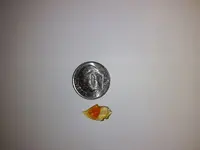
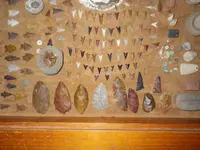
A beautiful one as well.They don't get much smaller than this one. I have dozens and dozens of these tiny points... some even smaller, but this one has great color! These are very typical in the Columbia River watershed.
good question that... some folk claim these were used primarily for fishing and of course there were many techniques get fish depending on the time of year, the place and the run. That would include, nets, hooks, fish spears and in the right circumstances, just grabbing them by hand as they tried to navigate a blockage. I have actually found stone weights, and wooden spear parts. And I am very lucky to have found writings from a man that lived and documented native practices in my watershed in the early 1850's. (that is another story...but he describes places I can walk around in that are still empty, but the roads pass next to them...trippy)...(the one thing that really stands out for me is that they were wet/damp all the time with no change of clothes.)It is nice material. What was it used for? Maybe a dart?
now THAT is good information. So much of what we have is "disassembled" bits and pieces of what was lost, discarded, broke or buried. What you just posted was THREE "types" of arrows, found together, made by the same, man or group at the same time. That is very enlightening, showing that even within that tribe/timeframe, there was more than one way to skin a cat! I have been told before that in the SW anyway, many times all they used was a pointed chip, that really brings it home for me.Way back when I was a kid I saw a cache some guys found in a crack in the mountains of southern New Mexico. There were 2,000 reed arrows, 3 pairs of sandals and 3 bows painted red. someone counted the arrows so the 2,000 is correct the rest are my estimates. 1800 of the arrows had a fire hardened wood tip, 180 of the arrows had a chip inserted in the wood tip. and 20 had a hafted arrowhead.
yes, it does seem to be missing material on one edge. It is worked on both sides, top and bottom, but also seems hastily made on a flake.It's a beauty but it does look like it is missing material on one side.
Maybe someone was making them to tradenow THAT is good information. So much of what we have is "disassembled" bits and pieces of what was lost, discarded, broke or buried. What you just posted was THREE "types" of arrows, found together, made by the same, man or group at the same time. That is very enlightening, showing that even within that tribe/timeframe, there was more than one way to skin a cat! I have been told before that in the SW anyway, many times all they used was a pointed chip, that really brings it home for me.
So now the question is...why 2000 arrows? Was this a seasonal migrating path? a redoubt for protection from invading Athabaskan tribes? I fully understand these folks had no "pockets" and were always on the move. Narrowing down the age of these artifacts would be interesting!
That would have been awesome to see!Way back when I was a kid I saw a cache some guys found in a crack in the mountains of southern New Mexico. There were 2,000 reed arrows, 3 pairs of sandals and 3 bows painted red. someone counted the arrows so the 2,000 is correct the rest are my estimates. 1800 of the arrows had a fire hardened wood tip, 180 of the arrows had a chip inserted in the wood tip. and 20 had a hafted arrowhead.