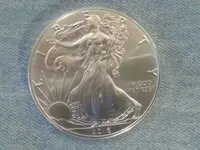
You can use a variety of factors, statistics, manipulation of numbers, and fancy wording to justify (or refute) almost anything. The OP stated that because the 40% were found CRH, he had exactly 50 cents each tied up in them. He traded exactly 10.5 40%ers for each ASE, claiming to have technically only paid $5.25 for each ASE which is an absolute steal of a deal. That is a bit of a manipulation. First, CRHing incurs expenses (gasoline, vehicular wear-and-tear, etc). You NEVER have only face value tied up in your CRH finds. Its always more, but damn near impossible to figure down-to-the-cent and is different for every CRHer as well as every CRHing excursion. However, the expenses cannot be negated or ignored if claiming things like, "I got a good deal." or "I'm making a profit from CRH.", or "I essentially only paid $X.xx because I used CRH finds.") etc.
Second, those traded 40%ers had a value themselves over 50 cents each. I would venture to guess that 99.99% of all pawn and coin shops in this country would have happily and quickly paid more than 50 cents in cash for each of the the 40%. For example, say this morning I luckily find a $100 bill on my way to the mailbox. I then "trade" my $100 for an average condition 1921 Morgan silver dollar. By the seller's logic, I'd have a completely free silver dollar because I had absolutely no money whatsoever tied up in the found $100 bill. In reality, I basically gave away ~$80 as that coin can be bought all day for ~$20. Even if $1 each is all the seller could get per 40%, he has now "paid" $10.50 + CRH expense per ASE. Still a probably good deal depending on how much expense he incurred, but we're now a far cry from $5.25 each. At today's prices and without shopping too hard, I think $1.50 each (if not more) could have been pretty easily and quickly obtained. Now he's paid $15.75 each + expenses. That's likely very close to full-blown retail price. Still, not horrible by any stretch of the imagination, but no longer anything that can be classified as a "bargain."
As with any deal, you'll almost always come out ahead by selling what you have and paying cash for what you want vs. trading what you have for what you want...especially when dealing with a business and not an individual. The business will generally make money of you "at both ends" by giving you a price for your item(s) at which they can resell for profit as well as charge you a price for their item(s) at which they turn a profit. Generally, you can get more than trade-in value by selling your items to an individual. Similarly, when paying with cash, you can often buy at a lower price than when trading. You will almost always "pay for convenience" by trading, as it should be. The one doing most of the leg work should make most of the money.
Now with all of this said, did the trader in this case make a "bad" deal? No one can answer that, but the trader himself...and even that will technically depend upon what he gets for the ASEs when he trades/sells them vs. what 420 40% silver halves would bring at that time. Its all a matter of opinion. There are spot-on arguments to show how he lost value. He now has over 20 ounces less silver than he did prior to the trade. Did he overpay? Possibly, but again its all opinion. You could even argue that the ASEs themselves are overpriced. At over $17 each, you're paying over a 20% premium on the spot price of an ounce of silver. With almost anything we purchase, someone somewhere probably has a valid argument of how we overpaid, while we could come up with some numbers or other beliefs on how it was a good deal. Brand-name vs. non-brand name, be it food clothes, whatever...you'll pay more for the brand name. Who gets to say whether or not its "worth it?"
Bottom line is that if the trader in this case (or any case) never regrets the trade, then he gets to claim it was a good deal...for him. However, he does not get to claim that he essentially paid $5.25 per ASE in this deal. That argument does not hold water.