What's new

Trigger guard needs its story told...help

villagenut

Gold Member
Joined
Oct 18, 2014
Messages
6,047
Reaction score
10,975
Golden Thread
0
Location
florida
Primary Interest:
All Treasure Hunting
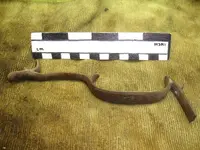
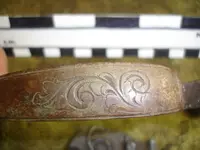
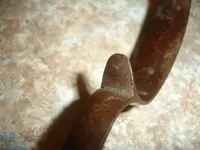
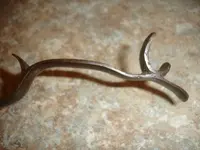
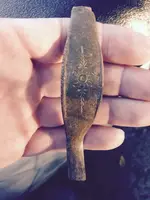
While I am new to t net I have been digging holes most of my life and after all the holes were dug, I now find it necessary to call on all of you to help me out.I have several artifacts with no absolute identity and will be posting them here for your expert opinions and experience.So I thank you all in advance.This double set trigger guard I found a few years ago, and while I suspect it may be from a Pennsylvania Rifle Works squirrel gun with some nice inscribing detail and lots of good old honest wear and tear, its all I know.Where I dug it was a fortification during the Third Seminole War about 1856-58 that consisted of settlers awaiting military protection. The guard may be older and perhaps a hand-me-down used for whatever protection it may afforded. It appears to have been ripped off the musket, if that was what it went to. Perhaps someone can identify the engraving to a certain time period and style. I am new to the forum so hopefully the photos will show up.Thanks again mnhtf (5).webpdsfvbhh.webpqsz (4).webp

 
That's a nice one! It does have the look of a Pennsylvania rifle guard, but it's similar to a lot of others as well. The civilian parts are a bit more difficult to positively ID in most cases than the military parts since they weren't standardized and varied widely depending on the region or gunsmith. And.... It could well be European also which adds to the fun. Dating it is also kind of a tricky subject too but if I had to guess I'd call it early 1800'sbut it could possibly be late 1700's as well
 
Upvote 0
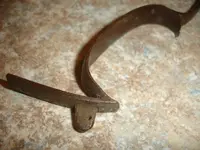
I wish I had a better view of the front of the trigger guard, the part that is pointing straight down. The tab that is showing was to hold the trigger guard on the rifle, and should have a hole in it for a pin to pass through. I'd like to see a close up of that part. I'd also like to see a close up of the back where it is bent. Here's something to think about. If you are in a close up fight with an enemy, and you only have one shot in your muzzle loading rifle, with no time to reload, it then becomes a very expensive club, with a wrist that is liable to break at the first whack, and that would bend up the trigger guard about as badly as yours.
 
Upvote 0
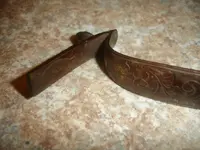
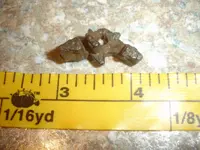
Here are some closer ups and some more detail. Also included is a photo of what I suspected to be a trigger mechanism from a small hangun but I may be completely wrong on that but thought...wwwww.webpeeeee.webprrrrr.webpqqqqq.webptttttt.webpit may have to do with the fort site ????
 
Last edited:
Upvote 0
Kind of rococo engraving. A Germanic influence in guard shape, Pa. followed in time with similar on long arms as evolution followed German makers work eventually following local demand/requests for change of style.. Guards can get tricky ,or telling, as each gunsmith could add a personal flare or regional/school of building shape to either or both ends where yours seems more utilitarian except for the engraving. Could have been a gift or presentation piece or a higher grade choice finish when new?
What puzzles me is the rear of the guard,(end at cm on ruler). Not seeing any thing near it even bent to proper curve,the round piece may have been a solid circle or not and still not finding a match. That makes it unique besides the engraving...
 
Upvote 0
Trying to unbend your guard back to original shape in my mind I came up with this link to a similar shape.

ginger_right.webp

L. Ginger Trade Rifle

This one is painted and less fancy. Yours would be the style this trade rifle borrowed from.

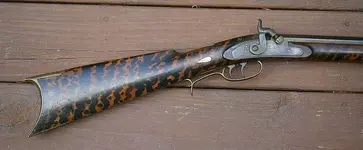
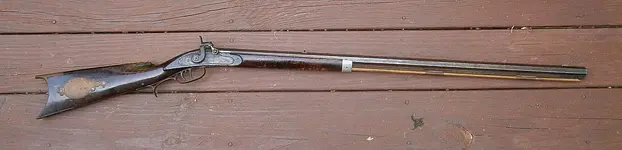
Perhaps like this one (a later half-stock 1850 ish)

Johnson_oa_rt.webp

Interestingly - with flintlocks and early percussion longrifles the materials were expensive and the labor and skill to engrave was cheaper. Most had some engraving or nice metalwork. The later ones and military muskets were more utilitarian.
 
Last edited:
Upvote 0
Thanks for the close ups, the trigger guard was probably bent because the stock was broken at the wrist. I don't recognize the last item as part of any mechanism on a muzzle loading firearm.
 
Upvote 0
image-3016665855.webp

Here is one I dug, I think it's a Pennsylvania long rifle trigger guard, it's got a cool engraving too. I don't know much about it though.
 
Upvote 0
The last part sort of, but not quite reminds me of a sear, but I'm thinking a more modern gun than a muzzle loader.... It may be part of a padlock or something as well
 
Upvote 0
The last part sort of, but not quite reminds me of a sear, but I'm thinking a more modern gun than a muzzle loader.... It may be part of a padlock or something as well

I figured as much, but as it was found in an area where any 1850's gun part may have been lost, it would be important for my log if it were Indian Wars period. I had been skeptical myself...that's why I included it here. Thanks for the input.
 
Upvote 0
Upvote 0
Thanks for the close ups, the trigger guard was probably bent because the stock was broken at the wrist. I don't recognize the last item as part of any mechanism on a muzzle loading firearm.

I never thought of that as being the reason for the bends on both ends of it, but it does make sense. I had figured that it got broken loose at the back end where it shows so much wear and that it became cumbersome to carry and use with it hanging at the back end so someone went ahead and bent the front end until it came off. But that would have made a open trigger problem. There was no fighting where this was found, so I doubt the stock got broken in action unless it happened some where else. Thanks for your thoughts, it all helps.
 
Upvote 0
This one is painted and less fancy. Yours would be the style this trade rifle borrowed from.

Perhaps like this one (a later half-stock 1850 ish)

View attachment 1069243

Thanks for the comparisons Charlie, They do look similar to mine, just too bad I can't get a solid time period.
 
Upvote 0

Users who are viewing this thread

Back
Top Bottom