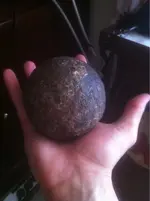
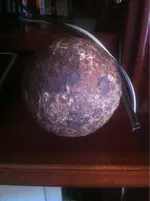
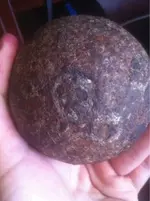
As my posting-name indicates, cannonballs are my specialty area of relics. My hangout at TreaureNet is the "What-Is-It?" forum. I rarely look at the Today's Finds forum. But Quindy sent me an email asking me to help you about the iron ball you found.
To determine with
certainty whether it is a cannonball or not, you'll need to weight it on a precision Postal Shipping scale (which measures in tenths-of-an-ounce), because typical household bathroom weighing-scales are too inaccurate to tell us the actual very-exact weight of your ball.
You'll also need to measure its diamter super-precisely, with a Digital Caliper, or a Diameter-Tape.
When you've got the ball's precisely-measured weight and diameter, compare that data with the charts in the Artillery Ordnance Manual, which tells the very-exact diamter and weight of British, French, yankee, and Confederate solid-shot cannonballs used in America from the Revolutionary War through the Civil War.
www.civilwarartillery.com/shottables.htm
If there is no match-up for your ball's exact diameter & weight in the Artillery Ordnance Manual's charts, it is not a cannnonball.
Based on the size of the ball in your hand and your estimate of its weight, it MIGHT be a 6-pounder caliber Solid-Shot cannonball, which weighed between 5 pounds 15 ounces and 6 pounds 1.6 ounces. I'm hoping along with you that it really IS a cannonball. But its precisely-measured weight and diameter will tell us yes or no about that.
If you are interested in learning more about actual historical cannonballs (and their "imposters"), you can read detailed Educational information which I co-authored with Mr. David Poche, here:
SolidShotEssentialsMod