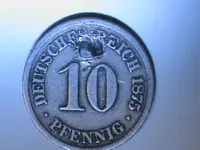
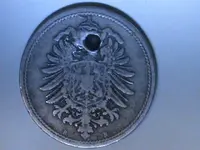
Yes, it is German. Imperial Germany, 10 pfennig. The type is KM (Krause-Mishler) #4, and it was struck in copper-nickel alloy, not silver. The "B" mintmark is for the city of Hannover. The mintage for the 1875-B was 4,120,000 (The 27.6 million figure quoted in the previous reply must have been a total of all mints for the year. The 1875-B mintage by itself is 4.1 million).
The fourth edition catalog prices (circa 2004) are $3.00 Fine, $12.00 Very Fine, $40.00 Extremely Fine, and $120.00 Uncirculated. To yours I would assign a Fine+ to VF details grade, with the obvious notation that it is holed, reducing its dollar value by about half.
The "B" mintmark, while common enough in the year your coin was struck, is actually one of the less-seen German Imperial mintmarks overall. For example, if your coin had been an 1875-A coin from Berlin, its 4th edition Krause values would have only been $0.25 F, $2.00 VF, $12.50 XF, and $70.00 UNC.
Without the hole, I'd have personally called it a seven or eight-dollar coin by retail prices (and would probably have marked it at three to five bucks in my dealer inventory). With the hole, it becomes only worth a dollar or two at best, monetarily.
But I'd have still been tickled to death to dig it- it's a cool find. Actually, I collect pre-1900 holed coins (note the avatar picture of me in my Holey Coin Vest and Holey Gold Hat, which I wear to shows). Don't be too disappointed or let anybody say mean things to your coin just because it is holed- holey coins need lovin', too! And the very fact that it IS holed tells you that somebody once cherished it enough as a keepsake to put a hole in it and carry it around as a charm or jewelry piece.
Cool find (assuming you found it?)
I have lots of these and their smaller 5-pfennig counterparts- they used to come up fairly often in the bulk lots I bought.