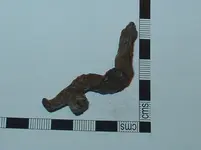
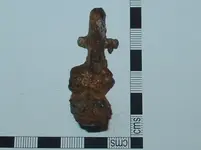
We hardly ever get Gun parts in the UK, & this is the first Frizzen we have ever found.
Any ideas which flintlock it went on? 18th C?
(found this Monday)
But I do notice a couple distinctive features. It's unusual for such a small "flat" where it would cover the pan. That and the hump between the pivot and the pan cover might indicate it was a weatherproof style pan.
Below is a Henry Nock pistol. Similar. And it would be of a similar size to yours.
But I do notice a couple distinctive features. It's unusual for such a small "flat" where it would cover the pan. That and the hump between the pivot and the pan cover might indicate it was a weatherproof style pan.
Below is a Henry Nock pistol. Similar. And it would be of a similar size to yours.
I think so. But there is an overlap. Muskets and fowling pieces tend to have frizzens over 2cm wide (3/4"+/-) up to 3cm (1-1/4"), while pistols tend to be 2cm . . . ish and smaller. The little muff pistols might go as small as 1cm (3/8"). Rifles hover around that 3/4" size - older used wider flints. And the frizzen is ideally a tad wider than the flint.
But as soon as you make a generalization statement along comes . . .
There are only so many ways to make a frizzen, and they all tend to look alike. One feature that changed over time, however, at least on military firearms, was the arm on the bottom opposite the face of the frizzen. This arm bore against the frizzen spring, which held it in place when it was closed and provided enough resistance to the flint to allow it to strike sparks before it was knocked open by the fall of the hammer. Your example shows an arm with a graceful curve, which is typical of mid- to late 18th century military muskets, including the British Brown Bess. With American flintlock muskets, the type I am most familiar with, this graceful curve had turned into an inelegant but practical rectangular lump by about 1810. I am pained to say that I do not own and am not familiar with the full series of Brown Bess muskets and so cannot say if a similar change occurred with British arms. It is entirely possible that your frizzen was part of a civilian firearm, not a military one. Sporting arms tended to be more delicate and graceful, and the curved arm survived longer. As has been suggested, it may have been part of a pistol. The frizzens of three British Model 1796 sea service pistols in my collection average 1 1/2" high by 7/8" wide at the pan cover by 1 1/4" from the face of the frizzen to the end of the curved arm. A U.S. musket frizzen of the same period measures 2 1/4" high by 1 1/4" wide at the pan cover by 1 5/8" from the face of the frizzen to the end of the curved arm. If it was from a civilian pistol or fowling piece it might be of any dimension. Hope this is helpful.