What's new

300 year old coin inprint found in book part 2!!

jimmy uk

Sr. Member
Joined
Nov 3, 2010
Messages
416
Reaction score
183
Golden Thread
1
Location
Essex
🥇 Banner finds
1
Detector(s) used
XP DEUS!
Primary Interest:
All Treasure Hunting
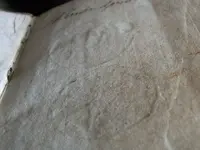
just looking at the book and i notice some strange marks on the front page and i looked at it at a different angle and there you go i think its a george 1st silver maybe gold coin inprinted
 

Attachments

  • 001.webp
    001.webp
    37.2 KB · Views: 1,048
  • 002.webp
    002.webp
    20.9 KB · Views: 1,051
  • 003.webp
    003.webp
    15.4 KB · Views: 1,041
Upvote 0
MD'ers have the most amazing eyes!
 
too bad you did not find it while the coin was still in place.--interesting thought --find out where the book came from --if a person was a money hider --maybe more money was hidden in their "other" books-- crooks seldom take time to read a book--thats why some folks used books as hiding places --some books are hollowed out --others like a bible theifs tend to naturally "avoid" --so folks often hide money in them -- a theif seeing a bible in a home might tend to avoid it , since knowing hes doing bad at the time --he tends to avoid touching a bible . :wink: or so goes the "logic"
 
Are you sure that it is not a personal library imprint?
 
ivan salis said:
too bad you did not find it while the coin was still in place.--interesting thought --find out where the book came from --if a person was a money hider --maybe more money was hidden in their "other" books-- crooks seldom take time to read a book--thats why some folks used books as hiding places --some books are hollowed out --others like a bible theifs tend to naturally "avoid" --so folks often hide money in them -- a theif seeing a bible in a home might tend to avoid it , since knowing hes doing bad at the time --he tends to avoid touching a bible . :wink: or so goes the "logic"
I'd sure be looking for those other books!
Good Eye :thumbsup:
 
Look at the Shillings for William III,Geo I, & Geo II :wink:
 
Veryinteresting! Do you think it may have fallen out in behind the wall during the last few hundred years? It may still be sitting there. Of course it may have been removed when the book was stashed. Judging by the strength of the imprint I'd guess the the book was pressed between others pretty tightly for a long period of time; either tightly on a shelf or in a pretty hefty stack. That's a great imprint!
 
That's VERY cool!

What I'm thinking though is...
Would there not have been TWO coins in there to produce those imprints?
Both are on the same side of the page yes? Which is opposite the book spine?

Correct me if I'm wrong!
 
could that be a watermark?
A watermark is made by impressing a water-coated metal stamp or dandy roll onto the paper during manufacturing. These watermarks were first introduced in Bologna, Italy, in 1282;[2] however the dandy roll was invented in 1826 by John Marshall. Watermarks have been used by papermakers to identify their product, and also on postage stamps, currency, and other government documents to discourage counterfeiting. In France, they were introduced during World War II by the Vichy regime, and counterfeited by people such as Adolfo Kaminsky. The invention of the dandy roll revolutionised the watermark process and made it much easier for a company to watermark their paper.

The dandy roll is a light roller covered by material similar to window screen that is embossed with a pattern. Faint lines are made by laid wires that run parallel to the axis of the dandy roll, and the bold lines are made by chain wires that run around the circumference to secure the laid wires to the roll from the outside. Because the chain wires are located on the outside of the laid wires, they have a greater influence on the impression in the pulp, hence their bolder appearance than the laid wire lines.

This embossing is transferred to the pulp fibres, compressing and reducing their thickness in that area. Because the patterned portion of the page is thinner, it transmits more light through and therefore has a lighter appearance than the surrounding paper. If these lines are distinct and parallel, and/or there is a watermark, then the paper is termed laid paper. If the lines appear as a mesh or are indiscernible, and/or there is no watermark, then it is called wove paper. This method is called line drawing watermarks
 
Demrok said:
That's VERY cool!

What I'm thinking though is...
Would there not have been TWO coins in there to produce those imprints? Yes
Both are on the same side of the page yes? Which is opposite the book spine?

Correct me if I'm wrong!
 
Looks to me like a Half Crown :thumbsup: What's the size?
 
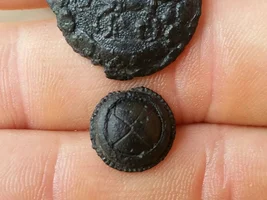
OK, got the book out, its a W&M 1692-93 Shilling (or if bigger a 1691-93 Halfcrown), these are very scarce coins & book at £200 (F)-£2000(EF) (the right one with the head is hard to make out, but maybe the same type of coin, but looks to be facing the wrong way)
 
Demrok said:
That's VERY cool!

What I'm thinking though is...
Would there not have been TWO coins in there to produce those imprints?
Both are on the same side of the page yes? Which is opposite the book spine?

Correct me if I'm wrong!

Good call. Seems if you look at the last pic the opposing page to the impressions shows a faint circle curve. So it looks like there may have been 2 coins sandwiched there. I am hoping he finds the coins slipped out and are resting on a sill plate or joint in the wall's construction. What a find that would be!
 

Users who are viewing this thread

Latest Discussions

Back
Top Bottom