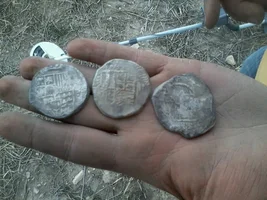
Yes, that program will take the Deus about as deep as you can get it on high conductive targets like the ones you mentioned provided that site conditions cooperate. Specifically: (1) EMI is low enough to allow you to run stable at sensitivity at 90 to 92 (depth performance plateaus at about 92/93 sensitivity. Above that you get minimal if any additional depth but start generating a lot of sensitivity to EMI so if you can run it at 92 that is great, but I wouldn't try to push it much higher) and (2) ground mineralization is low enough to allow you to operate at TX power of 3 (which is locked at 3 for 4 k for the legacy LF coil). If you get the mineralization bar graph on the right side of the display to peak out higher than 1/4 scale when you pump the coil, I would use the next lowest frequency (8khz) at TX 2 (or TX 1 if mineralization is very high) because the mineralization tends to scatter the transmit signal at higher transmit powers.
Some additional thoughts on iron wraparound - as you know I am not a fan of notching iron wraparound TIDs - 97-99, so I am OK with trying to make it sound different than the typical high conductor TID tones. I don't necessarily agree that you should make it sound like iron and I will tell you my reasons in a second. First, let me say that if you are operating at 4k, then something showing up in the 97-99 range will most likely be iron wraparound vs. a true high conductor or up-averaged non ferrous target. That likelihood goes down if you use the higher frequencies (or ID NORM ON - which pushes the TIDs higher in the range towards 99). Though it is still possible for some deep up-averaged targets to show up there (I encountered that this weekend and the TID went down when I started target recovery, but I was also operating at 12 and 25 khz with the X35 coil). In my opinion, the best thing to do is to make 97-99 sound different than ANY of your other 4 tones. That way you can clearly hear that you are in the very high TID range. If you make it sound like iron, it will be difficult to tell without glancing at your display and even then, you may be in pinging on a deep target that will give you the iron low tone but NO TID (just double dashes - - on the TID display). In that case you will be reliant on trying to ascertain whether that low tone is actually deep iron or iron wraparound by interpreting the horseshoe ferrous/non-ferrous/depth display. By making wraparound a very high tone (say 993 hz) then it will be more obvious, audibly that you are in the wraparound region in the event that you do not get a TID and the horseshoe display is giving you an ambiguous "deep target" indicator "sliver" that is straddling the ferrous/non-ferrous dividing line. At that point you can "interrogate" the suspected wraparound target further by hitting it with a higher frequency version of your base program (I do this by setting up a clone of the base program with all the same settings (except the tone breaks need to be adjusted if using 4 or 5-tone) but with a different frequency to I can just hit the +/- key to see how the suspected target responds). Just a thought.
If you are encountering a lot of iron targets at the site or in a particular area indicating a possible structure foundation, consider using a sifting program that simply consists of taking your base program and lowering sensitivity into the low 80's to minimize iron from "overwhelming" the detector and increasing reactivity to 2 or 2.5 to increase the ability of the Deus to separate shallower non-ferrous masked targets from ferrous "maskers" (I also personally like to use pitch versus tones when sifting and when detecting at normal sensitivity settings but that is a personal preference). It takes some discipline to commit to lowering sensitivity to sift through the iron to unmask non-ferrous keepers because it runs counter to our engrained, typical depth trumps all approach to detecting. But it DOES work if you commit to it and you would be surprised at what pops out of the ground when you do this at a "hunted out" site.
Happy hunting at what sounds like a fun site to hunt.


 .
.