What's new

Ancient Ring Found Today

goldnow

Sr. Member
Joined
Apr 10, 2008
Messages
386
Reaction score
2
Golden Thread
0
Detector(s) used
Tesoro Vaquero
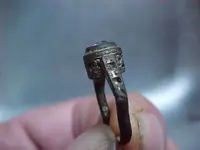
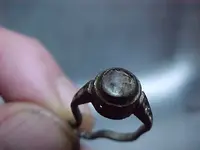
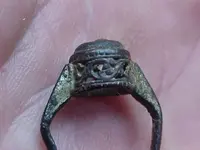
In the foot hills of the Alps in Italy, I found today this ring at around 9 inches in a forest near our home. At first, it gave me no thrill, as it looked cheap, stoneless, and no real style. At home, I gave it a rinse and the "diamond" appears, a few tender touches with a toothpick reveals gold plating, and after a few more dabs a design appears.

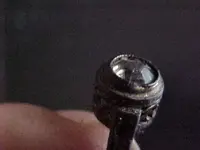
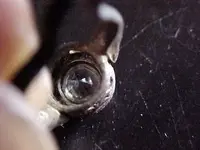
The "stone/glass(?)" is faceted, though with some chips out of the top. The metal looks to be bronze, but not positive, Not copper, not precious for sure.

Can anybody date this sweet little ring?..She can be anything from Roman to Victorian.
 

Attachments
  • Mvc-153f.webp
    Mvc-153f.webp
    25.6 KB · Views: 2,085
  • Mvc-149f.webp
    Mvc-149f.webp
    16 KB · Views: 1,698
  • Mvc-151f.webp
    Mvc-151f.webp
    16.4 KB · Views: 1,587
Upvote 0
Awesome ring!

I can only imagine who once wore it!
 
Very nice ring. Congradulations.HH....
 
ll I can say. That is an amazing find. If it is not worth a huge amount, I would have it replated and wear it as a conversation piece.

SKD
 
Nice 400 year old ring! :thumbsup:

 
:headbang:

Cool ring 8) it smacks Georgian to me :P made with a Roman feel in mind :thumbsup:

SS
 
1600's, 1700's, 1800's? Thanks for the suggestions.

I wish they had dates on them.

What's amazing with some of these old finds, is that you need an eye loupe to see the details and appreciate them.
 
My guess was a bit tongue-in-cheek. Just trying to hedge my bets. :tongue3:
 
BuckleBoy said:
My guess was a bit tongue-in-cheek. Just trying to hedge my bets. :tongue3:

I'm not good at aging jewelery designs, so any help is appreciated.. I just wanted to make sure if it was very early (Roman) or not. Anything in the last 400 years is probably most probable. Not 10 yards away, I found a 1600's religious piece, so your guess (tongue or not) was very possible.

Anybody know when gold plating or guilding started on jewelery, etc.?
 
goldnow said:
BuckleBoy said:
My guess was a bit tongue-in-cheek. Just trying to hedge my bets. :tongue3:

I'm not good at aging jewelery designs, so any help is appreciated.. I just wanted to make sure if it was very early (Roman) or not. Anything in the last 400 years is probably most probable. Not 10 yards away, I found a 1600's religious piece, so your guess (tongue or not) was very possible.

Anybody know when gold plating or guilding started on jewelery, etc.?
The Romans used guilding in Britain, not quite sure if it was before that here :dontknow:

SS
 
goldnow-
How many facets in the diamond?
Is the back of the diamond visible?
If not, can you make a guess at whether the back of the diamond is flat or faceted? This can help date the ring. Also, does the side carving go all the way through? If so, I think that it might represent early cloisonné designs...

The shape of the ring is important as well. The boxy shape of the top would highlight the stone and the curved ring with the lifted sides would allow more light underneath the stone to add color (assuming the bottom of the diamond is visible), otherwise, again, it would "push" the ring closer to the admirer...

I'm no expert, but here's a link to determine what type of cut it might be:
http://www.topazery.com/antique-diamonds.htm

I would suggest letting a curator at one of your better museums take a crack at this one if no one on Tnet can ID the date and/or origin. Unfortunately, according to history, much of the better Italian jewelry like this (I'm just guessing "Italian" here) was "repuposed" to pay for campaigns and for hiring armies for war.

Good luck with the ID and Fantastic find in any case!!!! :headbang:
-whynot
 
whynot said:
goldnow-
How many facets in the diamond?
Is the back of the diamond visible?
If not, can you make a guess at whether the back of the diamond is flat or faceted? This can help date the ring. Also, does the side carving go all the way through? If so, I think that it might represent early cloisonné designs...

The shape of the ring is important as well. The boxy shape of the top would highlight the stone and the curved ring with the lifted sides would allow more light underneath the stone to add color (assuming the bottom of the diamond is visible), otherwise, again, it would "push" the ring closer to the admirer...

I'm no expert, but here's a link to determine what type of cut it might be:
http://www.topazery.com/antique-diamonds.htm

I would suggest letting a curator at one of your better museums take a crack at this one if no one on Tnet can ID the date and/or origin. Unfortunately, according to history, much of the better Italian jewelry like this (I'm just guessing "Italian" here) was "repuposed" to pay for campaigns and for hiring armies for war.

Good luck with the ID and Fantastic find in any case!!!! :headbang:
-whynot

Thanks, Whynot.. I followed your link and what I have is a "single cut" diamond, I have added two pictures of the top and bottom of the "diamond", and a piece from Wikipedia on the Single Cut , which is 8 facets on top and 8 facets on the bottom.. I'm not saying I have a diamond necessarily, (considering the wear and chips on top) and is probably glass or quartz, but it does say the 8 cut was replaced in the 1600's by another style/method, which does help in the dating.

FROM WIKIPEDIA;

"By the mid 15th century, the point cut began to be improved upon: a little less than one half of the octahedron would be sawn off, creating the table cut. The importance of a culet was also realised, and some table-cut stones may possess one. The addition of four corner facets created the old single cut (or old eight cut). Neither of these early cuts would reveal what diamond is prized for today; its strong dispersion or fire. At the time, diamond was valued chiefly for its adamantine lustre and superlative hardness; a table-cut diamond would appear black to the eye, as they do in paintings of the era. For this reason, colored gemstones such as ruby and sapphire were far more popular in jewelry of the era."
 

Attachments

  • Mvc-157f.webp
    Mvc-157f.webp
    36 KB · Views: 1,069
  • Mvc-160f.webp
    Mvc-160f.webp
    38.9 KB · Views: 927
very cool find thank you for sharing.
 
Those little square sockets on the band below the top knot look to me like a place for more stones. I think there were four more stones set in the ring, two on each side.

Nice find.
 
Curious The George said:
Those little square sockets on the band below the top knot look to me like a place for more stones. I think there were four more stones set in the ring, two on each side.

Nice find.

I agree with your observation about the 4 side stones missing. I did some Googling, and the best match to this style is Rennaissance (sp?) period, 1500-1600's. Of course it could be a later copy of that period, but, considering the cut of the stone, coins, and other finds within 100 yards it is quite possible.

When I pulled it out it was a clump of dirt, and it went into the Junk pocket, thinking it was a wire with a knot, like that comes from a champagne type bottle to hold the cork in tight or to fix a broken tool. I rinse every piece of unidentifiable find, even aluminum foil wads, in hope of making an eye-field mistake, and this one paid off all those times I was diligent.
 

Users who are viewing this thread

Back
Top Bottom