What's new

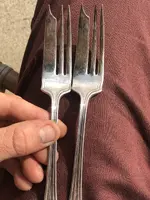
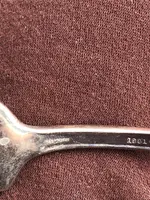
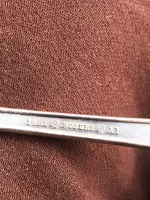
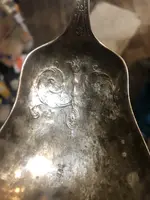
Any silver here?

rickertmork

Sr. Member
Joined
Jul 5, 2024
Messages
397
Reaction score
828
Golden Thread
0
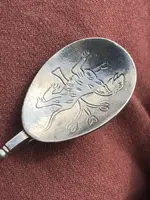
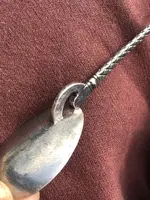
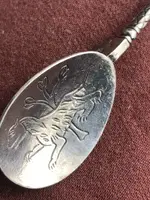
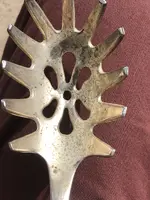
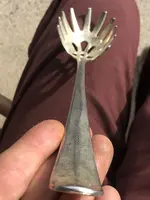
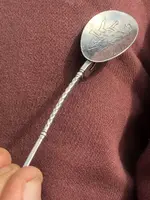
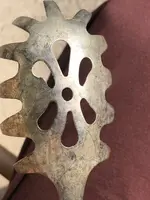
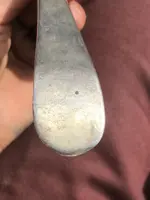
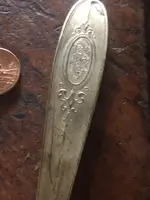
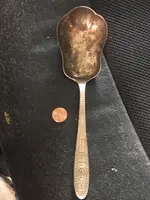
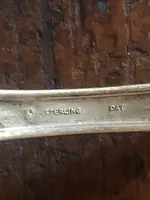
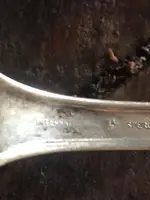
The salad spoon /fork has no markings same with the weird little spoon. The other forks I can’t identify
 

Attachments

  • IMG_7351.webp
    IMG_7351.webp
    2.7 MB · Views: 151
  • IMG_7342.webp
    IMG_7342.webp
    4.2 MB · Views: 125
  • IMG_7341.webp
    IMG_7341.webp
    2.9 MB · Views: 118
  • IMG_7345.webp
    IMG_7345.webp
    2.7 MB · Views: 129
  • IMG_7344.webp
    IMG_7344.webp
    2.9 MB · Views: 127
  • IMG_7343.webp
    IMG_7343.webp
    2.2 MB · Views: 114
  • IMG_7348.webp
    IMG_7348.webp
    2.1 MB · Views: 112
  • IMG_7347.webp
    IMG_7347.webp
    875 KB · Views: 109
  • IMG_7346.webp
    IMG_7346.webp
    2.8 MB · Views: 106
  • IMG_7349.webp
    IMG_7349.webp
    1.4 MB · Views: 101
  • IMG_7350.webp
    IMG_7350.webp
    1.2 MB · Views: 107
Upvote 8
Solid platinum would be an unlikely choice for flatware, primarily because of the cost, unless produced to order as a very high end luxury or collectible item. Flatware advertised as ‘platinum’ is more readily obtainable, but is made from high grade stainless steel (Austenitic, so non-magnetic) coated with a thin mirror platinum finish, such as the Lenox ‘Federal Platinum Collection.’

The flame test is not a reliable diagnostic for silver versus platinum. The tarnishing seen on silver when exposed to a flame is a result of copper oxidation. For sterling silver with 7.5% copper it’s readily seen and also on average quality silver plate. Platinum of course will not tarnish, but neither will ‘fine’ silver because it’s 99.9% pure with no added copper. Fine silver isn’t generally used for flatware because it’s too soft, but quality electroplated items may not tarnish either (depending on the thickness of the plate) because the silver is deposited as essentially pure metal.

Silver is the best thermal conductor of all metals, so it can often be distinguished by a hot water test. Silver items (both fine and sterling) immersed in hot water will heat up rapidly and retain the heat for longer compared to plated and base metals (or platinum). Some experience is needed to judge this (by pressing against your cheek for example) and, ideally, something of known composition to act as a comparison
So doing a cooldown test for silver? Silver will hold its heat for 50% longer than a plated one? Or more like 25 percent. What if compared to a regular stainless? I will test this later. I noticed that the spoon with a lion/monster animal on the bowl is extremely easy to bend.
 
So doing a cooldown test for silver? Silver will hold its heat for 50% longer than a plated one? Or more like 25 percent. What if compared to a regular stainless? I will test this later. I noticed that the spoon with a lion/monster animal on the bowl is extremely easy to bend.

Stainless steel is a rather poor conductor of heat relative to other metals. Comparative thermal conductivities in W/m-K (Watts per meter-Kelvin):

Fine silver: 429-430
Pure Copper: 385-401
Sterling silver: 360-410
Brass: 109-130 (but can be up to 233, depending on composition)
German silver (copper/nickel/zinc alloy): 20-29
Platinum: 71–72
Stainless steel: 14–20
 
looks like either silver or platinum.

Jamison
What looks like silver or platinum? Just because something does-doesn't mean it will be that.
I buy a fair bit of cutlery items and test it for its silver content. I find items that are sterling or another grade often but the test is a file and acid.
Here is a buy from yesterday.
4 spoons
20260504_090017.webp

Can a person tell by looking at them? 2 of the group of 4 were sold as silver, 925/800.
It turned out to be 3 on the right, the windmill was .925, worn so the marks on the back were gone almost.
38.65 grams total for $32 CAD.
 
Here is another test.

The "Ice Race": If you have a spoon you know is solid silver, place an ice cube on both at the same time. The ice on the sterling spoon will start sliding and melting into a puddle within seconds, while the plated brass spoon will take noticeably longer (often 30+ seconds vs. 5–10 seconds
 
Here is another test.

The "Ice Race": If you have a spoon you know is solid silver, place an ice cube on both at the same time. The ice on the sterling spoon will start sliding and melting into a puddle within seconds, while the plated brass spoon will take noticeably longer (often 30+ seconds vs. 5–10 seconds
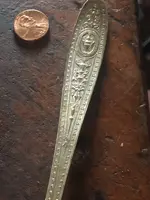
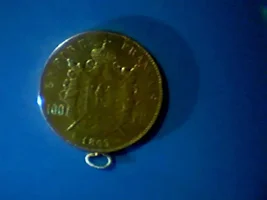
Look what I just found can I test it on this, or is it plated. the ice test look like you need different sized ice cubes on different sized cutlery or spoonage. I compared to weight to a real platinum ring, and I can tell right away it’s too light.
 

Attachments

  • IMG_7379.webp
    IMG_7379.webp
    1.1 MB · Views: 44
  • IMG_7380.webp
    IMG_7380.webp
    957.3 KB · Views: 44
  • IMG_7378.webp
    IMG_7378.webp
    1.2 MB · Views: 49
  • IMG_7381.webp
    IMG_7381.webp
    751.4 KB · Views: 44
  • IMG_7382.webp
    IMG_7382.webp
    670.1 KB · Views: 44
  • IMG_7383.webp
    IMG_7383.webp
    2.1 MB · Views: 43
Look what I just found can I test it on this, or is it plated. the ice test look like you need different sized ice cubes on different sized cutlery or spoonage. I compared to weight to a real platinum ring, and I can tell right away it’s too light.
So did the ice melt slow or quick?
 
Look what I just found can I test it on this, or is it plated. the ice test look like you need different sized ice cubes on different sized cutlery or spoonage. I compared to weight to a real platinum ring, and I can tell right away it’s too light.

Nice. That’s International Silver’s 'Wedgwood' pattern, designed by Alfred G. Kintz and introduced in 1924. It was produced in sterling silver (925) and I see no reason to doubt the mark or test the purity.
 
I don't see any sterling.
A1 is like a triple plated piece of cutlery.
I buy it as a premium over yellow brass.
Just for deplating the silver.
I have two handfuls of silver plated spoons from my Grandparents. I can see they are plated by the wear on the spoon lips. Do they have any scrap value with gold/Silver buyers?
 
I have two handfuls of silver plated spoons from my Grandparents. I can see they are plated by the wear on the spoon lips. Do they have any scrap value with gold/Silver buyers?
The places I called said they don’t take them, you would have to separate it and melt it down yourself to make it worthwhile to anyone. Or maybe there’s a better way
 
I have two handfuls of silver plated spoons from my Grandparents. I can see they are plated by the wear on the spoon lips. Do they have any scrap value with gold/Silver buyers?
The places I called said they don’t take them, you would have to separate it and melt it down yourself to make it worthwhile to anyone. Or maybe there’s a better way
I buy silver plated cutlery basically for high brass or low copper price.
Board sort is paying $7.25 for spoons and forks. $2.00 on silver plated knives.


So the short answer is the silver plated cutlery has value.
Most shops don't want the product as the margins aren't as lucrative as sterling.

I buy sterling knives off a few guys that don't want to process the handles. Face mask, welding outfit, MAPP torch and it's an interesting adventure. Some blades slide out vs some handles go off like a firecracker.
 
Some blades slide out vs some handles go off like a firecracker.
Reminds me of a side story. We had some green bamboo that was around 40-50mm in diameter. I did some research and found out that they use heat to bring out the sap and cure bamboo into a glossy finish. So here I am in the backyard one evening rolling bamboo back and forth across the fire in my weber kettle and it's working. Then all of a sudden ...Ba Boom! The bamboo blew up in hands, I was wearing gloves but still stung pretty good. The whole neighborhood went quiet except a dog down the street starting barking it's head off. Apparently I crossed a heat-pressure threshold on the bamboo :laughing7:
 
Reminds me of a side story. We had some green bamboo that was around 40-50mm in diameter. I did some research and found out that they use heat to bring out the sap and cure bamboo into a glossy finish. So here I am in the backyard one evening rolling bamboo back and forth across the fire in my weber kettle and it's working. Then all of a sudden ...Ba Boom! The bamboo blew up in hands, I was wearing gloves but still stung pretty good. The whole neighborhood went quiet except a dog down the street starting barking it's head off. Apparently I crossed a heat-pressure threshold on the bamboo :laughing7:
Note to self: No curing bamboo 🤣
 
Reminds me of a side story. We had some green bamboo that was around 40-50mm in diameter. I did some research and found out that they use heat to bring out the sap and cure bamboo into a glossy finish. So here I am in the backyard one evening rolling bamboo back and forth across the fire in my weber kettle and it's working. Then all of a sudden ...Ba Boom! The bamboo blew up in hands, I was wearing gloves but still stung pretty good. The whole neighborhood went quiet except a dog down the street starting barking its head off. Apparently I crossed a heat-pressure threshold on the bamboo :laughing7:
Reminds me of when I microwaved an egg to hardboil it, for 15 minutes and it exploded in my mouth. Couldn’t taste anything for a month.
 

Users who are viewing this thread

Back
Top Bottom