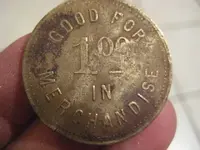
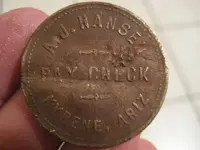
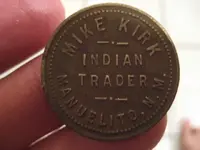
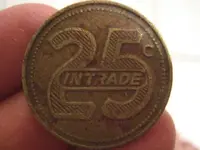
Buy that old timer a drink! Nice trade tokens - not tags - they were used as cash in general store businesses. Quite often the customers needed to buy staple goods but were broke, so they borrowed money from the storekeeper. Rather than lending the customer cash (which could be used to buy booze at the town saloon or goods from a rival store rather than the intended purpose) the storekeeper used tokens which could be used only at his store.
The AZ one is shown in Birt's AZ Tokens and Scrip book (I don't have the newer AZ catalog by Spooner) only in a 12 1/2¢ denomination as the only business known from the town. He rated it as rarity 10, $500 estimated value in 1990. He gives the small bit of historical info that Hansen was a general merchant in 1901-02. I would presume from the "Pay Check" wording that either Hansen operated some sort of other business (like a farm or mine) where he paid his workers in these tokens, or he had a cooperative deal with the owner of the other business to loan employees money against their pay checks. Looking at where Kyrene is/was - in the Phoenix metro area - I don't know what the cooperating enterprise may have been.
The NM one is listed in Kiser's NM book as part of a denomination "set" from 5¢ to $5 with rarity 8 and $60 estimated value in 2009. The manufacturer of the token was the Meyer & Wenthe company of Chicago as can be told by the reverse - the "In Trade" across the value. They are relatively modern, say ca. 1935-50.
John in ID