What's new

Brass escutcheon?

DownNDirty

Bronze Member
Joined
Jun 1, 2015
Messages
2,183
Reaction score
3,209
Golden Thread
1
Location
South Carolina
🥇 Banner finds
1
Detector(s) used
Minelab Equinox 800
Primary Interest:
All Treasure Hunting
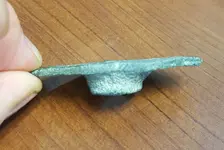
I found this at a home site where I have found a bunch of flat buttons-some with back marks and some not. So the house was there in the 1700s and early 1800s (based on the button types). It has a large threaded hole in the middle; it's pretty solid. Ideas? Thanks!
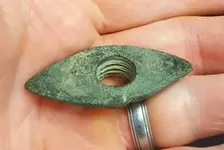
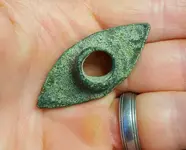
one.webp two.webp

three.webp
 
its a type of nut for a bolt. used when making light weight wooden things to spread out the load. At least i think thats what it is. They had those on old racing carriages. Look into it may or may not be a lead for you.
 
Upvote 0
It's not gun related, although it has the look of a 1700's sand cast item, just not something that was used on a gun. Keep in mind that in the 1700's early 1800's there were no brass screws or bolts. Screws and bolts were iron, each one individually filed to shape, each one a different size and thread. The bolt threads were filed, and in the case of an iron nut, the nut was heated red hot, and the bolt forced through, making the nut and bolt unique to each other. With your brass fitting, it couldn't have been heated red hot like iron, but the maker would have used an iron bolt that was forced through the hole to thread it.
 
Upvote 0
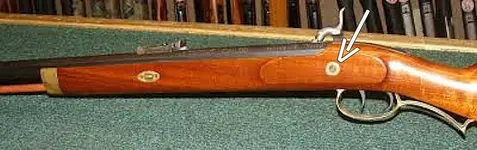
After thinking about it, I said it's not gun related. It could possibly be an unfinished escutcheon on the opposite side of a cap lock firearm, the nut that bolted the caplock to the firearm. However if it was in fact used for that, it would have been polished and filed, so I really don't think that's what is was. The arrow points out what I'm talking about.
1.webp
 
Upvote 0
It's not gun related, although it has the look of a 1700's sand cast item, just not something that was used on a gun. Keep in mind that in the 1700's early 1800's there were no brass screws or bolts. Screws and bolts were iron, each one individually filed to shape, each one a different size and thread. The bolt threads were filed, and in the case of an iron nut, the nut was heated red hot, and the bolt forced through, making the nut and bolt unique to each other. With your brass fitting, it couldn't have been heated red hot like iron, but the maker would have used an iron bolt that was forced through the hole to thread it.

Thanks for the insight-this is very useful info.
 
Upvote 0
This part would not be threaded. It acts as a washer and the bolt screwed into the lock plate.

After thinking about it, I said it's not gun related. It could possibly be an unfinished escutcheon on the opposite side of a cap lock firearm, the nut that bolted the caplock to the firearm. However if it was in fact used for that, it would have been polished and filed, so I really don't think that's what is was. The arrow points out what I'm talking about.
View attachment 1455267
 
Upvote 0
This part would not be threaded. It acts as a washer and the bolt screwed into the lock plate.

You are right. Don't know what I was thinking.
 
Upvote 0

Similar threads

Users who are viewing this thread

Back
Top Bottom