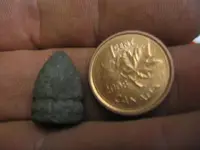
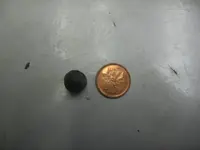
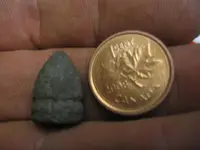
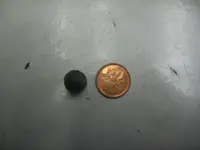
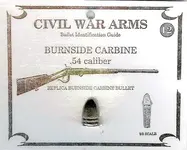
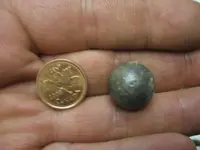
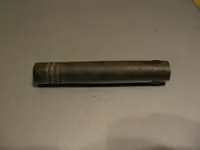
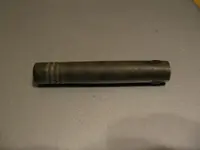
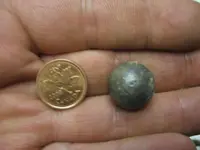
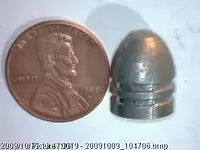
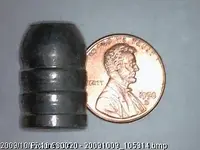
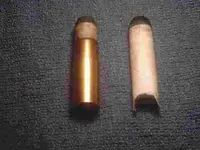
What we know for sure now. Its old...its .500 in diameter....Hay2 scaled the diameter correctly.
I "think" its a cartridge projectile personally.
Now, if there's any field of knowledge that is full of confusing terminology, it's bullet and bore diameters and cartridge designations. Naming a bullet or cartridge based on its actual bore diameter is relatively recent, 20th century, in fact. The bullet in a Spencer .56-50 cartridge is not .56 inch, it's a nominal .52 (.512 to .519) inch diameter. The .56 is the diameter of the cartridge case, not the bullet. Some other examples: the .38-40 bullet is .40 inch; a .38 Special bullet is .358 inch; the bore of a .44 caliber percussion revolver is .451 inch; the bore of a .36 caliber percussion revolver is .375 inch; the .44 Russian, Special and Magnum bullets are all .429 inch; and so on. Fun, eh?
Makers of early cartridge arms had to invent methods of naming the cartridges, since there was at the time no established convention. One of the early established cartridge arms was the Spencer repeating rifle, which saw service in the American Civil War. It was named based on the chamber dimensions, rather than the bore diameter, with the earliest cartridge called the "No. 56 cartridge," indicating a chamber diameter of .56 inch; the bore diameter varied considerably, from .52 to .54 inch. Later various derivatives were created using the same basic cartridge but with smaller diameter bullets; these were named by the cartridge diameter at the base and mouth. The original No. 56 became the .56-56, and the smaller versions, .56-52, .56-50, and .56-46. The .56-52, the most common of the new calibers, used a .50 caliber bullet.
Most this was gleaned off the internet.
TiredIron


 Least I don't.
 OLD TIMERS MUST BE SETTING IN
  PS; CANADIAN PENNIES ARE THE SAME SIZE A THE U.S


 Monty
Monty

 I didnt know there was a muzzle loading "cartridge" ignited by a musket cap. I use 2-50 grain Pyrodex pellets and a shotgun primer... Interesting.