Putting magnets in a sluice and using the magnetite as a gold-catching medium was not something Plath invented in the 1990s.
We've been using magnets in sluice boxes for decades. I was using ordinary permanent magnets, including cow magnets, in my sluices back in the 1980s. We had to. In some of the ground we worked there was so much black sand that you could load the riffles with magnetite in an hour.
And we were discussing this stuff among prospectors long before the CleanGold patent.
But here's what really puts the issue to bed:
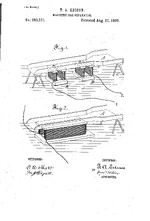
Thomas Edison patented the magnetic-riffle sluice principle in 1882.
Edison filed U.S. Patent No.
263,131 in 1881. It was granted August 22, 1882.
His apparatus was an inclined mining sluice with magnets mounted
UNDER THE FLOOR OF THE SLUICE.
The magnets held the naturally occurring magnetic material—magnetite/black sand—in place as the gravel and water traveled through the box.
And what did Edison say that accumulated magnetite did?
It
forms riffles for stopping the gold...
That's not somebody today interpreting Edison's invention. That's Edison describing what his invention did in 1882. He specifically discusses its use in
hydraulic gold mining and says that as magnetic material washes away, new magnetic material replaces it, continually maintaining the riffles.
He also specifically says
permanent magnets can be used instead of electromagnets.
Even more importantly, Edison didn't just patent a particular magnet holder. One of his actual patent claims was the
method of forming riffles in a mining sluice by magnetically arresting magnetic material flowing through the sluice.
Here's Edison's patent:
Now fast-forward
114 years.
David Plath's CleanGold patent claims priority from
May 16, 1996, was filed in 1997 and issued in 1999 as U.S. Patent No.
5,927,508.
Here's Plath's patent:
Recovery of gold fines from gold-bearing ores is achieved by flowing an aqueous slurry of particulate gold-bearing ore over a sluice supporting a mat of magnetically susceptible particulate material, which preferably includes the magnetite content of the ore or a quantity of magnetite added to...
patents.google.com
Read the two patents.
Plath puts flexible magnetic sheeting along the bottom of a sluice. The sheet has closely spaced alternating magnetic poles. Magnetite collects above those poles and forms a porous, corduroy-like mat. Fine gold settles into and is retained by that magnetite.
So strip away the particular construction details and compare the operating principles:
EDISON — 1881/1882
Magnets beneath sluice.
↓
Magnets hold magnetite/black sand.
↓
Magnetite forms the riffles.
↓
Those magnetite riffles retain fine gold.
PLATH — 1996/1999
Magnetic sheet beneath sluice surface.
↓
Magnetic sheet holds magnetite/black sand.
↓
Magnetite forms a riffled/porous mat.
↓
That magnetite mat retains fine gold.
That's
114 years apart!!!
Plath's patent contains narrower details that Edison didn't have—particularly the flexible magnetic sheet with closely spaced alternating transverse poles. So technically Plath only patented a particular configuration and improvement. But
the underlying magnetic-sluice principle was not his invention.
Magnets under a sluice creating magnetite riffles to retain gold were described and patented by Thomas Edison in
1882.
Here's another interesting fact: Edison's Patent 263,131 does
not appear in the prior-art patent list printed with Plath's issued patent, even though Plath's patent cites numerous older patents. Make of that what you will.
And then there's the old
49erMike episode. Those of us who were actually there remember it all to well...
Mike Higbee and I are still great friends, and we were both involved with the old 49erMike prospecting forum. We'd been discussing magnets and sluices for years. I remember when Plath threatened legal action concerning discussion of magnets/CleanGold on the site. I was there.
Our response was simply to Not promote his sluice box anywhere ever again.
We quit talking about it. All of the CleanGold material was removed and discussion of it wasn't allowed on the site afterward. I'm not the only person who remembers the incident, either.
In
2013,
russau, who was also part of that old prospecting crowd, independently posted this about 49erMike and CleanGold:
“the owner of that sluice threatened Mike with a lawsuit if he didnt stop and erase all of that thread”
Here's Russ's original 2013 post:
I stumbled on a sluice called CleanGold on a website called fossickers.com I am interested in the cleanup sluice. It looks like a combination of sluice/miller table and they make some impressive claims. I was wondering if anyone has seen one or used one and your thoughts. Thank you

www.treasurenet.com
Russ, Mike and I along with many others on here go way back into the late 80's - to early 90's in various mining forums.
We were talking about magnets and using them before CleanGold existed. Other prospectors were doing it before CleanGold existed.
And most conclusively,
Thomas Edison put the concept into a U.S. patent in 1881–1882—more than a century before Plath filed his patent.
There is even modern patent literature describing Edison's 1882 invention as an early practical magnetic separator for mining: magnets under the sluice held the ferrous material in place, producing riffles that captured gold.
So no, Dave Plath did not invent the basic concept of magnetic riffles in a gold sluice.
He patented a particular 1990s version of an idea that was already very, very old.
And whatever the scope of Plath's particular patent claims may have been before they expired, they certainly didn't rewrite 114 years of mining history. 👍👍