What's new

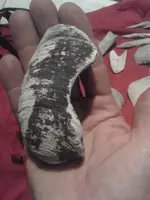
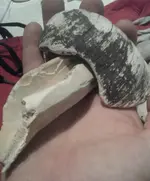
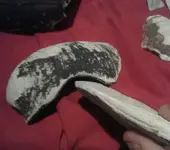
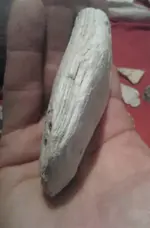
Conch shell tool frame

GatorBoy

Gold Member
Joined
May 28, 2012
Messages
14,812
Reaction score
6,156
Golden Thread
0
Primary Interest:
All Treasure Hunting
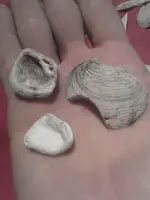
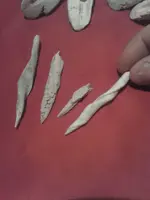
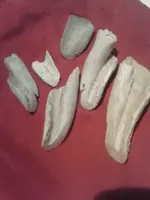
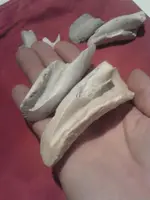
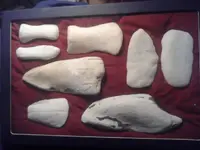
Just messing around with some Ryker mounts and thought I'd see how this looked.
Adze and chisel like tools.
The two pieces at the bottom are made from the lip of the shell..the rest from the body.
Went scouting a new property today and had company while attempting to cross a small piece of water.. we both stayed still long enough for the photo..then we both went separate ways.
..... not sure why that photo is sideways ...
 

Attachments
  • ForumRunner_20131021_145844.webp
    ForumRunner_20131021_145844.webp
    46.5 KB · Views: 157
Last edited:
Upvote 0
Thank you ma'am
 
I don't know bout them gators. You say those are made out of shells? Very cool finds!!!!! I'm amazed they weathered the times!!!

Sent from my SM-N900V using Tapatalk

In the right conditions they can last... it doesn't take much change in conditions and they will just disintegrate.
 
shell stays preserved, often patinates, well in SOME FL soils. In my experience a heavier humic layer without much oxygen preserves both bone and shell. Plus, they often used the hardest parts of the shells to make tools.

Shell that is exposed to weather elements often just deteriorates away. If shell is rolled around in surf or is in water it gets abraded to death and/or algae and pH, etc. eats slowly away. In fact, even great preserved shell, once it hits air, starts getting chalky...well most of it! Shell middens and areas where people lived usually have more of this humic component mixed in with broken shell and other human debitage. I think it all adds up to great preservation. The shells on top may even be decomposing and causing pH differences,,,,, i bet someone has done a thesis on that!!!! I'd love to see the pH, O2 levels, and other measurements from top to bottom of a shell midden, or any wet site. Would be very different from an upland dry site. In some wet sites and even shell middens the pottery sometimes crumbles as soon as it pops out, especiallly if it gets wet afterward.

The nicest areas I've ever seen were dark, black midden soil mixed with lenses of shell debitage, all jumbled up for centuries. I have pics somewhere that show the walls and washouts of middens after storms/hurricanes.

What freaks me out, GB, is finding what looks like very weathered (but worked/ground) shell, usually clam, where it's not expected, I think they used shell for chalk itself, either to some kind of ethnobotanic effect (WOW!) mixed with something, or added to food, or paint.....heck I don't know, but I've found ground shell fairly deep and insitu, as well as many small columnellas in the same places I've always thought they were crab-picks, LOL. I expect to see drill like columnellas and deteriorating clamshell in the surf, but not up into a site.... So many sites gone now, wonder if archies ever figured some of this stuff out.
Hey, calcium carbonate is a good acid reducer, maybe they had a lot of indigestion and heartburn back in the day!!!
It's the #1 type of medication bottle I've found in dumps!!???????
 
Last edited:
I love the way you think Tom.. very "real"
I've found and pondered the same ground clam shells your talking about..some patinated and definitely part of their refuse.
Many I've found are rounded off nubs.
I though about the possibility of those being used to touch up the edge of adze tools.
Ancient rolaids.. definitely a possibility!"
What about this one... ground up and used as a polishing compound?
 
Last edited:
"Many I've found are rounded off nubs."..... !!!!!!!!!!!!!!!!:dontknow:???:icon_scratch::icon_thumleft:

And I've kept so many of them!! LOL
I've also kept all the broken bevels from shell adzes, many dozens. I wonder if measuring the bit angle would mean anything to anyone??!! Of course they all fit in a range....
I wonder about a lot of shells, LOL

If you walk middens along west central gulf coastal FL you will find they are made of mostly broken shells from food refuse. Among the eaten shells are clams, Mercenaria, the Southern Quahog. Some of the largest ever measured have come from small coves at the tip of my county, Pinellas.

For some apparently cultural reason (like right handedness??), the reserved the left valve of the quahog for use as tools and the right valves are broken. I've walked middens after major storms and seen many quahog valves on the beach and at least 90 percent of the whole shells are left valves. Most if not all of these left valves are tools or are "blanks" for making tools. They made hammers and anvils, as well as choppers, scrapers, even cordage "reels", out of these valves.

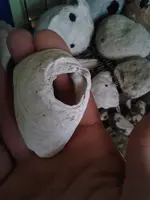
They used the rounded top of the shell as a hammer/anvil, and with enough wear it will produce an indentation, even a hole. Most people do not see this and think they are just shells. They are common artifacts around here.

GB, it's these nubs that I think that are the logical end use-wear progression from clamshell tool to powder...! We know that other shells are not the same, more brittle, the clam is more readily powdered. Maybe they had the kids pounding and grinding shell all day to keep 'em busy and out of the way of the calf-thick rattlers. When we eat blue crabs I use a metal pick that is no better than those little colunmella drill-like thingies. A buddy and me have made (and destroyed) some shell implements and they work great like the little picks for crab and the sunray clam for fish scaling and cutting meat, vs the powdering of clamshell on an abrading stone...
 
Man.. I could have a blast hunting with you.
I have to locate some of these and take some photos.
Away from home at the moment.
This is like a different language to folks who haven't got to know ... really got to know shell tools..and just shell in general in our neck of the woods.
 
Last edited:
OK.. let's see if I have some examples of these obscure barely talked about things.. ha!
You have to be pretty in tune with your area to pick out some of what were talking about here...but I know some that look at this will probably go..."ahhh ...oh yeah...those little things."

ForumRunner_20131023_213556.webp

I have much better examples of those little nubs but... trying to keep track of things is definitely a task.
 

Attachments

  • ForumRunner_20131023_214126.webp
    ForumRunner_20131023_214126.webp
    44.5 KB · Views: 82
You're not the only one that keeps those Tom!

ForumRunner_20131023_214722.webp


ForumRunner_20131023_215500.webp
 

Attachments

  • ForumRunner_20131023_215823.webp
    ForumRunner_20131023_215823.webp
    58.8 KB · Views: 88
Last edited:
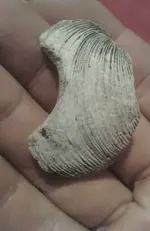
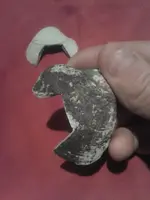
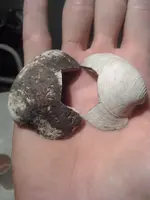
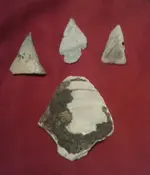
These last two made me think quite a bit..they are from the same site found months apart.
They don't show any heavy use wear like the others..that last one for instance is polished inside the notch.
They are exact copies of eachother.
I'm thinking they must have been a measuring device to gauge the width of something..Mabey a hole or shaft.
Or Mabey their legal lobster size? Kidding...


ForumRunner_20131023_224430.webp
 
Last edited:
Hehe

IMG_20131023_213528-1-enhanced.webp
 
A progression, sort of..


a reference pic think it might be from Marco... few would recognize or even pick up this piece of shell without cordage on it..
 
That cordage spool is from Marco Island.
Great bunch of preserved cordage,wood and other perishables from that site..
One more... then I'll clam up.


ForumRunner_20131024_085231.webp
 
yesterday from my travels and travails. ..............clam shell mania. WTH!!?!?!???!??????


Dems da ones!
I haven't seen anything written about them at all.
 

Users who are viewing this thread

Back
Top Bottom