What's new

Did someone say Flood Tunnels?

chalkoutline

Hero Member
Joined
Apr 1, 2025
Messages
679
Reaction score
279
Golden Thread
0
Hello,
I woke this morning thinking about Truro (1848) and the flood tunnel from Smith's cove and came up with the attached diagram which shows the MP with two stacked boxes in an air-lock between 100 and 110ft.

The distance from the MP to Smith's Cove is 465ft. This means the flood tunnel represents the hypotenuse of a right triangle with sides equal to 100 and 465. The inimum angle of the tunnel would be 8 to 9 degrees.


The tide at Oak Island will rise to 10 feet twice a day during high tide. Since the flood tunnel is at a declining angle, the tide would push in and fill the tunnel/MP so the only way the air-lock could be maintained would be if the finger drains pointed downward and long enough so when the tide rose, all the seawater pushed into the finger drains/tunnel would drain out at low tide.

I always wondered how the depositors would retrieve the treasure with the flood tunnel active but i now see it is quite simple...
They sized the finger drains and flood tunnel angle to maximize the time during low tide in order to breach and recover the treasure at low tide. This may have been the purpose of the 90ft stone.

Low tide typically occurs around 6pm so when the Onslow company quit for the day they had missed their opportunity. When high tide was then reached, there wasn't enough dirt above the air-lock to prevent the hydrostatic pressure of the seawater to push down the air-lock and flood the MP overnight.
-CO
 

Attachments
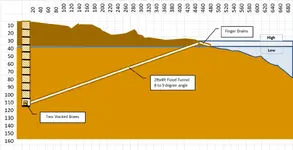
  • Finger Drains.webp
    Finger Drains.webp
    50.8 KB · Views: 101
Last edited:
Also, the finger drains would have to use material that would survive the constant exposure to seawater. I think Truro said they were stoned.

Although this theory seems possible, i still don't believe it plausible due to the time it takes to dig the 400ft long flood tunnel which i calculated to be longer than the dry season...even if dug from both ends.
 
Google Ai indicates that Onslow (1803) needed to keep 15ft of dirt above the air-lock so it looks like the MP wouldn't have flooded had they stopped at 90ft. Its when they dug to 93ft and drove a rod down to the 98ft platform that breached the air-lock.
 
Google AI indicates the air-lock will last as long as the clay remains hydrated and the wooden platforms do not rot or shrink.
 
Hello,
I woke this morning thinking about Truro (1848) and the flood tunnel from Smith's cove and came up with the attached diagram which shows the MP with two stacked boxes in an air-lock between 100 and 110ft.

The distance from the MP to Smith's Cove is 465ft. This means the flood tunnel represents the hypotenuse of a right triangle with sides equal to 100 and 465. The inimum angle of the tunnel would be 8 to 9 degrees.


The tide at Oak Island will rise to 10 feet twice a day during high tide. Since the flood tunnel is at a declining angle, the tide would push in and fill the tunnel/MP so the only way the air-lock could be maintained would be if the finger drains pointed downward and long enough so when the tide rose, all the seawater pushed into the finger drains/tunnel would drain out at low tide.

I always wondered how the depositors would retrieve the treasure with the flood tunnel active but i now see it is quite simple...
They sized the finger drains and flood tunnel angle to maximize the time during low tide in order to breach and recover the treasure at low tide. This may have been the purpose of the 90ft stone.

Low tide typically occurs around 6pm so when the Onslow company quit for the day they had missed their opportunity. When high tide was then reached, there wasn't enough dirt above the air-lock to prevent the hydrostatic pressure of the seawater to push down the air-lock and flood the MP overnight.
-CO
Yet of course ZERO evidence of any kind has ever been presented to prove that the fictional flood tunnels ever existed.

The only tunnels ever dug on the island were those done by folks looking for the fictional treasure.
 
Ive been fact checking my horizontal tunnel calculations...
1. The depositors would arrive early may and start digging the 12ftx12ftx100ft MP shaft. This would take about 5-6 weeks using a cubic yard bucket.
This means the flood tunnel from the MP to Smith's Cove could not begin until middle of June.
2. To avoid bad weather, they need to leave oak island by the end of sept.
3. The time to fill the MP shaft will also take about 5-6 weeks. This means they must be filling the MP by mid August.

This provide the timeframe/constraint for digging the 2ftx4ftx465ft flood tunnel: 2 months....from mid june to mid August.

Google AI indicates the flood tunnel could be dug at about 2ft per day.

Since a person on their knees takes up the entire 2ftx4ft opening, the buckets would have to be small (i.e., 1 cubic ft) in order to scrunch down and pass it over the person's shoulder. At 2ft per day, they would only be removing 16 buckets which is due to the dry, hard clay required for not using cribbing.

At 2ft per day, to dig in one direction would tale over 7 months. So they would need to dig the tunnel in both directions.
This would require a cofferdam at Smith's Cove which could be built while the MP is being completed.

This reduces the 7 months to 3.5 months. This means the flood tunnel could not be completed in the 2 month constraint making it highly improbable.

In order to dig the flood tunnel within the 2 month constraint, they would need to dig at the rate of 4 to 5ft per day. That would require removing 32 to 40 buckets per day.

As the tunnel got deeper they could have used more buckets and men (i.e., like a bucket brigade) to speed things up: however, the dry clayish till seems to be the bottleneck.

Finally, the tunnel would need to be lit in order to move and pass buckets, etc..that would burn oxygen which probably isn't very good in such a long dig.
 
As digs throughout the past 70 years have shown, no flood tunnels ever existed. The are part of the fictional delusion of the money pit.

The only persons claiming to have seen flood tunnels, 90 foot stone, and a money pit, are the ones attempting to fleece investors out of money.
 
No one has ever actually followed any tunnels back to the money pit but there have been some sort of finger drains found. Could they be flood tunnels? anything is possible, others say they and the coconut fibers were for salt collection. Which leads me to say they were there, just a matter of what for...
 
Yet of course ZERO evidence of any kind has ever been presented to prove that the fictional flood tunnels ever existed.

The only tunnels ever dug on the island were those done by folks looking for the fictional treasure.
Truth Be Told, can you now provide us with irrefutable evidence to support those two statements made by you, or were you merely expressing your entitled personal opinion, perhaps as another frustrated sceptic?
If you feel that the Money Pit never contained treasure then we are in agreement at least on that point.
You apparently believe that the Money Pit, the flood tunnels and the treasure itself are all delusional subjects of fiction, that loaded statement does imply that anyone who dares to disagree with your statement has mental health issues, if that is the case it does not faze me at all.
For my part I have personally openly stated that in my own published opinion/theory that the Money Pit was created as a vital sand sump, my CAD that illustrates this hypothesis is now internationally available in the public domain.
Now Truth be Told, it's your turn, please enlighten us, what is your own personal theory regarding the real purpose for the construction of the Money Pit, always remembering that it has to justify all the work done.
To remind you, in the 180ft deep twelve foot wide Money Pit shaft eighteen platforms that were constructed, by using 24 logs 14ft long by 6" wide logs at every ten foot level. You therefore have to be looking at around 200 logs that were required to be first felled, and that was just part of the hard work required for the construction of the Money Pit shaft.
You have to consider the labour and hard work required for all the timber felling and then cutting to the required lengths, and then transporting this stockpile to Oak Island in order to construct and fit in the Money Pit as platforms, plus all the mining excavating work that was required.
I can't wait to hear your own theory that justifies all this extensive hard work done just for the completion of the Money Pit shaft, that never contained treasure.

Oak Island Sage
 
Last edited:

Users who are viewing this thread

Back
Top Bottom












