What's new

Equinox Gold and Silver VDIs

hageneyr

Jr. Member
Joined
Aug 25, 2017
Messages
51
Reaction score
213
Golden Thread
0
Location
Downingtown, PA
Detector(s) used
Garrett AT Pro
Primary Interest:
All Treasure Hunting
ImageUploadedByTreasureNet.com1534019938.080169.webp
 
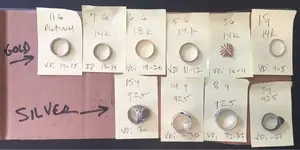
Some of my recent beach finds with the 800...thought i would share what they all rang up as.
 
Nice haul. I'm a little jealous.
 
Good to know. Thanks for posting. HH
 
What was the tab to ring ratio - lol. Nice saves.
 
If i see a 14 im thinking tab for sure but am pleasantly surprised 1 out of 50 times!
 
If i see a 14 im thinking tab for sure but am pleasantly surprised 1 out of 50 times!

1 out of 50 is not bad. Those damn ubiquitous, round juice freshness seals at a solid sounding 7 are driving me insane.
 
the plat was higher than I expected but since I have never found one, I don't have a clue
 
the plat was higher than I expected but since I have never found one, I don't have a clue

Good point. Pure platinum has less specific conductivity than iron (!), but total mass (in this case a hefty 11g) and purity plays a role. Still a little higher than I would expect too. But that's the way it is with jewelry.

Some other platinum ring TID data here with discussion.

http://www.treasurenet.com/forums/equinox/580593-lets-talk-small-ladies-rings.html#post5840003
 
Last edited:
GREAT DIGS, and thanks for sharing VDI info with us on each of them...

Steve
 
thanks for the info . finds like yours are why I want to up grade to the equinox 800 for hunting in the water as soon as I can make that happen.
 
Thanks for the info and congrats on the gold and silver finds.
 
The VDI of 4-5 thru me off a bit, I'll pay more attention to those. Welcome information "hageneyr" Thank you.
 
The VDI of 4-5 thru me off a bit, I'll pay more attention to those. Welcome information "hageneyr" Thank you.

Oh yeah, thin gold can def ring up down there. The TID is a function of the metal composition/purity (which affects specific conductivity), total metal mass, shape, the presence of a continuous conductive circuit (closed vs. open loops) and thickness of the of the metal (e.g., thin rings have greater resistance to induced currents created by the coil's magnetic field). The irregular shape, discontinuous loop conductivity circuit, and thickness effects dominate even high metal mass gold chains which drives their TIDs to very low numbers. Metals of lower specific conductivity such as gold, lead, and aluminum are more highly affected by these factors than high conductors like pure copper and silver. The detector (via the coil receive windings) is looking for a high strength (the field strength is a function of the conductivity factors I mentioned previously and transmit frequency), symmetric (ideally donut-shaped indicating a probable coin) magnetic field that is created by the current induced in the conductive target by the magnetic field created by the transmit coil windings.
 
Last edited:
Congrats on the finds & thank You for sharing VDI #s.
They should be helpful.


Oh yeah, thin gold can def ring up down there. The TID is a function of the metal composition/purity (which affects specific conductivity), total metal mass, shape, the presence of a continuous conductive circuit (closed vs. open loops) and thickness of the of the metal (e.g., thin rings have greater resistance to induced currents created by the coil's magnetic field). The irregular shape, discontinuous loop conductivity circuit, and thickness effects dominate even high metal mass gold chains which drives their TIDs to very low numbers. Metals of lower specific conductivity such as gold, lead, and aluminum are more highly affected by these factors than high conductors like pure copper and silver. The detector (via the coil receive windings) is looking for a high strength (the field strength is a function of the conductivity factors I mentioned previously and transmit frequency), symmetric (ideally donut-shaped indicating a probable coin) magnetic field that is created by the current induced in the conductive target by the magnetic field created by the transmit coil windings.

Now that's a mouth full. I'll have to read this a couple more times to fully understand.
 
Congrats on the finds & thank You for sharing VDI #s.
They should be helpful.


Now that's a mouth full. I'll have to read this a couple more times to fully understand.

LOL - I know - there are a lot of competing effects going on.

Let me summarize without the science mumbo jumbo: thin gold and especially gold chains (even with high metal mass) will by the nature of their material properties and shape ring up with lower VDI's but because of the variability in shape, mass, and composition of gold jewelry it can ring up over a wide range of VDI's including the high teens. Lower conductor (e.g., gold) target VDI's tend to be lower and more dominated by shape and thickness than by metal mass vs. high conductors like silver which will ring up high even if they are small.

High conductors can be detected at greater depths because of their higher field strengths compared to mid conductors (independent of frequency). Higher frequencies help small, mid-conductors become more visible to the detectors, but high frequency signals cannot penetrate as far as low frequency signals into the ground. That is why silver can be typically detected at much greater depths than gold (independent of frequency) and also why you want to use lower frequencies to maximize detection depth of silver targets.

Probably made things worse - but its complicated competing effects.
 
Last edited:
The first three in the top row are particularly interesting... those VDI's fall right on pull tabs and zinc pennies.
 
Congratulations on the jewelry finds! :icon_thumleft:
 
the Platinum ring also has a large surface area compared to a typical band which certainly helps.
 

Users who are viewing this thread

Back
Top Bottom