What's new

Gold coins on Mark Twain's ship that sunk off NC?

Darren in NC

Silver Member
Joined
Apr 1, 2004
Messages
2,905
Reaction score
1,965
Golden Thread
0
Detector(s) used
Tesoro Sand Shark, Homebuilt pulse loop
Primary Interest:
Shipwrecks
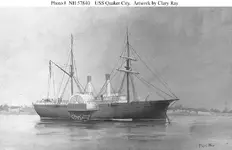
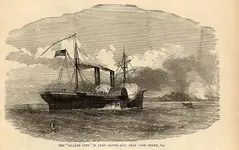
Mark Twain's memorialized trip to the Holy Land and beyond was made possible by traveling on the side-wheel steamer Quaker City. She had quite a colorful history. She was built with a wooden hull at Philadelphia, Pennsylvania, in 1854. She was built for the Collins Line of New York. She conducted one voyage from New York to London and then sold at a sheriff's sale when this firm dissolved in 1858, continuing commercial work.

She was chartered by the Navy in April 1861, soon after the outbreak of the Civil War, and sent to enforce the Federal blockade of the mouth of Chesapeake Bay. Over the next five months, she captured or took part in the capture of ten would-be blockade runners.

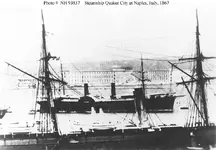
Decommissioned in May 1865, Quaker City was sold a month later and resumed her commercial career. During a trip to Europe in 1867, she was the scene of some of the tales related by Mark Twain in his book The Innocents Abroad. The steamer was sold and renamed Colombian in 1869, then, after joining the Haitian Navy in the same year,became Mont Organisé. Sold again in February 1871, she was renamed La République, but was lost at sea later in that month.

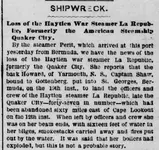
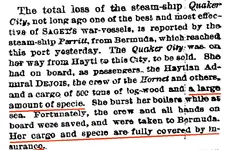
In some accounts, it was presumed she was lost near Bermuda, but this was confused by where the reports of her loss came from. Some off her crew and passengers lost at sea were picked up and brought to Bermuda. She was actually lost off Cape Lookout, NC. The New York Times states she had a considerable amount of specie onboard. Silver dollars were rarely minted since the 1840s, and since the gold rush, the gold standard was being instated heavily during this time. So it is possible that this large amount of specie is actually gold. Today's gold prices may warrant another look at this wreck.

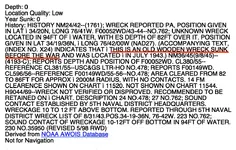
It's interesting to note that on the AWOIS listings near Cape Lookout, there is a large wooden wreck in need of further exploration. This wreck had a considerable relief (10-12 ft off the seafloor) for an old wooden wreck, which means she was a fairly large vessel at one time. The chances of this wreck being the Quaker City is not very high, but money could be made easily if an enterprising film company would create a documentary or show about "The Quest for Treasure on Mark Twain's Shipwreck." Networks or streaming services would pay good money for such a series, IMHO. And I am for hire, if you need a good researcher for the show. (hint...hint). :thumbsup:
 

Attachments

  • Lynnhaven Bay.webp
    Lynnhaven Bay.webp
    117.2 KB · Views: 137
  • NY Times Feb 25, 1871.webp
    NY Times Feb 25, 1871.webp
    112.7 KB · Views: 74
  • Quaker City.webp
    Quaker City.webp
    59.7 KB · Views: 80
  • AWOIS possibility.webp
    AWOIS possibility.webp
    122.5 KB · Views: 74
  • 1867 in Naples Italy.webp
    1867 in Naples Italy.webp
    50.7 KB · Views: 62
  • NY Herald Feb 25, 1871.webp
    NY Herald Feb 25, 1871.webp
    94.3 KB · Views: 68
Mark Twain's memorialized trip to the Holy Land and beyond was made possible by traveling on the side-wheel steamer Quaker City. She had quite a colorful history. She was built with a wooden hull at Philadelphia, Pennsylvania, in 1854. She was built for the Collins Line of New York. She conducted one voyage from New York to London and then sold at a sheriff's sale when this firm dissolved in 1858, continuing commercial work.

She was chartered by the Navy in April 1861, soon after the outbreak of the Civil War, and sent to enforce the Federal blockade of the mouth of Chesapeake Bay. Over the next five months, she captured or took part in the capture of ten would-be blockade runners.

Decommissioned in May 1865, Quaker City was sold a month later and resumed her commercial career. During a trip to Europe in 1867, she was the scene of some of the tales related by Mark Twain in his book The Innocents Abroad. The steamer was sold and renamed Colombian in 1869, then, after joining the Haitian Navy in the same year,became Mont Organisé. Sold again in February 1871, she was renamed La République, but was lost at sea later in that month.

In some accounts, it was presumed she was lost near Bermuda, but this was confused by where the reports of her loss came from. Some off her crew and passengers lost at sea were picked up and brought to Bermuda. She was actually lost off Cape Lookout, NC. The New York Times states she had a considerable amount of specie onboard. Silver dollars were rarely minted since the 1840s, and since the gold rush, the gold standard was being instated heavily during this time. So it is possible that this large amount of specie is actually gold. Today's gold prices may warrant another look at this wreck.

It's interesting to note that on the AWOIS listings near Cape Lookout, there is a large wooden wreck in need of further exploration. This wreck had a considerable relief (10-12 ft off the seafloor) for an old wooden wreck, which means she was a fairly large vessel at one time. The chances of this wreck being the Quaker City is not very high, but money could be made easily if an enterprising film company would create a documentary or show about "The Quest for Treasure on Mark Twain's Shipwreck." Networks or streaming services would pay good money for such a series, IMHO. And I am for hire, if you need a good researcher for the show. (hint...hint). :thumbsup:
Darren you excel yourself.

Great research ad great story which deserves to be told.

Crow
 
I can see the marketing plan to link Mark Twain to the ship as selling point. A story of the ships history and the ships fate. then a dive trip exploring the site suspected to be wreck. It would be single exploration dive to finish and of course allusion to treasure. The dive team would have come a with realistic costing of a drive and exploration of the site.

One would have to look at documentary format. The average length of a documentary varies by format, but
feature-length documentaries are typically between 75 and 120 minutes, while television-formatted documentaries are often around 50-60 minutes. Shorter formats like mini-documentaries can be 2-25 minutes, and docu series consist of multiple episodes, each 30-60 minutes long.

The Quest for Treasure on Mark Twain's Shipwreck is good title. Say a 60 minute doc Broken down further mark twain who he is and his trip to Europe 10 min. his connection to the ship ten minutes . The history of the ship 10 minutes. it final loss and cargo of specie. 10 minutes later reports of wreck ear cape look out. a brief history of shipwreck around cape look out 10 minutes then filmed dive search for shipwreck 10 minutes.

The average cost of a documentary can vary significantly, from a few thousand dollars to millions, but a common starting point is
$1,000 to $4,000 per finished minute. Factors like duration, scope, crew experience, locations, and editing all impact the final cost. More complex, high-end productions can easily reach several hundred thousand dollars.

Crow
 
Haiti – large amount of specie?
During the period when the steamer Quaker City (later Mont Organisé and La République) was in Haitian service, the country was under the government of President Nissage Saget (1870–1874). Haiti had recently endured severe political instability and was attempting to stabilize while functioning under the liberal Constitution of 1867. Saget’s government focused on redeeming depreciated paper money, and this led to new laws and financial reforms, including a domestic loan to back Haitian currency with U.S. gold and silver coins after 1872.wikisource

Haiti's Debt and Payments
Haiti's most significant financial burden during this period was the indemnity debt imposed by France in 1825, requiring vast annual payments meant to “compensate” former slaveholders for Haiti’s independence. The required payments were far beyond the nation's budget, and from the very beginning, Haiti was forced to borrow from French banks to meet these obligations. Payments were structured as yearly installments, creating a cycle in which Haiti made annual payments to France and, at the same time, paid interest on the loans it had to take to meet each installment.wikipedia+4
Ownership and Banking of Haitian Debt
In the 19th century, Haiti’s debt was primarily owned by French creditors and banks. Early loans involved institutions like Ternaux Gandolphe et Cie, later shifting to more prominent banks including Crédit Industriel et Commercial (CIC). These banks not only held large portions of Haiti’s debt but also took over treasury operations and, by the 1880s, controlled almost all major financial functions in the country, extracting hefty commissions and deepening dependency. These arrangements essentially meant France and its banking sector had direct control over Haitian fiscal policy and debt servicing mechanisms throughout the late 19th century.caribbean-beat+4
Annual Payments and Impact
Payments to France and its banks were required annually, and payment failures triggered punitive taxes, further borrowing, and even foreign intervention threats. By this period (circa 1871), the "double debt" had become a core feature of Haitian finances — annual national revenues were dwarfed by debt installments, and repeated borrowing ensured long-term subordination to foreign bankers. This cycle only deepened as Haiti sought additional loans to offset earlier debts, often with even harsher terms, and with new banks (e.g., CIC) entering to manage both the public and external debt by the end of the century.mediapart+5
Summary Table: Haiti's Political and Debt Situation ca. 1871

Aspect​
Details (1871)​
Source​
Government
President Nissage Saget, Liberal Constitution

wikisource

Debt Payee

France, French banks

wikipedia+2

Payment Structure

Yearly installments, borrowing for each

wikipedia+1

Major Banks

Ternaux Gandolphe et Cie, Crédit Industriel et Commercial (CIC)

mediapart+1

Debt Impact

Dominated budget, punitive taxes, dependency

caribbean-beat+1
In summary, when Quaker City was in Haitian service, Haiti was struggling under the weight of externally owned debt, chiefly managed by French banks, which required yearly payments that drained much of the nation’s revenue and locked Haiti into a cycle of dependency and vulnerability.news.un+5
  1. https://en.wikisource.org/wiki/Haiti:_Her_History_and_Her_Detractors/Part_I:_Chapter_XVII
  2. https://en.wikipedia.org/wiki/Haitian_independence_debt
  3. https://www.caribbean-beat.com/issue-189/haitis-double-debt-on-this-day
  4. https://news.un.org/en/story/2025/04/1162406
  5. https://english.elpais.com/international/2024-04-03/haiti-an-economy-condemned-by-a-19th-century-debt.html
  6. https://www.wilsoncenter.org/blog-post/haiti-where-descendants-slaves-paid-descendants-slaveholders
  7. https://www.mediapart.fr/en/journal/international/110622/haiti-dark-history-french-colonial-banks-resurfaces
  8. https://www.nytimes.com/2022/05/20/world/french-banks-haiti-cic.html
  9. https://en.wikipedia.org/wiki/Ministry_of_Justice_and_Public_Security_(Haiti)
  10. https://www.jstor.org/stable/274404
  11. https://www.aaihs.org/frederick-douglass-haiti-and-diplomacy/
  12. https://en.wikisource.org/wiki/Page:Haiti-_Her_History_and_Her_Detractors.djvu/240
  13. https://www.jstor.org/stable/jj.6195059.4
  14. https://www.reddit.com/r/history/comments/uwtxtq/the_root_of_haitis_misery_reparations_to/
  15. https://en.wikipedia.org/wiki/Republic_of_Haiti_(1859%E2%80%931957)
  16. https://www.nytimes.com/2022/05/20/world/americas/haiti-history-colonized-france.html
  17. https://papers.ssrn.com/sol3/Delivery.cfm/SSRN_ID3843365_code4292810.pdf?abstractid=3843365&mirid=1
  18. http://www.piketty.pse.ens.fr/files/Henochsberg2016.pdf
  19. https://en.wikipedia.org/wiki/External_debt_of_Haiti
  20. https://dash.harvard.edu/bitstreams/95025b29-d54b-45bf-bc4f-10e4bb6ef272/download
 
Haiti – large amount of specie?
During the period when the steamer Quaker City (later Mont Organisé and La République) was in Haitian service, the country was under the government of President Nissage Saget (1870–1874). Haiti had recently endured severe political instability and was attempting to stabilize while functioning under the liberal Constitution of 1867. Saget’s government focused on redeeming depreciated paper money, and this led to new laws and financial reforms, including a domestic loan to back Haitian currency with U.S. gold and silver coins after 1872.wikisource

Haiti's Debt and Payments
Haiti's most significant financial burden during this period was the indemnity debt imposed by France in 1825, requiring vast annual payments meant to “compensate” former slaveholders for Haiti’s independence. The required payments were far beyond the nation's budget, and from the very beginning, Haiti was forced to borrow from French banks to meet these obligations. Payments were structured as yearly installments, creating a cycle in which Haiti made annual payments to France and, at the same time, paid interest on the loans it had to take to meet each installment.wikipedia+4
Ownership and Banking of Haitian Debt
In the 19th century, Haiti’s debt was primarily owned by French creditors and banks. Early loans involved institutions like Ternaux Gandolphe et Cie, later shifting to more prominent banks including Crédit Industriel et Commercial (CIC). These banks not only held large portions of Haiti’s debt but also took over treasury operations and, by the 1880s, controlled almost all major financial functions in the country, extracting hefty commissions and deepening dependency. These arrangements essentially meant France and its banking sector had direct control over Haitian fiscal policy and debt servicing mechanisms throughout the late 19th century.caribbean-beat+4
Annual Payments and Impact
Payments to France and its banks were required annually, and payment failures triggered punitive taxes, further borrowing, and even foreign intervention threats. By this period (circa 1871), the "double debt" had become a core feature of Haitian finances — annual national revenues were dwarfed by debt installments, and repeated borrowing ensured long-term subordination to foreign bankers. This cycle only deepened as Haiti sought additional loans to offset earlier debts, often with even harsher terms, and with new banks (e.g., CIC) entering to manage both the public and external debt by the end of the century.mediapart+5
Summary Table: Haiti's Political and Debt Situation ca. 1871

Aspect​
Details (1871)​
Source​
Government
President Nissage Saget, Liberal Constitution

wikisource

Debt Payee

France, French banks

wikipedia+2

Payment Structure

Yearly installments, borrowing for each

wikipedia+1

Major Banks

Ternaux Gandolphe et Cie, Crédit Industriel et Commercial (CIC)

mediapart+1

Debt Impact

Dominated budget, punitive taxes, dependency

caribbean-beat+1
In summary, when Quaker City was in Haitian service, Haiti was struggling under the weight of externally owned debt, chiefly managed by French banks, which required yearly payments that drained much of the nation’s revenue and locked Haiti into a cycle of dependency and vulnerability.news.un+5
  1. https://en.wikisource.org/wiki/Haiti:_Her_History_and_Her_Detractors/Part_I:_Chapter_XVII
  2. https://en.wikipedia.org/wiki/Haitian_independence_debt
  3. https://www.caribbean-beat.com/issue-189/haitis-double-debt-on-this-day
  4. https://news.un.org/en/story/2025/04/1162406
  5. https://english.elpais.com/international/2024-04-03/haiti-an-economy-condemned-by-a-19th-century-debt.html
  6. https://www.wilsoncenter.org/blog-post/haiti-where-descendants-slaves-paid-descendants-slaveholders
  7. https://www.mediapart.fr/en/journal/international/110622/haiti-dark-history-french-colonial-banks-resurfaces
  8. https://www.nytimes.com/2022/05/20/world/french-banks-haiti-cic.html
  9. https://en.wikipedia.org/wiki/Ministry_of_Justice_and_Public_Security_(Haiti)
  10. https://www.jstor.org/stable/274404
  11. https://www.aaihs.org/frederick-douglass-haiti-and-diplomacy/
  12. https://en.wikisource.org/wiki/Page:Haiti-_Her_History_and_Her_Detractors.djvu/240
  13. https://www.jstor.org/stable/jj.6195059.4
  14. https://www.reddit.com/r/history/comments/uwtxtq/the_root_of_haitis_misery_reparations_to/
  15. https://en.wikipedia.org/wiki/Republic_of_Haiti_(1859%E2%80%931957)
  16. https://www.nytimes.com/2022/05/20/world/americas/haiti-history-colonized-france.html
  17. https://papers.ssrn.com/sol3/Delivery.cfm/SSRN_ID3843365_code4292810.pdf?abstractid=3843365&mirid=1
  18. http://www.piketty.pse.ens.fr/files/Henochsberg2016.pdf
  19. https://en.wikipedia.org/wiki/External_debt_of_Haiti
  20. https://dash.harvard.edu/bitstreams/95025b29-d54b-45bf-bc4f-10e4bb6ef272/download
Good point and a very good find.

I could imagine Haiti currency below was pretty worthless outside of Haiti. I just cannot see the French accepting Haitian currency for payments outside of Haiti.

Screenshot 2025-11-04 211041.webp


Screenshot 2025-11-04 211431.webp


Since it appears french companies had control still Haiti banking system perhaps they was using French currency in loan repayment below.payment in coin or bullion as distinguished from payment in paper money.

Screenshot 2025-11-04 212214.webp


Screenshot 2025-11-04 212320.webp

Haiti: Where the Descendants of Slaves Paid the Descendants of Slaveholders. Haiti, one of the world's poorest countries, was forced to pay France 112 million francs (approximately $560 million in today's money) for recognition of its independence and sovereignty.

So in effect its possible a shipment of gold french francs was transshipped to new York where in turn it would been transshipped back to France.

Interesting!

Crow
 
It is quite complicated to convert monies of old time to today's value. Haiti had to pay the debt in French gold Francs. the initial debt amounted to about 32 metric tons (32,000 kilos) of pure gold. I believe Haiti is still paying on the interests on loand it took to pay the original debt, but now to American banks that lend them the money to pay off the French banks.
  • Haiti had to take loans from French banks, including one of 30 million francs in 1825, to finance the first payment.
  • Payments to France combined direct payments and servicing loans, creating a "double debt" burden.
  • The first annual payment of 30 million francs was roughly six times Haiti's yearly government revenue at that time.
  • Haiti made payments totaling approximately 112 million francs over about 70 years.
  • Haiti also paid interest on loans, with agreements varying over the decades with France.
Duration of Payments
  • Initial indemnity payments started in 1825.
  • Official last payment on the indemnity was in 1878.
  • Loan payments concluded by 1887-1888.
  • Including loans taken to cover payments, the debt payments extended until roughly 1947
It is really complicated and frankly shamefull how the first slave country to gain independence was and is being treated.
However, if you want to know if there was a large amount of gold on board, you will have to dig deep down the rabbit hole.
Is it worth spending a lot of time on this research?
 
The French gold franc coin in 1888 belonged to a long tradition of gold coinage introduced by Napoleon Bonaparte in 1803, known as the Napoleon 20 Francs coin. This coin was the result of a major monetary reform aimed at stabilizing and modernizing the French economy after the Revolution. The coin weighed 6.45 grams with 90% purity, containing about 5.81 grams of pure gold.

By 1888, this gold franc coin functioned not only as France's main gold currency but also played an important role internationally. France, along with Belgium, Italy, Switzerland, and later Greece, formed the Latin Monetary Union in 1865. This union standardized currency specifications among member countries based on the French gold franc model, facilitating cross-border trade and using gold coins interchangeably. The 20 franc gold coin became a symbol of political and economic stability in France, circulating widely across Europe and influencing other countries' coinage.

The Napoleonic gold franc represented both a stable currency and a political symbol, illustrating France's transition through various regimes from empire to republic during the 19th century. Minted continuously until 1914, the coin witnessed key historical shifts and was essential in international commerce in the late 1800s.
 
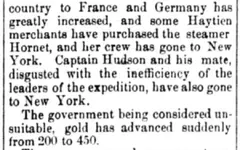
No one knows for certain what the specie was for, but there are clues. Why did the La République (Quaker City) have the crew of the Hornet traveling with her? Why would a crew abandon their ship? The Hornet was a filibuster supply ship for the Cuban insurgents fighting for the independence of Cuba. It was a guerilla war (known as the Ten Year's War) against the Spanish. In January of 1871, the Hornet arrives in Port-Au-Prince, waiting on war contraband arriving from New York. This causes quite a standoff, as Spanish warships came, demanding her to be handed over. The Haitian response was immediate, and they put their gunboats beside her for protection. Haiti was sympathetic to the Cuban cause.

Shortly after this, the Hornet gets sold to Haitian merchants, and at the same time, gold prices skyrocket due to an unstable government in Haiti. So the crew, no longer needed, prepares to leave for New York, as stated in the attached account. They board the La République, apparently with an unspecified amount of specie. Later, they are rescued off North Carolina while the La République is still listing and soon to sink. They are brought to Bermuda, before their return to New York.

So was the specie a non-government, private payment from the merchants for the Hornet? (I tend to think this is most likely, considering the crew was aboard). Was it government gold being transferred for security in a more stable location? Was it payment of undisclosed gov't debt? Was it to pay for more Cuban war supplies? Was it a combination of any, or all of these? The newspaper accounts state that the specie was covered by insurance. Perhaps there is a record somewhere that will one day shed light on the specific nature of the specie on board.
 

Attachments

  • Hornet crew.webp
    Hornet crew.webp
    42.8 KB · Views: 69
Definitely there is more meat on the bone.

To find American shipping insurance records from 1871, you should look for the records of specific insurance societies, such as the Society for the Registry of Shipping (later Lloyd's Register of Shipping), and look for lists of vessels in records from that period. For ships that sank, you can try searching for related government reports or other details from the period.

After doing a little search through those 1871 records. One thing she La République is not in the Lloyd's register. No real surprises there as we can rule out British insurance companies. But there is other ways to skin a cat.

In university of Florida night have the answer? Part of the Special and Area Studies Collections, George A. Smathers Libraries, University of Florida Repository there is a file Annual marine insurance policies, 1870, 1872, 1874-1879, 1881, 1883-1884 File — Box: 6 ( While 1871 is not specifically claimed in the box. the event happened in 1871 and sometimes to claim was not lodged good time after the event. It always worth checking the following year 1872?)

Series 6 includes cargo pouches, charter parties, maritime protests, insurance policies, and contractual records. The largest part of the collection consists of cargo pouches. The original pouch envelopes, many of which were wrapped in bundles marked "consignment envelopes," have been retained.

A typical cargo pouch contains sales receipts, import slips, invoices, insurance receipts, memoranda and charter memoranda. Some pouches (especially 1876 and 1877) may also include towing bills, quarantine bills, shipwright bills, bills of lading, storage receipts, consulate bills, custom house receipts, warden's office legislative acts, bank correspondence, sugar weight return notices, marine protests, import bonds and trust receipts. Sugar transactions are prominent throughout most years, but also included are railroad grain transactions (1879), iron rails (1880) and bat guano sales (1882). Some cargo pouches contain charter parties and have been labeled as such. Charter parties found independent of cargo pouches are listed separately.

Box 6 contains insurance policies, receipts and ledgers (1870-1885) related to ships, cargoes on ships, and cargoes stored in wharves and bulkheads. The ledger entitled "Marine Insurance G.R. and Co." lists vessels with merchandise, exit ports, dates and amounts of insurance (in gold or currency), and compliments material found in many of the cargo pouches.

The majority of the maritime papers are written in English with some in Spanish and a few in French and German.

Failing that Searching for specific "1871 French maritime insurance records" is challenging due to the lack of a single centralized database, but you can look for records from French insurance companies, government archives, or international archives like Lloyd's Register
. Records might include insurance contracts, vessel classifications, and shipping logs. French government and historical archives: National and regional archives in France may hold maritime insurance policies or related documents, especially for companies that have since closed or been absorbed.French insurance company archives: Check for records from French insurance companies that operated in 1871. If they no longer exist, their records may have been transferred to a national archive.

Crow
 
In regards to French insurance industry.

The insurance market really took off in the 1820s at times when the growth of activities was not only focused on mutual firms but also on capital companies (fixed premium insurers). While mutual companies opted to diversify their activities by introducing new schemes and opening offices in several regions, capital companies relied on the support of the financial market to expand.

Fixed premium insurers

Known as fixed premium insurers, the first capital companies appeared as early as 1819. It was with the support of wealthy businessmen and the banking sector that these insurers set foot on the French market. The Breton banker Marie-Auguste de Gourcuff, close to King Louis XVIII, founded in 1819 the Société des Assurances Générales contre l'Incendie as a public limited liability company.

Other companies would follow:

the Compagnie française du Phénix (which would give rise to Assurances Générales de France, the AGF) was set up in 1819 by Jacob Dupan and Charles Xavier Thomas,
the Compagnie Royale, which became Nationale and then GAN, was founded in 1820 on the initiative of 16 bankers,
the Union-Incendie, which came into being in 1828, had 20 bankers as its shareholders. It gave birth to the Union des Assurances de Paris (UAP) which would later become AXA,
the Soleil-Incendie began operations in 1829,
the Union-Vie, established in 1829, was the first life insurer to see the light of day after the Restoration. Royale-Vie, a life insurance company followed, entering the market in 1830.

After the Restoration of 1814, nearly 100 insurance companies were, therefore, established. In spite of this boom, several young companies went bankrupt, with only 30 fixed-premium companies staying the course. The market was then driven by five main companies: Société d'Assurances Générales contre l'Incendie, Phénix, Compagnie Royale d'Assurances, Union-Incendie and Soleil-Incendie, all of which experienced robust growth based on a risk selection strategy.

It is noteworthy that the newly established companies were rapidly turning to international development. The Union-Incendie was the first French insurer to establish itself outside France, notably in Spain, Switzerland, Germany and England. The company managed to settle even in South America and the Far East.

At the end of the 19th century, French insurers were present in 16 foreign countries, mainly in Europe and North Africa.

Mutual insurance companies

The first mutual property & casualty insurance company was limited to the coverage of fire insurance. The "Compagnie d'Assurances Mutuelles contre l'Incendie de Paris" was set up in 1816.

Between 1816 and 1883, nearly 200 mutual companies had been established in France. As with fixed premium companies, a large number of these young companies quickly disappeared. In 1892, there were only 51 mutuals left on the market. Among the most active of these companies was the Mutuelle de Poitiers, founded in 1838 and still in operation.

The Mutuelle Immobilière Incendie was created in 1828 by a lawyer from Sarthe, Louis Basse, who in 1839 also introduced the Mutuelle Mobilière Incendie to the market.

Still at the initiative of L. Basse, a third company appeared in 1842 under the name of Mutuelle Mobilière du Mans.

These above companies insurance records may still exist in archives in France. Each one may be progressively removed from hunt by detailed research into each company to see if they still existed in 1871 and did marine insurance.

Crow
 
The book on L'Union. Incendie, Accidents, Risque Divers. 1823-1953 Published by 9, Place Vendome Paris, 1953 and french insurance companies from 1823 -1853 might worth searching through?

Crow.
 
I tried searching through American Lloyd’s Register of American and Foreign Shipping 1871 no luck at present. Mystic seaport has extensive maritime records.

Crow
 
Thanks for sharing an interesting topic Darren.

This is what I love about researching these treasure stories. You never know what you come across and you are always learning, finding new data bases and archives. Regardless if the project never evolves reaching each stories sharpens research skills. For those who hones and sharpened their research skill's the rewards is finding the project that is proverbial 'Goldilocks project'. The project that ticks all the boxes.

Crow
 
Last edited:
Crow, we both, along with others here, have many stories to tell. Some us from experience, and some from digging in and finding good research, and of course, both.

I would love to see a TV/streaming series that explored these "Goldilocks" stories of shipwrecks. I believe the money in treasure hunting today is not found on the wrecks themselves. The world has become too political for that to be a realistic goal anymore. The money is found in filming, and selling the rights for distribution.

I have enough research for an entire season to be filmed, just here in NC. I am amazed at the wrecks that have already been salvaged, but few people have heard of them. There are endless wrecks with endless possibilities. And the hunt for the truth behind these wrecks is more addicting than almost anything else I've done.

Keep digging. Keep sharing. Of course, keep the real Goldilocks cases for a real project. 8-)
 
Last edited:

Users who are viewing this thread

Back
Top Bottom