
You are using an out of date browser. It may not display this or other websites correctly.
You should upgrade or use an alternative browser.
You should upgrade or use an alternative browser.
GPZ 7000 Successor, March 9th boys…. Apply for those second mortgages…
- Thread starter Jennifer-007
- Start date


- Joined
- Mar 19, 2003
- Messages
- 2,676
- Reaction score
- 3,337
- Golden Thread
- 0
- Location
- Washington
- Detector(s) used
- Custom Designs and Prototypes
- Primary Interest:
- All Treasure Hunting
PI detectors have long had some amount of iron ID when using a DD coil than can look at reactive signals during TX. The problem is that iron is not purely magnetic-reactive, it often has a resistive eddy component. And at depth, the eddy component may dominate the RX signal making deep iron look non-ferrous. Which is exactly what you get with both PI and VLF.The GPZ 8000 is designed to recognize IRON, a magnetic metal and exclude the Iron. Show me! Can the predecessors do that?
I was told that the eventual goal is to adopt BT LE Audio which is the new low-latency standard intended to replace AptX-LL. Chip vendors are still tying their shoes, mostly over licensing issues. However, I finally see LE Audio headphones showing up on Amazon. I have an LE Audio system running and latency is around 30ms, bout the same as AptX-LL. There is no wireless with zero latency, and anything less than 50-60ms is not perceptible.Unlike the older Wi-Stream, the new filings show a shift toward a proprietary low-latency 2.4GHz/Bluetooth hybrid module. This suggests the 8000 will finally ditch the WM12 module in favor of a direct-to-headset connection with zero lag—likely compatible with the ML105 or a newer "ML200" headset.
But with metal detectors, it is actually the best sense available. Human sound processing often fills in gaps and creates perceptions that aren't necessarily in the sound that was heard. This is a benefit with metal detecting because it creates an additional audio filter that helps pick out a faint target in the presence of noise that the detector electronics alone might miss. Plus it's faster than sight.The MOST unreliable sense humans have is "hearing".
You don't have to use the stereo audio if you don't want to. Use mono, and apply to either ear.A large segment of the population is hearing disabled
I don't understand your other comments. When I tested the 8k, I found the stereo audio to be a mess. But with time, it may be useful. As someone in the video said, "It's gonna take some getting used to." I have long been a proponent of stereo audio where the different signals get processed between the ears. The Naulitus was the first to do this, and the White's V3 did it better.

Jennifer-007
Full Member
- Joined
- Mar 27, 2010
- Messages
- 204
- Reaction score
- 675
- Golden Thread
- 0
- Detector(s) used
- Minelab, GPX, GPZ, Garrett Axiom, Falcon MD-20, Heckler Fabrication 30+ Ton Per Hour Trommel, Kubota M62 TLB, 6 tray commercial dry washer / dry blower.
- #184
Thread Owner
I’d love to hear from someone who’s heard the new 8000 audio and has also used Nenad’s SP01 with its pseudo stereo to see how they compared, any iof you have experience with both systems that can comment.PI detectors have long had some amount of iron ID when using a DD coil than can look at reactive signals during TX. The problem is that iron is not purely magnetic-reactive, it often has a resistive eddy component. And at depth, the eddy component may dominate the RX signal making deep iron look non-ferrous. Which is exactly what you get with both PI and VLF.
I was told that the eventual goal is to adopt BT LE Audio which is the new low-latency standard intended to replace AptX-LL. Chip vendors are still tying their shoes, mostly over licensing issues. However, I finally see LE Audio headphones showing up on Amazon. I have an LE Audio system running and latency is around 30ms, bout the same as AptX-LL. There is no wireless with zero latency, and anything less than 50-60ms is not perceptible.
But with metal detectors, it is actually the best sense available. Human sound processing often fills in gaps and creates perceptions that aren't necessarily in the sound that was heard. This is a benefit with metal detecting because it creates an additional audio filter that helps pick out a faint target in the presence of noise that the detector electronics alone might miss. Plus it's faster than sight.
You don't have to use the stereo audio if you don't want to. Use mono, and apply to either ear.
I don't understand your other comments. When I tested the 8k, I found the stereo audio to be a mess. But with time, it may be useful. As someone in the video said, "It's gonna take some getting used to." I have long been a proponent of stereo audio where the different signals get processed between the ears. The Naulitus was the first to do this, and the White's V3 did it better.
Jen
Jennifer-007
Full Member
- Joined
- Mar 27, 2010
- Messages
- 204
- Reaction score
- 675
- Golden Thread
- 0
- Detector(s) used
- Minelab, GPX, GPZ, Garrett Axiom, Falcon MD-20, Heckler Fabrication 30+ Ton Per Hour Trommel, Kubota M62 TLB, 6 tray commercial dry washer / dry blower.
- #185
Thread Owner
Some coil tech by JP, and he says the quiet part out loud (toilet seat). lol
- Joined
- Apr 9, 2007
- Messages
- 639
- Reaction score
- 544
- Golden Thread
- 0
- Primary Interest:
- All Treasure Hunting
That's a record!
One thousand buzz-words in 68 seconds! The takeaway? "Toilet seat".
It's a bird, It's a plane, it's a Toroidal coil, it's stacked windings! It's a Toilet seat!
"Key Coil Options
- Geowizard
One thousand buzz-words in 68 seconds! The takeaway? "Toilet seat".
It's a bird, It's a plane, it's a Toroidal coil, it's stacked windings! It's a Toilet seat!
"Key Coil Options
- Z18 (18-inch) Concentric Toroidal Coil: Engineered for maximum depth and coverage in open, highly mineralized ground.
- Z17 (17-inch) Concentric Toroidal Coil: Ideal for high EMI (electromagnetic interference) areas and conductive soils, providing stability and high sensitivity to small-to-medium gold.
- Z13 (13-inch) Concentric Toroidal Coil: Best for highly vegetated or rocky terrain, offering improved maneuverability, balance, and reduced user fatigue. "
- Geowizard
Last edited:
- Joined
- Apr 9, 2007
- Messages
- 639
- Reaction score
- 544
- Golden Thread
- 0
- Primary Interest:
- All Treasure Hunting
Whats a Toroid?
Toroid windings involve wrapping wire around a donut-shaped (toroidal) core to create high-inductance, compact inductors or transformers with minimal electromagnetic interference. The winding process involves passing wire through the center hole and over the outer edge, creating a self-shielded, high-Q factor coil. Common types include windings for inductors and transformers, often tailored for specific frequency ranges.
- Geowizard
Toroid windings involve wrapping wire around a donut-shaped (toroidal) core to create high-inductance, compact inductors or transformers with minimal electromagnetic interference. The winding process involves passing wire through the center hole and over the outer edge, creating a self-shielded, high-Q factor coil. Common types include windings for inductors and transformers, often tailored for specific frequency ranges.
- Geowizard
Jennifer-007
Full Member
- Joined
- Mar 27, 2010
- Messages
- 204
- Reaction score
- 675
- Golden Thread
- 0
- Detector(s) used
- Minelab, GPX, GPZ, Garrett Axiom, Falcon MD-20, Heckler Fabrication 30+ Ton Per Hour Trommel, Kubota M62 TLB, 6 tray commercial dry washer / dry blower.
- #188
Thread Owner
"Key Coil Options
- Geowizard
- Z18 (18-inch) Concentric Toroidal Coil: Engineered for maximum depth and coverage in open, highly mineralized ground.
- Z17 (17-inch) Concentric Toroidal Coil: Ideal for high EMI (electromagnetic interference) areas and conductive soils, providing stability and high sensitivity to small-to-medium gold.
- Z13 (13-inch) Concentric Toroidal Coil: Best for highly vegetated or rocky terrain, offering improved maneuverability, balance, and reduced user fatigue. "
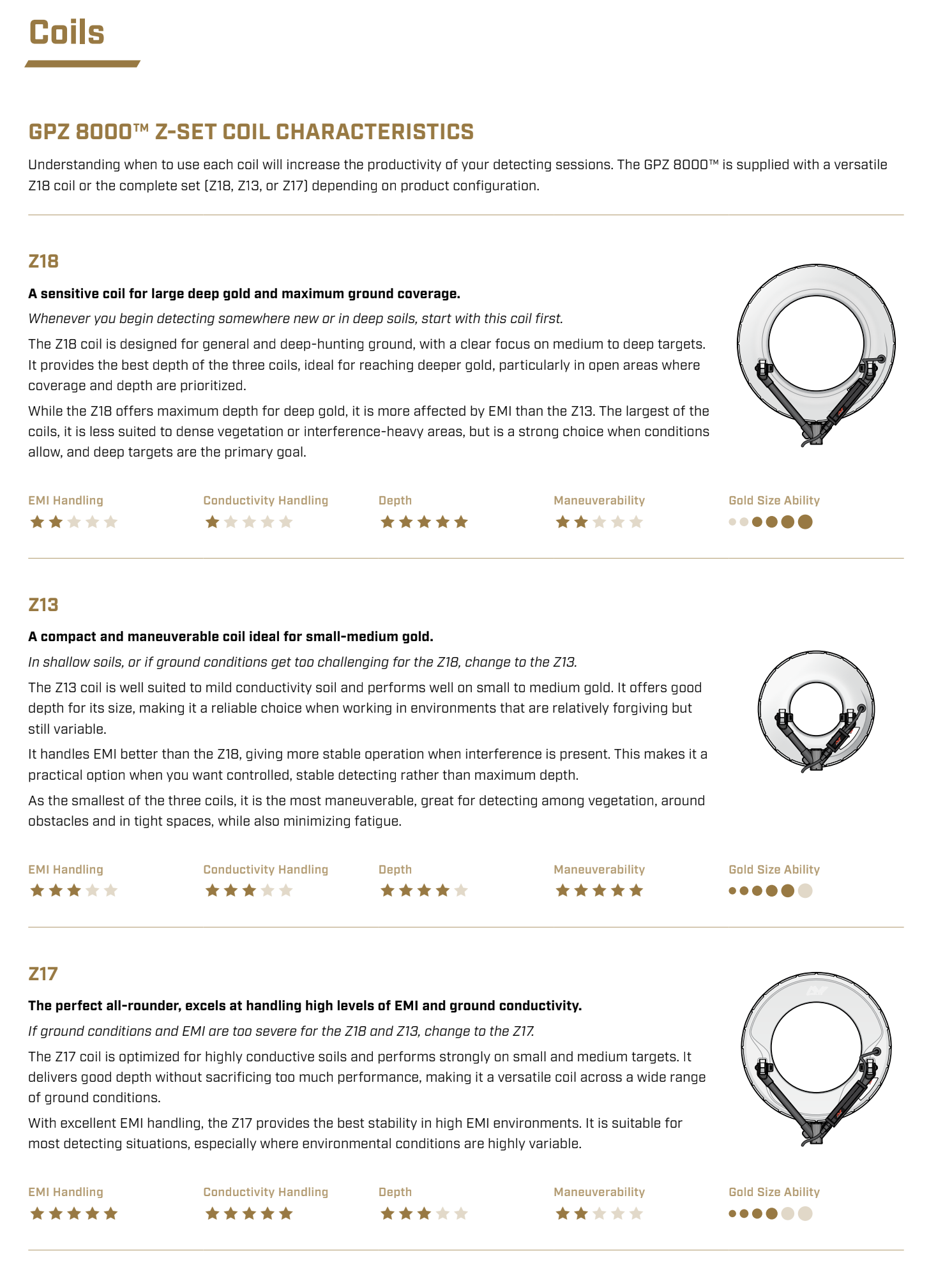
If anyone is curious of coil weights…
Standard Weight Summary (Lbs/Oz)
As confirmed in the March 2026 release documentation, here is the official weight breakdown in standard units:
• Total Detector Weight (with standard Z18 coil): 6.1 lbs
• Z13 13-inch coil - Handles vegetation-heavy terrain with balance and minimal fatigue. Great for locating small to medium gold, Z13 13-inch Coil: Approx. 1 lb 8 oz
• Z17 17-inch coil - Excels in high EMI and conductive soils, achieving stable performance and strong target response on small to medium gold, Z17 17-inch Coil: Approx. 1 lb 14 oz
• Z18 18-inch coil - Covers diverse ground and reaches deep soil layers, detecting larger gold while maintaining maximum depth, Z18 18-inch Coil (Standard): Approx. 2 lbs 7 oz
- Joined
- Apr 9, 2007
- Messages
- 639
- Reaction score
- 544
- Golden Thread
- 0
- Primary Interest:
- All Treasure Hunting
RE post #187:
The video is revealing!
I'm sure the dealers left impressed with the pinpointing capability of the 8000 on sunbaker iron particles!
- Geowizard
The video is revealing!
I'm sure the dealers left impressed with the pinpointing capability of the 8000 on sunbaker iron particles!
- Geowizard
- Joined
- Apr 9, 2007
- Messages
- 639
- Reaction score
- 544
- Golden Thread
- 0
- Primary Interest:
- All Treasure Hunting
Sales Engineers and "the art of the pitch";
Geophysical Well logging in the oil patch...
After advancing from electronic bench tech in Kenai, Alaska to field engineer, then training engineer at company headquarters in Houston, I eventually found myself in the role of Sales Engineer, making cold calls, knocking on doors of "Company Men" at oil rigs all over the Rockies. I drove every dusty rig road to oil wells all over Wyoming, Colorado, Kansas, Nevada, Montana and Utah. I became a "Land Man" similar to the movie.
How?
I discovered the Log library in Denver. I knew interpretation of well logs. As a Professional Well Log Analyst, I discovered undiscovered Black Gold, Texas Tea.
I mastered the art and science of oil and oil wells. I mastered "the art of the pitch".
- Geowizard
Geophysical Well logging in the oil patch...
After advancing from electronic bench tech in Kenai, Alaska to field engineer, then training engineer at company headquarters in Houston, I eventually found myself in the role of Sales Engineer, making cold calls, knocking on doors of "Company Men" at oil rigs all over the Rockies. I drove every dusty rig road to oil wells all over Wyoming, Colorado, Kansas, Nevada, Montana and Utah. I became a "Land Man" similar to the movie.
How?
I discovered the Log library in Denver. I knew interpretation of well logs. As a Professional Well Log Analyst, I discovered undiscovered Black Gold, Texas Tea.
I mastered the art and science of oil and oil wells. I mastered "the art of the pitch".
- Geowizard

- Joined
- Mar 16, 2011
- Messages
- 15,108
- Reaction score
- 20,200
- Golden Thread
- 1
- Location
- San Diego
- 🥇 Banner finds
- 1
- Detector(s) used
- Equinox 800/900, Fisher Impulse AQ, E-Trac, 2 Excal 1000's, White's TM808, VibraProbe, 15" NEL Attack, Mi6, Steath 920ix and 720i scoops, TRX, etc....
- Primary Interest:
- All Treasure Hunting
Is this what us lay people consider the "halo" around a degrading target? All of us have had a target that initially sounded good, only to have it disappear or sound/read completely different after removing some of the surrounding ground matrix.PI detectors have long had some amount of iron ID when using a DD coil than can look at reactive signals during TX. The problem is that iron is not purely magnetic-reactive, it often has a resistive eddy component. And at depth, the eddy component may dominate the RX signal making deep iron look non-ferrous. Which is exactly what you get with both PI and VLF.
- Joined
- Apr 9, 2007
- Messages
- 639
- Reaction score
- 544
- Golden Thread
- 0
- Primary Interest:
- All Treasure Hunting
Minelab and the art of the pitch;
Early in California history was the discovery of Gold at Sutters Mill and the American River. Prospectors needed shovels! The shovel was the tool and prospectors bought them by the boat loads.
Minelab needs to back up their marketing with more than BS. Metal detecting, prospecting and exploration for gold is expensive. We expect more bang for the buck and we should get it. If Minelab expects sell GPZ 8000's and we could see a tool worthy of the bucks, we would be buying GPZ 8000's like shovels!
- Geowizard
Early in California history was the discovery of Gold at Sutters Mill and the American River. Prospectors needed shovels! The shovel was the tool and prospectors bought them by the boat loads.
Minelab needs to back up their marketing with more than BS. Metal detecting, prospecting and exploration for gold is expensive. We expect more bang for the buck and we should get it. If Minelab expects sell GPZ 8000's and we could see a tool worthy of the bucks, we would be buying GPZ 8000's like shovels!
- Geowizard
- Joined
- Apr 9, 2007
- Messages
- 639
- Reaction score
- 544
- Golden Thread
- 0
- Primary Interest:
- All Treasure Hunting
AI Overview
Sutter's Mill was a water-powered sawmill owned by John Sutter and built by James Marshall in Coloma, California, on the South Fork of the American River. On January 24, 1848, Marshall discovered gold in the mill's tailrace, sparking the California Gold Rush. This site is now part of the Marshall Gold Discovery State Historic Park.
Key Details About the Site and Discovery:
They didn't have AI... They didn't need it.
- Geowizard
Sutter's Mill was a water-powered sawmill owned by John Sutter and built by James Marshall in Coloma, California, on the South Fork of the American River. On January 24, 1848, Marshall discovered gold in the mill's tailrace, sparking the California Gold Rush. This site is now part of the Marshall Gold Discovery State Historic Park.
Key Details About the Site and Discovery:
- Location: The mill was located in Coloma, CA, approximately 40 miles east of Sutter’s Fort in Sacramento, positioned along the South Fork of the American River.
- The Discovery: James Marshall found flakes of gold in the tailrace—the channel that carried water away from the sawmill wheel—on January 24, 1848.
- Purpose: The mill was constructed to supply lumber for John Sutter's expanding settlement (Nueva Helvetia/Sacramento) and to support incoming American migration.
- Impact: The discovery triggered a massive migration of "forty-niners" to California in 1849, leading to rapid population growth and California's statehood in 1850.
- Current State: Today, the site of the mill and discovery is protected within the Marshall Gold Discovery State Historic Park, which features exhibits about the event.
They didn't have AI... They didn't need it.
- Geowizard
- Joined
- Apr 9, 2007
- Messages
- 639
- Reaction score
- 544
- Golden Thread
- 0
- Primary Interest:
- All Treasure Hunting
Cudamark,Is this what us lay people consider the "halo" around a degrading target? All of us have had a target that initially sounded good, only to have it disappear or sound/read completely different after removing some of the surrounding ground matrix.
Halo is spot on!
Gold is easy to find if we know what to look for. Early Spaniard explorers searched for Gold and Silver. They looked for "Halos" visible to the casual observer. The Halos are the product of decomposing Iron that forms iron oxides having colors of orange, red and brown depending on chemistry. Iron it turns out is a very common associated mineral that decomposes creating a Gossan or Halo.
The signal depends on the detector. Ground balancing changes the detection threshold, Removing the surrounding iron mineralization (matrix) changes the signal. If the iron matrix is removed, the signal should be expected to shift phase toward Gold in VLF or add depth in the GPZ 8000.
- Geowizard
Last edited:
- Joined
- Mar 19, 2003
- Messages
- 2,676
- Reaction score
- 3,337
- Golden Thread
- 0
- Location
- Washington
- Detector(s) used
- Custom Designs and Prototypes
- Primary Interest:
- All Treasure Hunting
Halo effect is different. Halo effect is when the eddies generated in a target spread out into the surrounding soil. This can be caused from the target itself leaching conductive ions or oxides into the soil, or because the soil was already conductive (like wet salt sand). This might explain why someone digs up a target 12" deep but in air it is only detected at 10".Is this what us lay people consider the "halo" around a degrading target? All of us have had a target that initially sounded good, only to have it disappear or sound/read completely different after removing some of the surrounding ground matrix.
When a target reads differently after soil is removed it's probably because the soil caused a phase rotation of the TX signal that, likewise, caused a phase rotation of the target response. When the soil is removed, the extra phase rotation is removed. This is especially noticeable in viscous soils which can hold/release magnetic fields.
In cases where you dig and the target disappears, this can be completely corroded iron/steel that, in situ, supported eddy currents but when dug got obliterated and the signal disappears. It can also be caused by mineral pockets. Ferinstance, some of the gold areas I hunt have seen wildfires where a hot coal falls to the ground, bakes a small pocket of ferric dirt into maghemitic dirt, and the pocket then behave essentially like a hot rock. You get a signal but when you dig, it disappears.
Jennifer-007
Full Member
- Joined
- Mar 27, 2010
- Messages
- 204
- Reaction score
- 675
- Golden Thread
- 0
- Detector(s) used
- Minelab, GPX, GPZ, Garrett Axiom, Falcon MD-20, Heckler Fabrication 30+ Ton Per Hour Trommel, Kubota M62 TLB, 6 tray commercial dry washer / dry blower.
- #196
Thread Owner
A nice ounce full from the Nevada gold fields, with an 8000.
https://forums.robsdetectors.com/topic/17882-first-ounce-with-the-gpz-8000/
Jen
https://forums.robsdetectors.com/topic/17882-first-ounce-with-the-gpz-8000/
Jen
- Joined
- Apr 9, 2007
- Messages
- 639
- Reaction score
- 544
- Golden Thread
- 0
- Primary Interest:
- All Treasure Hunting
Another excellent lead-in!
Thanks, Jen!
Rye patch:
It's small, shallow gold and mostly bullet fragments.
Rye Patch, Nevada, natural gold typically has a purity of around 79–85%, with the remaining composition largely made up of silver and small amounts of iron. This Nevada gold is known for being relatively high-purity, yet it is rarely absolute, often containing natural impurities that give it a paler color compared to refined gold.
No introduction needed:

 www.youtube.com
GPZ 8000 GPZ 7000 GPX 5000 The absolute must watch video for all prospectors.
Poseidon Diggers 2nd video testing the GPZ-8000 is up and this is my analysis.
Four days ago:
Even MORE Gold! GPZ8000 Nugget Depth SUPERTEST 2
Game over!
- Geowizard
Thanks, Jen!
Rye patch:
It's small, shallow gold and mostly bullet fragments.
Rye Patch, Nevada, natural gold typically has a purity of around 79–85%, with the remaining composition largely made up of silver and small amounts of iron. This Nevada gold is known for being relatively high-purity, yet it is rarely absolute, often containing natural impurities that give it a paler color compared to refined gold.
No introduction needed:
DetectorMods
Minelab repairs and modifications, i have been detecting since 1980 and found hundreds of thousands worth of gold nuggets. I build highly modified detectors so to give prospecting a greater chance of life changing finds. I make the worlds best detector technology better. So you want to find...
www.youtube.com
GPZ 8000 GPZ 7000 GPX 5000 The absolute must watch video for all prospectors.
Poseidon Diggers 2nd video testing the GPZ-8000 is up and this is my analysis.
Four days ago:
Even MORE Gold! GPZ8000 Nugget Depth SUPERTEST 2
Game over!
- Geowizard
Last edited:
- Joined
- Apr 9, 2007
- Messages
- 639
- Reaction score
- 544
- Golden Thread
- 0
- Primary Interest:
- All Treasure Hunting
Deliberate;
Wyatt Earp's father according to the narrative in the movie Tombstone, was a Territorial Judge. He explained to a young Wyatt; "Deliberate before you pull the trigger". Later in the movie, after the OK corral shootout and having a brother murdered by the Clantons, Wyatt set out to seek revenge by eliminating the Clantons. He completed that with one exception. The exception was a young, unarmed Clanton running away alone on foot.
Buyers of the latest, greatest, whiz-bang metal detectors owe ourselves the responsibility to deliberate before pulling the trigger!
I was "out" after the Minelab Dealers only show listening to the pitch in broken english and later watching demonstrations of detectorists scratching the surface of the dirt for trash. That combined with comparative testing by the Poseidon Diggers where the 5000/25" double-D combination outperformed the zed 8000. Yes, I have been to the land "down under" and I didn't meet any women that made me nervous! Back in the Stone Age, I was training auditoriums full of crazy Aussie Ag pilots about precision GPS navigation systems in Queensland, NSW, and Victoria. Vegemite sandwich, mate? Wanna join us for some pi$$, mate? Check unduh ye bonnet, mate? Ways ye willy bin? Closest I ever came to getting killed was looking to my left, seeing no cars and stepping out into oncoming traffic.
Being deliberate means collecting evidence, listening to testimony, weighing the evidence, reaching a verdict. You be the Judge!
- Geowizard
Wyatt Earp's father according to the narrative in the movie Tombstone, was a Territorial Judge. He explained to a young Wyatt; "Deliberate before you pull the trigger". Later in the movie, after the OK corral shootout and having a brother murdered by the Clantons, Wyatt set out to seek revenge by eliminating the Clantons. He completed that with one exception. The exception was a young, unarmed Clanton running away alone on foot.
Buyers of the latest, greatest, whiz-bang metal detectors owe ourselves the responsibility to deliberate before pulling the trigger!
I was "out" after the Minelab Dealers only show listening to the pitch in broken english and later watching demonstrations of detectorists scratching the surface of the dirt for trash. That combined with comparative testing by the Poseidon Diggers where the 5000/25" double-D combination outperformed the zed 8000. Yes, I have been to the land "down under" and I didn't meet any women that made me nervous! Back in the Stone Age, I was training auditoriums full of crazy Aussie Ag pilots about precision GPS navigation systems in Queensland, NSW, and Victoria. Vegemite sandwich, mate? Wanna join us for some pi$$, mate? Check unduh ye bonnet, mate? Ways ye willy bin? Closest I ever came to getting killed was looking to my left, seeing no cars and stepping out into oncoming traffic.
Being deliberate means collecting evidence, listening to testimony, weighing the evidence, reaching a verdict. You be the Judge!
- Geowizard
Last edited:
Jennifer-007
Full Member
- Joined
- Mar 27, 2010
- Messages
- 204
- Reaction score
- 675
- Golden Thread
- 0
- Detector(s) used
- Minelab, GPX, GPZ, Garrett Axiom, Falcon MD-20, Heckler Fabrication 30+ Ton Per Hour Trommel, Kubota M62 TLB, 6 tray commercial dry washer / dry blower.
- #199
Thread Owner
That didn’t take long… 🤣 No wonder it’s taking forever to get coils, Minelab’s selling them all on Alibaba. 🤣

- Joined
- Dec 9, 2012
- Messages
- 8,718
- Reaction score
- 22,235
- Golden Thread
- 0
- Location
- Concrete, WA
- Detector(s) used
- Nokta FoRs Gold, a Gold Cube, 2 Keene Sluices and Lord only knows how many pans....not to mention a load of other gear my wife still doesn't know about!
- Primary Interest:
- Prospecting
That didn’t take long… 🤣 No wonder it’s taking forever to get coils, Minelab’s selling them all on Alibaba. 🤣
Amazing. As is typical, China orders one unit from the actual manufacturer
and then they reverse engineer it and sell it at a massive discount....like 80%
off the actual MSRP of the bonafide unit.
There's a sucker born every minute, and no doubt many are wasting their money
buying counterfeit detectors thinking they're the real thing, and then they find out
the damn thing won't operate properly.
If you click on the "GONGCHAA GLOBAL LLC" link, you can see all the products
they're hawking at ridiculous prices. Wouldn't trust 'em for a second.


Featured Treasure Finds
Featured Treasure Finds
Similar threads

- Replies
- 15
- Views
- 3K


Users who are viewing this thread
Total: 3 (members: 0, guests: 3)













Latest Discussions
-

-

-

-
Any heathy and able "real" treasure hunters needing authentic sites.
- Latest: DIPDIZZYWIZZEL
-

