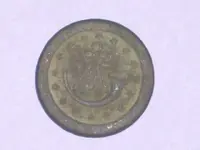
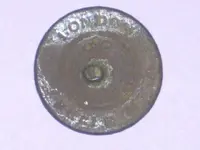
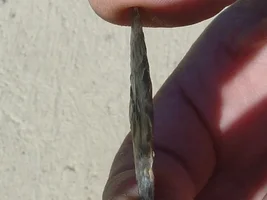
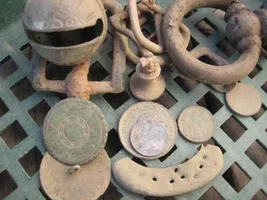
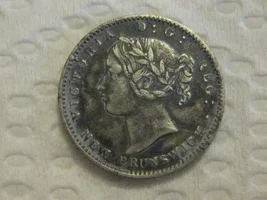
It looks to be IKECIK GILT or IKEBIK GILT...I really can't make it out&have not tried to clean it yet...when dropped it sounds like a coin&appears to be copper or brass,thin like a coin also.fyrffytr1 said:Looks like an early militia/rifleman's button. I can't make out all the wording on the back. I see London and Gilt. What is the other word?
Yes i am pretty sure now that it IS a riflemans/militia button...but will wait awhile to mark it solved,Thank's for the lead...fyrffytr1 said:Looks like an early militia/rifleman's button. I can't make out all the wording on the back. I see London and Gilt. What is the other word?
Saw a few on William Leigh button site...it appears to be a button either rev.war or war of 1812,he has them listed at $125.00-$185.00...I beleive this is solvedtokenhead said:Yes i am pretty sure now that it IS a riflemans/militia button...but will wait awhile to mark it solved,Thank's for the lead...fyrffytr1 said:Looks like an early militia/rifleman's button. I can't make out all the wording on the back. I see London and Gilt. What is the other word?
Thank youTheCannonballGuy said:No question about it, definitely "Treble Gilt."
Your button is an unknown US state's Militia Rifleman button, manufactured in England, approximately 1816-to-1830. It is button RF-26B in the Albert button-book.
On a 19th-century button's backmark, the term "plate" or "plated" means silver plating (not gold, which was termed "gilt"). I mention that because particularly regading a Treble-plated (triple-plated) button, careful cleaning may reveal an appreciable amount of silverplate still remaining on it, mainly in the recessed areas on the button's face.
Again...Thank You !TheCannonballGuy said:You're welcome.
About cleaning your brass button (not pewter)... I use common household ammonia -- plain ammonia, not "sudsy" or any other formula. Ammonia can be too harsh for heavily encrusted or heavily corroded buttons, so DO NOT use it unless you are absolutely certain the button can withstand it. As a precaution, dilute the ammonia 50/50 with water. Put the button in it, face-side up. Let it sit for 90 seconds, remove it, dip a toothbrush's tip into the ammonia and scrub gently. Then rinse the button thoroughly under running water, to get rid of every trace of ammonia on it. If further cleaning is needed, put the button back into the ammonia for another 60 (or 30) seconds, and repeat the gentle scrub with the toothbrush's tip. Don't forget to rinse thoroughly! It's very important not to overclean, which is why I do it in stages.