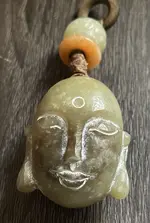
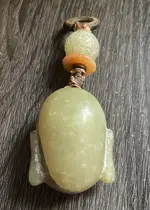
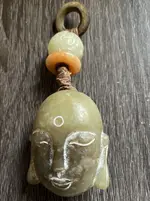
In India, a dot on a woman’s forehead indicates she is married. The stone doesn’t look like jade to me. Jade has a waxy look.
In the Hindu religion (and to some extent in Jainism and Buddhism), the dot worn by women as a sticker or an ointment is called a ‘bindi’ and an indication of married status if it’s
red. Other colours have different meanings. Men also wear a similar mark, usually called a ‘tilak’ which may be red, white or clay-based to stimulate the ‘third eye’ (ajna chakra) and enhance intuition, or for spiritual protection. Often they’re worn by both men and women during religious rituals, cultural events, or to represent a specific sect to which they belong.
In Buddhism specifically, Buddha images and bodhisattvas (compassionate, enlightened beings) have a dot on the forehead above and between the eyebrows called an ‘urna’, which may be represented as a whorl of hair, a spiral, a
circle, or sometimes a gemstone. It’s an auspicious sign of divine perception and the thirty-first physical characteristic of the Buddha. Unlike the Hindu bindi, the urna is a bodily feature, not a decorative mark.
I believe the pendant is Buddhist not Hindu, and could be
a Buddha (not
the Buddha) or a bodhisattva. Achieving Buddhahood is a state of enlightenment and a bodhisattva is someone who has made a resolution or commitment to become a Buddha after confirmation or prediction from a living Buddha that this will come to pass.
Can’t help on age or origin.