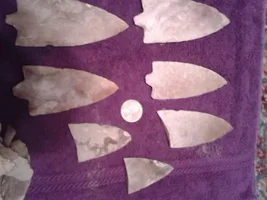
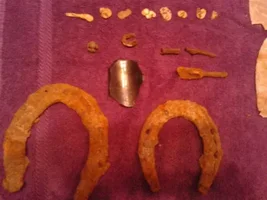
L37, below is a post you made in this Swift section, that started another thread about the mines (down from this one).
I hate to say this, but over half the carvings you mention seeing in your area were NEVER mentioned in any of the 30+ Swift's Journals I have read! Sure, there are several old carvings in different areas and several "landmarks". Again, the key is to find all of them together and in the "areas" Swift states (in relation to the mines, rockhouses, etc.). Also, from my research, Swift did NOT mention any carvings at the actual mines (nor would he have wanted to carve anything too close). The carvings Swift mentions are "on the trail to the mines" - starting at various spots in the journals and around some of the cache sites. The only indentifiers Swift ever gave that were close to the mines were shapes of rocks and descriptions of the mines themselves (ie: on a second ledge, red sandstone, opening the size of a hogshead barrel).
I have found the blue rock with three "chop marks" on it where Swift buried crowns. However, most all of the other "signs" he gives in the journals (in relation to the buried caches) were carved on trees - these are no longer standing anywhere near the blue rock. YOU, YOURSELF, stated there are no trees 250+ years old, so how did you find any of Swift's signs then?
There has been a lot added (and some subtracted) to most Swift Journals through the years. Also, I will give a few reasons in my book why the latitude and longitude numbers are NOT reliable, even if the journal one has was copied PRECISELY!
I am NOT saying you have not found a mine or mines. However, from the symbols you state, they seem to be Indian and maybe Spanish mines but NOT Swift mines - especially the 1717 carving you found (which predates Swift by decades). Also, as many Swift buffs will tell you, people made carvings in the KY mountains (and other areas) as early as the early 1800's, trying to sell land or sell someone a journal or scam money some other way. I have spoken to several people in the area I found Swift's mines and have heard stories about people, especially during the Depression, carving trees and rocks with JS and other signs supposedly associated with Swift. The few carvings I have found that I believe to be Swifts I had to hunt HARD to find as they were covered with moss from age!
Again, ALL of the Swift Journals I have read (which I believe to be from the same original source, as there are too many similarities, which I will cover in my book as well), NEVER state Swift carving anything near any of the mines!!!!
There are many carvings and petroglyphs associated with the John Swift Silver Mines, here are the ones I know of that are documented by very good sources and what I believe pertain to his upper mines, there are many, but first let me point out a few things.
I know where many of the carvings, I am going to mention are located and others approximately, because I have not been there to observe them but they are there and documented as well, by very good sources and are nearby as well. For over 30yrs I have studied the lengend, folklore and various stories and books by Paul Henson and Ralph Volker, Draper manuscripts fragments an other details etc. as well as, and most importantly the carvings and petroglyphs on my trips to the area of the mines. Some of the carvings were left by the Native Americans Indians, as well as, the many early european pioneers, traders, and miners that were with Swift, and later on possibly some of their relatives and maybe even local people who may have known or know of them presently. ( this is a good reason for one to be prudent when looking for the mines, as well as, other dangers). Over the years I have marked the locations of the various carvings and petroglyphs, that I know of, in the area that I search, on topographical quadrangle maps. I will only say that one can follow the carvings from a certain point that Swift mentions in his journal and by deduction and carefully studying their locations and extensiveness thoughout Ky, "will leave you asking some some very important questions, to yourself as it did for me. After careful scientific study through the techniques of map surveying and topo art, ("which is" using the "carvings" as small geo maps, to match the topography of the surrounding terrane) and many years of deduction and by paying close adherence to Swifts journal, by keeping in mind the landmarks and geologic structures that he mentions, that "have to be present" within the mine area, the route "he said" that "he" traveled and the objective that he was trying to find, to locate the mines on his first trip, as well as, taking into consideration the routes, trails and traces and gaps that "he said he" was using in his journal, as he came into and out of KY, and the locations of the carvings" historic markers etc., "will lead you to the area of his upper mines". This is still a very large area once you get there. It took me many years to narrow it down within the area, I have always believed them to be in, "and believe me it is a needle in a haystack". By taking the carvings and applying them to the terrane through the techniques of, (Topo art) and extensive scientific map survey of the locations of the random carvings, in my area, as well as, very good familiarity with the surrounding area and knowledge of its early and recent history, etc., I have been able to discover their location exactly. Now here are the carvings that I have studied over the years, some of them were very useful and are evidence in themselves topographically of the exact location of the "Upper mines". Remember it took many many years for me to narrow the location of the mines down, because there is much redundance in the surronding topography of the terrane, "but this is exactly why many of these carvings were used" these men were smart and knew the area very well and carefully chose these carvings so as not to give away the location of the mine, but back then they would never have dreamed of topo maps. Enough said!, here are the carvings I know of, I will try to describe them, (Blackburns Anchor, the S.J.M, the 101, the M, a dot above it, the notched "S", The lettters EP, RR and FF, the skull, the foot, the perpendicular pair of feet, the bear paw, the left hand, the shell turtle, the circular turtle with head and feet and tail, the vulva, the turkey track, the bow and arrow, the 7 and 5/8, the 102..^, the circle within the circle, the oval within and oval with two elk tracks next to it, three pair of elk tracks, the half sun with three rays, the smiling sun with sunglasses and a j-shaped mouth, 1717t, .WW., the stick man, the mans face, the indian head, the spanish soldiers head, the insect or six legged bug, the figure eight, the human figure of head and shoulders, and the most important one, " the hexagon or square compass and trowel", as well as, other carvings,,motiffs and indian symbols. These are the carvings I am familiar with and the ones I used, which proved to be enough. They are the key carvings to finding the exact location of the upper mines, and their significance pertain to the Lost "Upper "Silver Mines of Johnatan Swift. Remember in the area of the mines there must also be a lighthouse, a buffalo rock, a haystack rock, two monument rocks - (one twenty five high the other thirty five feet high) out in front of his rockhouse, which faces east, a hanging rock, a staircase, a peculiar rock, a rock that stands, a rock that leans against the cliff, all of these must be present there are other facts and details as well. All of this, I have studied and searched for over the many years and many trips to the area, and by using the science of deduction, map survey, and topo art techniques, historical evidence, etc. and great familiarity of the land and much diligent study and fun!, has finnally payed off and lead me to, the exact location of the Lost "Upper Silver Mines of Johnathan Swift. I am presently and actively persuing my discovery and (I am presently reproducing a historical chart, through map survey), which would be a facimilly or reproduction of the survey lines or important survey papers that Swift lost to the Indians when he was attacked, which may lead, "in the future " to the discovery of the lower mines and other caches buried by Johnathan Swift, hopefully!, I will keep ya'll informed, scoffers too.
Sincerily
Swifty (L37something/Johnny's Lighthouse)


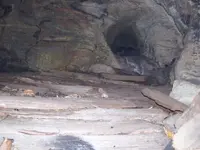
 THAT... is a WOWSTER!

 Plus, this would put the skeptics to bed!
 ?
?


 It is a known fact that the falls was "salted" to milk investors!