
You are using an out of date browser. It may not display this or other websites correctly.
You should upgrade or use an alternative browser.
You should upgrade or use an alternative browser.
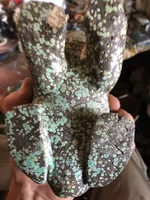
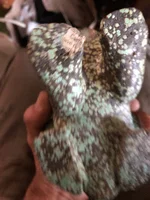
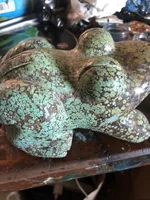
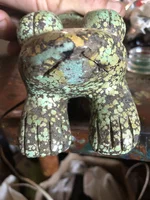
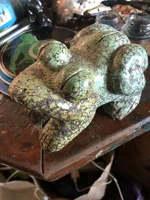
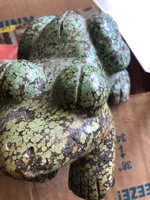
🔎 UNIDENTIFIED I found this antique frog in my family’s boxes of junk
- Thread starter rickertmork
- Start date
rickertmork
Sr. Member
- #3
Thread Owner
It’s some kind of rockIt looks kinda petrified to me with my old eye's!
Upvote
0
rickertmork
Sr. Member
- #6
Thread Owner
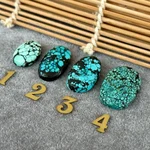
I have no infono idea behind how it was acquired? I would guess that is what is known as "African turquoise" ... a more common and less valuable stone.
Upvote
0

UnderMiner
Silver Member
- Joined
- Jul 27, 2014
- Messages
- 4,490
- Reaction score
- 12,372
- Golden Thread
- 2
- Location
- New York City
- 🥇 Banner finds
- 2
- Detector(s) used
- Minelab Excalibur II, Equinox 800
- Primary Interest:
- All Treasure Hunting
Does it croak when you pet it?
Upvote
0

AU Seeker
Silver Member
- Joined
- Oct 14, 2007
- Messages
- 2,558
- Reaction score
- 5,188
- Golden Thread
- 0
- Location
- South Carolina
- Detector(s) used
- E-Track, MXT, CZ6A
- Primary Interest:
- All Treasure Hunting
Some sort of turquoise, if it’s Chinese it could be fake turquoise. But it looks pretty good.
Looking at the photo of the bottom of the feet, it appears that one foot is chipped showing a red clay looking material, I think it made of clay with glazing that looks like turquoise.no idea behind how it was acquired? I would guess that is what is known as "African turquoise" ... a more common and less valuable stone.
That being said the photos are not in focus and get very blurry when enlarged, so without better photos it's really hard to determine what it is.
Age would be hard to determine IMHO.
Upvote
0
rickertmork
Sr. Member
- #9
Thread Owner
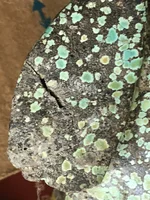
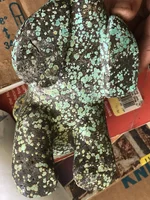
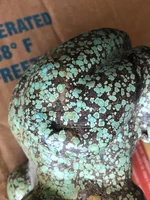
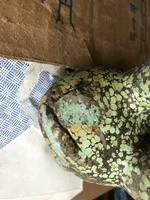
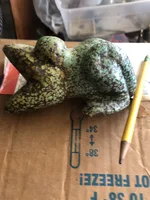
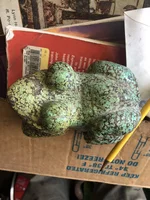
Better pictures, my grandpa was an interior designer and would get old foreign nick nacks, that’s probably what it is. But they bit the dust so I can’t ask them.
Attachments
Upvote
0
AU Seeker
Silver Member
- Joined
- Oct 14, 2007
- Messages
- 2,558
- Reaction score
- 5,188
- Golden Thread
- 0
- Location
- South Carolina
- Detector(s) used
- E-Track, MXT, CZ6A
- Primary Interest:
- All Treasure Hunting
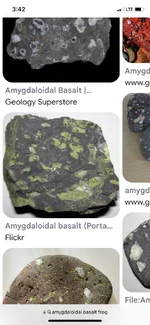
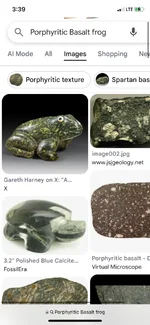
I'm not seeing what I thought I saw in your other photos now that I see these better photos, I do now think it is indeed some type of stone, what type I'm not sure but it appears to be some type of a basalt based stone, such as Amygdaloidal Basalt, Porphyritic Basalt or Volcanic Porphyry sometimes called Galaxy Stone (mistakenly called "black pudding stone").
Still hard to say how old and where it was carved.
Still hard to say how old and where it was carved.
Upvote
0

unclemac
Gold Member
- Joined
- Oct 12, 2011
- Messages
- 8,077
- Reaction score
- 9,408
- Golden Thread
- 0
- Primary Interest:
- Beach & Shallow Water Hunting
African Turquoise (Jasper) – Rainbow Minerals
 rainbowminerals.com
Upvote
0

- Joined
- Feb 3, 2009
- Messages
- 52,538
- Reaction score
- 208,619
- Golden Thread
- 1
- Location
- Eastern Ontario Canada
- 🥇 Banner finds
- 1
- Detector(s) used
- Deus, Deus 2, Minelab 3030, E-Trac,
- Primary Interest:
- Relic Hunting
Take a Qtip, dip it in acetone. Rub in a spot where it won't be seen. Look at the tip to if there's any color on it.Looks very old
The other thought it's from Japan.
The heavy, high-gloss "all-over crackle" texture and spotting are characteristic of specific retro mid-century pottery techniques—often seen in vintage Japanese celadon or studio art pottery—which were intentionally crafted to mimic the organic matrix and varying matrix patterns found in natural gemstones like turquoise.
Upvote
0
AU Seeker
Silver Member
- Joined
- Oct 14, 2007
- Messages
- 2,558
- Reaction score
- 5,188
- Golden Thread
- 0
- Location
- South Carolina
- Detector(s) used
- E-Track, MXT, CZ6A
- Primary Interest:
- All Treasure Hunting
I respectively disagree, if you look at the bottom of the frog in his last photos, you can see where some of the "turquoise" looking stones have fallen out of the matrix leaving an exact impression of those pieces, also you can see that the matrix/black stone has vesicles in it very characteristic of basalt/volcanic stone.Take a Qtip, dip it in acetone. Rub in a spot where it won't be seen. Look at the tip to if there's any color on it.
The other thought it's from Japan.
The heavy, high-gloss "all-over crackle" texture and spotting are characteristic of specific retro mid-century pottery techniques—often seen in vintage Japanese celadon or studio art pottery—which were intentionally crafted to mimic the organic matrix and varying matrix patterns found in natural gemstones like turquoise.
At first impression before the latest photos, I thought it was chips of turquoise blended in a resin of some sort and roughly casted as the frog and then final shaped and polished.
Last edited:
Upvote
0
rickertmork
Sr. Member
- #16
Thread Owner
Are you saying that the turquoise were placed in the holes like concrete or something?I respectively disagree, if you look at the bottom of the frog in his last photos, you can see where some of the "turquoise" looking stones have fallen out of the matrix leaving an exact impression of those pieces, also you can see that the matrix/black stone has vesicles in it very characteristic of basalt/volcanic stone.
At first impression before the latest photos, I thought it was chips of turquoise blended in a resin of some sort and roughly casted as the frog and then final shaped and polished.
Upvote
0
- Joined
- Feb 3, 2009
- Messages
- 52,538
- Reaction score
- 208,619
- Golden Thread
- 1
- Location
- Eastern Ontario Canada
- 🥇 Banner finds
- 1
- Detector(s) used
- Deus, Deus 2, Minelab 3030, E-Trac,
- Primary Interest:
- Relic Hunting
Well there's 2 tests to perform.
1) acetone
2) Hot needle
Once those 2 tests are performed we can eliminate a few theories.
So if @rickertmork can do these 2 simple tests it might provide the answer.
1) acetone
2) Hot needle
Once those 2 tests are performed we can eliminate a few theories.
So if @rickertmork can do these 2 simple tests it might provide the answer.
Upvote
0
AU Seeker
Silver Member
- Joined
- Oct 14, 2007
- Messages
- 2,558
- Reaction score
- 5,188
- Golden Thread
- 0
- Location
- South Carolina
- Detector(s) used
- E-Track, MXT, CZ6A
- Primary Interest:
- All Treasure Hunting
Not necessarily, if this is indeed any of the types of stone I mentioned or other similar types of stone, the matrix and the green pieces got mixed together thousands or possibly millions of years ago and over time became a solid piece, but since the matrix and the green pieces are different types of stone some of the green pieces separated from the matrix.Are you saying that the turquoise were placed in the holes like concrete or something?
We still don't know if the green pieces are turquoise, so I will not be calling them that again.
That being said if this is actually chips of turquoise or some other green stone blended in a resin of some sort and roughly casted as the frog and then final shaped and polished, then yes that could be what it is.
Upvote
0
AU Seeker
Silver Member
- Joined
- Oct 14, 2007
- Messages
- 2,558
- Reaction score
- 5,188
- Golden Thread
- 0
- Location
- South Carolina
- Detector(s) used
- E-Track, MXT, CZ6A
- Primary Interest:
- All Treasure Hunting
You might want to explain to him how to do those tests.Well there's 2 tests to perform.
1) acetone
2) Hot needle
Once those 2 tests are performed we can eliminate a few theories.
So if @rickertmork can do these 2 simple tests it might provide the answer.
Upvote
0
- Joined
- Feb 3, 2009
- Messages
- 52,538
- Reaction score
- 208,619
- Golden Thread
- 1
- Location
- Eastern Ontario Canada
- 🥇 Banner finds
- 1
- Detector(s) used
- Deus, Deus 2, Minelab 3030, E-Trac,
- Primary Interest:
- Relic Hunting
I did in post #14 for the 1).You might want to explain to him how to do those tests.
Thought the #2 was self explanatory.
He can read post #14 again.
For #2 Get a sewing needle hold it with a pair of pliers on the thread hole end. He's the pointed end red hot. Press the needle in a spot where you can't see it. If the needle goes in then you know it's a plastic or resin made object.
It's called process of elimination in doing tests on objects. Simple quick send effective.
Been doing acetone tests for decades on stones. If you see color it's dyed.
Turquoise is one, lapis is another one they dye.
Upvote
0





Featured Treasure Finds
Featured Treasure Finds
Similar threads


Users who are viewing this thread
Total: 1 (members: 0, guests: 1)












Latest Discussions
-

-
-
-
 Rare Color Dr Townsend’s Sarsaparilla Albany NY quatrefoil Iron Pontil
- Latest: Harry Pristis
-

