What's new

I have a feeling this will be a Tough One...

BuckleBoy

Platinum Member
Joined
Jun 12, 2006
Messages
18,159
Reaction score
9,723
Golden Thread
4
Location
Moonlight and Magnolias
🥇 Banner finds
4
Detector(s) used
Fisher F75, Whites DualField PI, Fisher 1266-X and Tesoro Silver uMax
Primary Interest:
All Treasure Hunting
Hello All,


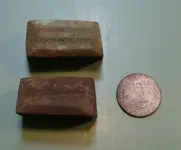
These brass pieces seem to be fairly common finds. I have found two, and two of my buddies have found one each. One was found in a Civil War site, and the others were found at homesteads, so I'm leaning towards farming-related for an ID. Now to figure out what the heck they went on... :icon_scratch:


I feel certain that others must have dug examples of these pieces. Does anyone else have one to post to this thread?


Dates of the sites may not matter as much (like the scythe handle ferrule from earlier this year), since these could've been lost after a site was turned into farm land... but these were all found at 1850s to 1880s sites. So there's at least a rough time frame to work with.

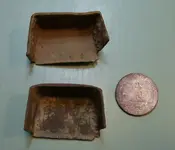
Below are some photographs from several angles:

1. an angle showing the Edge and the Top of these items

2. a photo of the Top only

3. a photo of the Closed Side of these (there are two grooves in one of them, and there is one groove in the other. The other side of these items is open.)

4. a photo of the Bottom.


I hope this will be an easy ID for someone, but I've studied these these items for several years now with no ID yet, so it may be a long road ahead.
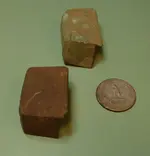
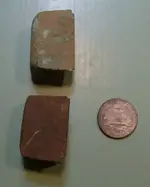
brass.webp

brass1.webp

brass2.webp

brass3.webp


Thanks in advance for your help. I'm excited to hear your ideas.


Regards,


Buckles
 
Upvote 0
Upvote 0
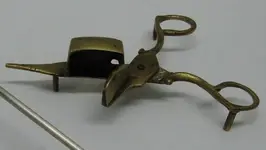
A Ha!

:icon_thumleft: :icon_thumleft: :icon_thumleft:


wick trimmer.webp


Looks dead on to me. What do y'all think?
 
Upvote 0
Thanks Jim, thanks Cheyenne.
 
Upvote 0
Montana Jim said:
I'd feel confortable calling that a "great" ID... nice work johnnyi :coffee2:

Yes, that is one of the most Miraculous ID's I've ever seen. I thought it would take a hundred replies for it to get solved.

Bravo, Johnny!


I also wonder what happened to the rest of these wick trimmers. Would there be any practical reason to convert them to shears by breaking the snuffer part off? I don't think they actually have sharp blades on them at all... It seems odd that the rest of them are not often found.

I would bet that a vigilant digger would recognize this piece in their unknown brass bin after reading this post.


Again, nice work everyone. I have one more frustrating relic that I'll post in the coming days.


:thumbsup:
 
Upvote 0
BuckleBoy said:
I also wonder what happened to the rest of these wick trimmers. Would there be any practical reason to convert them to shears by breaking the snuffer part off? I don't think they actually have sharp blades on them at all... It seems odd that the rest of them are not often found.

I am assuming that the little brass box's only purpose was to capture the trimmed wick so as not to get the sooty ashes on things, but I can see where in dimly lit spaces the box would make it hard to see what you was doing and maybe was just broken off so that visibilty was better. The wick trimmer went on being a wick trimmer only minus the capture box.
 
Upvote 0
72cheyenne said:
BuckleBoy said:
I also wonder what happened to the rest of these wick trimmers. Would there be any practical reason to convert them to shears by breaking the snuffer part off? I don't think they actually have sharp blades on them at all... It seems odd that the rest of them are not often found.

I am assuming that the little brass box's only purpose was to capture the trimmed wick so as not to get the sooty ashes on things, but I can see where in dimly lit spaces the box would make it hard to see what you was doing and maybe was just broken off so that visibilty was better. The wick trimmer went on being a wick trimmer only minus the capture box.

I had assumed that the box was the snuffer part--sort of a 2 in 1 tool. But perhaps the box also made them unweildy?


I guess it could always be that the brass box was poorly connected to the rest of the tool...but I feel certain that the boxes did not receive much rough use. After all, how much force is required to trim a candle wick or snuff one out? I think these were pretty obviously removed and discarded.

Lost to history, perhaps.


8)
 
Upvote 0
BuckleBoy said:
72cheyenne said:
BuckleBoy said:
I also wonder what happened to the rest of these wick trimmers. Would there be any practical reason to convert them to shears by breaking the snuffer part off? I don't think they actually have sharp blades on them at all... It seems odd that the rest of them are not often found.

I am assuming that the little brass box's only purpose was to capture the trimmed wick so as not to get the sooty ashes on things, but I can see where in dimly lit spaces the box would make it hard to see what you was doing and maybe was just broken off so that visibility was better. The wick trimmer went on being a wick trimmer only minus the capture box.

I had assumed that the box was the snuffer part--sort of a 2 in 1 tool. But perhaps the box also made them unweildy?


I guess it could always be that the brass box was poorly connected to the rest of the tool...but I feel certain that the boxes did not receive much rough use. After all, how much force is required to trim a candle wick or snuff one out? I think these were pretty obviously removed and discarded.

Lost to history, perhaps.


8)

I'm not very knowledgeable on things such as this, so therefore I have done a little research and reading. The wick trimmer that these pieces came off of I am sure were designed to trim the wicks on oil lamps, not candles. I searched Google patents looking at wick trimmers and although I didn't find an exact match, I did see references to "capture devices" being incorporated into the designs of some of the trimmers. I am almost certain that the little box part of the trimmer was designed as a capture device more so than a snuffer, as some if not most oil lamps you could roll down the wick into the lamp to snuff it out. Although its design could be used as a snuffer also. It is amazing how inventors can design such a simple tool to be so multipurpose.

On another thought as to why they seemed to be removed, maybe the "capture device" was in the way of sharpening the trimmer, therefore broken off to make sharpening the blade more accessable.

As you said, lost to history. :'(
 
Upvote 0
72cheyenne said:
On another thought as to why they seemed to be removed, maybe the "capture device" was in the way of sharpening the trimmer, therefore broken off to make sharpening the blade more accessable.

That is a Very good possibility.
 
Upvote 0

Similar threads

Users who are viewing this thread

Back
Top Bottom