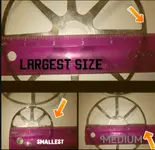
A few random thoughts - maybe they might help?
Whatever these are, I agree the indexing key probably means they went on a shaft.
Interesting, each size has a different style indexing key. Hum...?

They are also light weight -- possibly that's an essential clue? (Why spend the extra labor to cut out the wedges if not to save weight?)
If this is tin or aluminum, I'm not sure if any money is saved in raw material, even if you account for the recycled scrap (i.e., the wedges themselves, once punched out).
In other words, why not just make a solid disk with a central notched or keyed hole? (Perhaps this is to provide a visual indication..?)
Regardless of size, there are (8) wedges to each wheel. Any reason for this?? Hum...?
I've been working on the assumption that the spokes are intended as a material carrier while in-motion. (Sort of like the cassette tape and film ideas already presented.)
However, any chance the materials go "through" the wedge openings? (Seems unreasonable if the mystery material to be held or transported by this object is subject to cuts or abrasions, etc..)
The mid-size design does not have tapered spokes, but the other two do.
Not sure if that means anything - it's just an observation.
Do we know the exact diameters of each disk?
I'm just wondering if they go up in size by an "obvious" factor... maybe the square root of 2, or something related to an aperture value, etc..
Are there in-between (or larger, smaller) sizes "missing", and not yet unearthed?
Compared to the spoke diameter, the thickness of the outside circumference is not very substantial.
This leads me to conclude that if this device is a carrier, or separator, for a material to be transported (unwound, etc..), whatever that is must not be very heavy (else that measurement would be more substantial).
Maybe the indexing keys are to prevent incorrect association with an end device, designed to accept a wide range of attachments.
For example, old-time screw-in fuses had slightly different diameters, threads, or electrode depths to prevent inserting the wrong value fuse into a fusebox circuit.
Something along those lines.... does the keyed index here perform a similar "preventative" function, or it is just coincidental?
I do like the idea of a cassette tape wheel, (audio, film, etc...) but all the ones I'm familiar with do not have centers like this.
And in the case of audio cassette tapes, those are usually plastic, not metal (and don't look like this anyway.)