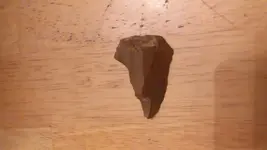
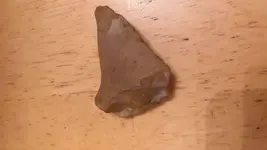
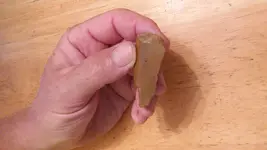
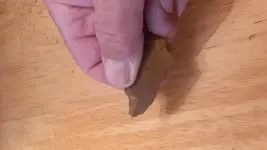
Let’s just assume, for the sake of argument, that the flake in question is a man made flake.
Are you making the point to say that there is no way to know if a random flake had been utilized?
Or that there is no way to know if it hasn’t?
And to take it a step further, are you confusing purpose of manufacture with random or possible function?
In other words, It could have been used to do X, therefore it must have been made to do X?
Fair enough.
The Piled-Higher-and-Deeper among us drive me nuts with their fragmented perspective that reduces everything they deal with to abstract ideas they can logic-chop to their hearts' content. They seem to imagine that reality is a mosaic of conclusions drawn from little, independent considerations. Same pattern as biology showed 50 years ago : all they could do was kill things and dissect them into smaller and smaller units. But they were marketing that as "Biology," which purported to be the study of
living organisms.
1) You know that it was found 125 miles from the lithic source. What does that tell you about the likelihood of its being produced intentionally ? Ditto the likelihood that an exceptionally far-ranging wanderer found it, decided it would be useful back home and carried it home with him ? (Subsidiary consideration : how many "natural" flakes show bulbs of percussion trimmed away like that one does ?) Many puzzling questions have pretty obvious answers when considered from a wider perspective.
Is there any way to know if it had been used ? As an abstract question, that depends on what it was used for. As in the replication cases Bob Patten cited years ago. But in this case, the damage (apparent use-wear) along one edge, in conjunction with the absence of this on the other edge is suggestive.
Could-have-been-used
vs. was-used is a real PhD-type concern. The study of the past went to ruination when Boas hijacked it & re-focused its objective as the discovery of cultural behaviors. Which is howling idiocy in light of the fact that social organization, culturally-specific beliefs and the rest of it (except in rare cases like trophy head hunting) do not leave diagnostic evidence to be discovered -- only remains that can be conjecturally interpreted as evidence of them. The whole thing's a snipe hunt to keep people unable to think anything through occupied with futility lest they start asking real questions and disturb business as usual.
As for possible function, would you expect it to have been suitable for use cutting down a tree and shaping it into a canoe ? Such questions tend to answer themselves. And reach the point of being absurd when it's considered that their survival strategy involved,probably, a hundred specific tasks we can't visualize or even imagine because we're too far-removed from them, technologically.