What's new

Jaw Notch TRSS point

larson1951

Silver Member
Joined
Apr 8, 2009
Messages
4,974
Reaction score
3,894
Golden Thread
0
Location
North Dakota
Detector(s) used
tesoro
Primary Interest:
Other
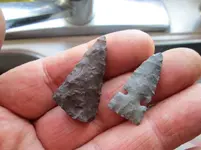
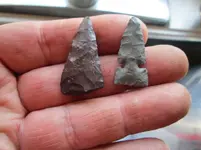
yesterday we found a jaw notch 'tongue river silicified sediment' (TRSS) arrow point
i don't know the story behind a jaw notch but gotta say they were always finely made by a master knapper and the finest material was used

the other RBSW knife (broke) is a more rare find as far as the material used (Rainy Buttes Silicified Wood).........
.....this material is found in montana and the dakotas and originates from the rainy buttes area in SW North Dakota

just FYI.....any thoughts?

larson1951

IMG_0282.webp

IMG_0284.webp
 
Upvote 0
We find those "Jaw Notch's",out here Steve.Never knew what they were called,very cool and thanks!!
 
Larson, nice side notched arrow pt. Where I'm from it would be called a Washita pt. I often wondered why they can't just generalize pt. types instead of having dozens of names for basically the same pt.
When I first started collecting artifacts I always assumed the delicate bird pts. were the hardest to make but after learning to flint knap I learned they were the easiest to make. It really doesn't take a master knapper to make a fine delicate bird pt. but it does take a master knapper to make a large thin blade. If you have ever found a wide thin blade than you know it was done by a master.
Also, love Rainy Buttes !
 
Thats a nice one Larson. Another one for a frame.
 
I agree RBSW wasn't used much. But it seems like it was used more frequently by later period cultures like the Mandans. Possibly because it was in their territory. Every tribe seemed to have their territory - where they could and could not go...

Folsom people used it a lot probably because it was in their travel routes..

Now why didn't the archaic period groups use it much...hmm... Got me thinking now..
 
Larson, nice side notched arrow pt. Where I'm from it would be called a Washita pt. I often wondered why they can't just generalize pt. types instead of having dozens of names for basically the same pt.
When I first started collecting artifacts I always assumed the delicate bird pts. were the hardest to make but after learning to flint knap I learned they were the easiest to make. It really doesn't take a master knapper to make a fine delicate bird pt. but it does take a master knapper to make a large thin blade. If you have ever found a wide thin blade than you know it was done by a master.
Also, love Rainy Buttes !


hey hey thanks kansas for your comment

i think i think my description might be a local one
this is a plains or prairie side notch point variation
what i am referring to is the design of the notch
a 'jaw notch' is different than like the white PW point i have in my avatar
i am talking about the way the specific notch is shaped and a washita does not have these type notches
the shape of the notches on this one are like a sideways 'key hole' or a 'cul-de-sac'........
...note that the inside of the notch is way larger than the entry area of the notch

i think you are right and i am wrong about the 'master knapper' thing............what i meant to say is that when we find many side notch points these with this type notch always seem to be real nice
.....one thing i cannot figure out is the term 'bird point'...........these were used for buffalo and elk.....not for birds

anybody have an idea how the 'bird point' term got started?

i think Reaper could maybe shed some light on this subject

larson1951
 
I would imagine that when people started finding bird pts., lets say 150 yrs. ago, they probably just assumed that something that small could only be used for small game. Boy were they wrong !
What amazes me is the durability of stone pts. I did a demonstration several yrs. ago for a group of archys on primitive archery. I shot stone tipped arrows through 3/8 in. plywood from a 45lb self bow. I had stone pts. of various sizes but a couple were the size of the one you found and they penetrated with no damage, in fact I have shot the same pts. several times with no damage. There were a couple of larger pts. that had minor damage but not what you would expect.
 
I would imagine that when people started finding bird pts., lets say 150 yrs. ago, they probably just assumed that something that small could only be used for small game. Boy were they wrong !
What amazes me is the durability of stone pts. I did a demonstration several yrs. ago for a group of archys on primitive archery. I shot stone tipped arrows through 3/8 in. plywood from a 45lb self bow. I had stone pts. of various sizes but a couple were the size of the one you found and they penetrated with no damage, in fact I have shot the same pts. several times with no damage. There were a couple of larger pts. that had minor damage but not what you would expect.

You are so right most small game was taken with a blunt end weapon. Most people back then could throw a mean rock.
 
Cool Finds! :thumbsup: It would appear that with a longer base before the notches would allow the point to be hafted on to the shaft allowing the point to have more strength upon penetration. With a smaller projectile, the less chance of hitting any large bones and better penetration.
 
hey hey thanks kansas for your comment

i think i think my description might be a local one
this is a plains or prairie side notch point variation
what i am referring to is the design of the notch
a 'jaw notch' is different than like the white PW point i have in my avatar
i am talking about the way the specific notch is shaped and a washita does not have these type notches
the shape of the notches on this one are like a sideways 'key hole' or a 'cul-de-sac'........
...note that the inside of the notch is way larger than the entry area of the notch

i think you are right and i am wrong about the 'master knapper' thing............what i meant to say is that when we find many side notch points these with this type notch always seem to be real nice
.....one thing i cannot figure out is the term 'bird point'...........these were used for buffalo and elk.....not for birds

anybody have an idea how the 'bird point' term got started?

i think Reaper could maybe shed some light on this subject

larson1951
Haallejua!I wrote my observation on the bird points just within the last couple days...and nobody replied,but thats OK,like you said Steve they were for much bigger game.
 
copy/paste

I am no expert but what I have seen....
I hope ya dont mind me interjecting a quip about "Bird Points",and I dont intend to step on any toes,as I know terminology is something collectors and especially archies cling tightly too......Bird points.....I am an avid archer and always have been,I have taken numerous species of bird from doves-turkeys,when taking birds one doesnt depend on blood letting like one would with larger game,but you depend on shock,a sharp object doesnt creat shock....a blunt object does(I have some blunts I will post when I get a chance)also I have read many accounts of the netting of waterfowl and Jack Rabbits(out here)In several cave excavations these nets have been found.When one calls a small pointed piece a Bird point,its an oxymoron,in my simple mind of physics and result.......several years ago I had an opportunity to take a rogue Bison Bull.....long story.....Now....I have taken Elk,sheep,bear Mt. lion,antelope,countless deer,and HUNDREDS of wild pig with a bow,so I would not take this bull with anything other than a bow.I have a close friend that has taken several Cape Buffalo with a bow as well as a Bison(that was smaller than the bull I was after)he conveyed to me that even him shooting 80 lbs(draw weight)a heavy grained arrow and a big 150 grain Zwickey Broad head he had obtained minimal penetration,which is not desirable for various reasons.I scoffed,at this advice because I had taken the majority of my big animals with 125 grain Zwickeys and Thunderheads(Brand names)well about that time I received a call from a broadhead company rep.that had heard about my future hunt and knew my "availability ",of wild hogs(which for those who dont know,hogs have a thick plate of grisle behind their shoulder that protects the vitals and will stop a magnum bullet.This rep asked me if He sent me a dozen of these new broadheads I would shoot a boar hog in the plate....I abruptly said,"NO!!!!",why would I wound a pig?Well they had done extensive field testing already including many of the toughest skinned animals in the world,he just wanted to prove it to me....I gave him the credit of the doubt and obliged.For time reasons I wont detail that hunt other than that the heads showed up...they were 100 grains and TINY,but were still over 3/4" wide,and the hog I shot was huge mature Boar with 2.5" of plate on bothe sides at 30 yards I blew completly through not only both plates but both shoulder blades(I still have one....gave the other to that company)So I was sold on these,and they are what I used on my Buffalo......my first and second shots blew completly through the bull(didnt hit bone or they would not have)After the bull was dead,we shot the 150 grain Zwickey's and several other big,long wide points into the bull as a test.....none of them got he same penetration even though they wer heavier which carries more kinetic energy......the small heads had less drag!Since then these smaller heads are all I use and the results are astounding....I strongly beleive the Indians figured this out as well and many of the "Bird Points",may very well have been for larger game......just my personal observation,and another observation I made in that whole ordeal,is that the Indians ran more Bison off cliffs then they shot with a bow and not many shot them with bows off a horse like we see in the movies!!!!They are one of the most unbeleibly tough,risiliant,FAST,and just flat awesome animals there is
 
That is awesome !!! This is a great read thanks for posting !!!!
 

Users who are viewing this thread

Latest Discussions

Back
Top Bottom