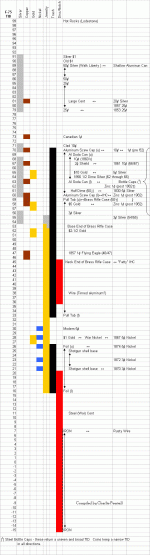
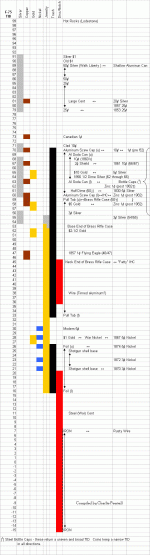
Good comments so far. My comment on this is coming from the perspective of "having been there" in the days when TID was first introduced. When Teknetics came onto the scene, we were amazed when a dealer showed us that a pulltab gave one tone, and a nickel or gold ring gave another tone! This was quite amazing back in 1982-ish, as no one had ever seen such a thing. A few friends of mine ran out and bought those early Teknetics, thinking they were going to get rich digging gold rings till their arms fell off

Needless to say, it didn't take long for the reality to sink in: There's still an aweful lot of aluminum junk that perfectly mimics gold rings! Doh! So during this time, several of us began to mock these TID units. And to this day, as Bama-Bill pointed out, people still do. Sure they're not exactly perfect! All they do is show conductivity, not actual composition. BUT, back in the mid-80s, we began to see a curious phenomenom play out: those guys with these newfangled TID machines were inevitably coming in with the better finds to the monthly meetings. It still didn't make sense to me (I still had non-TID machines). I would reason: "how stupid is that? You're going to dig it anyways, so why not just look at it when you dig it up?" or "I can reject tabs too, by just increasing the knob on my disc. control, so what?".
But now, 25+ yrs. later, having seen both sides of their evolution, I can tell you for certain, that TID (LCD as you call it) is a definate plus, even for relicky mindset guys, who plan to dig everything anyhow. Here are a few examples:
A friend of mine and I were night-hunting a plowed field in a historic area. He was using a 6000 Di pro, but since it was night, could not see his needle bounces. So effectively, he was hunting non-TID. I on the other hand, was using an Explorer. Each night, I would trounce him on good targets (reales, buttons, etc...) 3x to 1x. Neither of us was consciously passing anything conductive, so it baffled both of us why I kept beating his pants off. Afterall, this was furroughed fields, so depth wasn't the issue, and certainly, the 6000 Di pro is a good machine. Finally, we both began to see what was subconsciously happening: Since targets were prolific in this field (we never lacked signals to dig), I must have subconsciously been passing cr*ppy flitty sounds (there was some shredded aluminum little stuff), while he, with his no-tone, no-TID, was merely hearing a beep, or no-beep. Ie.: no tone fluctuations to give him any clue whatsover. So while I didn't purposefully pass anything, not even low conductors, I was being subconsciously drawn to favor signals that locked on, like coins and buttons. He on the other hand, had equal # of targets, but invariably .22 shells, foil, etc... Not that I would pass any of those, but when you don't lack for signals to dig, you subconsciouly tend to pick the "better sounding" signals. That is a near impossibility for non-tone-ID machines, because the machine either beeps, or it doesn't. Period. That is just one case where the TID machine was favorable, when there was ample targets to choose from, and limited hunt period times, even when you're not passing lows.
Another example of the merits of TID: They tore down some grandstands (blt 1920s) in my town. Underneath these bleachers, was acres of hard-pan soil, where 70+ yrs. of tabs, foil coins, etc... had rained down. Naturally, there was millions of pulltabs. And the demolition process was going to go from demo, to fill-dirt, in a matter of days. We hit it, and it was quickly clear that no one was going to be a "hero" and look for nickels. Silver was the name of the game for this short run

I was using a Whites Eagle at the time, and, as you know, it has a 1 to 95 scale. I set it to reject everything from 46 down. 46 was approximately where the larger beefier square tabs come in, so it left me with most junk tuned out, and most coins tuned in, and a happy compromise for target "averaging". Imagine my surprise when I found a $5 gold piece! My immediate thought was "wait, I thought I had gold and low conductors tuned out?". So I waived it over the coil to see where it reads: 47/48-ish! Yup, a single digit or two higher on the disc, and I would've lost it. Any lower on the disc, and I'd have spent 4 days digging tabs. So you can see how a tiny imcrement of TID pays off, in a micro-situation like this. Bear in mind that this is just one junky scenario, and in relicky situations, you can just elect to dig all, even if flitty, low, etc...
Even when/if you plan to dig-all anyhow, it's a fun rush to be in that colonial site, with no modern human influence, and see the perfect "penny/dime" signal flash across your screen


 When I swipe left to right and get a reading that is the same or within 1 digit on the return pass 99% of the time it is a good item and not trash. Just more information to decide whether to dig. In trashy sites digging every hit gets old after about an hour.