TheRingFinder
Bronze Member
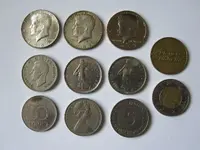
Bought 700 dollars worth of halfs - These are my finds:
1 - 1967
1 - 1969
1 - 1977 I believe it is an "S" - looks un-circulated
2 - 5 Francs - 1970, 72
1 - 5 Marks 1979
1 - Canada 2 dollar - 1996
1 - Australian 20 - 1979
1 - 50 Forint - 2001
1 - Georgivs shilling - 1948
1 - Baseball token
1 - 1967
1 - 1969
1 - 1977 I believe it is an "S" - looks un-circulated
2 - 5 Francs - 1970, 72
1 - 5 Marks 1979
1 - Canada 2 dollar - 1996
1 - Australian 20 - 1979
1 - 50 Forint - 2001
1 - Georgivs shilling - 1948
1 - Baseball token
Last edited:
Upvote
0


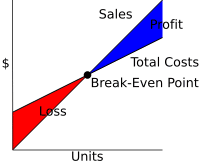
 Welcome to TNET & Coin Roll Hunting (CRH). Dollar wise you pretty much broke even. That's a total of 11 coins. If they were all sold to you as half dollars, that face value of $5.50, the 67 & 69 halfs are 40% silver which are probably worth $2.75 each, the Canadian $2 Dollar coin at todays exchange rate is worth approximately $1.90 American, I couldn't tell you the value of the other coins at this time. I don't believe the 1977 "S" is silver. I don't think it has any extra value. You could try Ebay (FeeBay) or Craigs List but I'm not very familiar with them. You would have to do more research to determine the value of the other coins but I don't think they have much value. How did you buy them? From a bank or from a person who said all the coins were half dollars? From a bank you most likely don't have any recourse. You would need to contact the private person if you bought the coins from them & they told you they were all half dollars.



 If I read your post right, you were able to buy a bag from a bank for $700. Did you buy the bag off of the machine? The bags on the machines around here hold either $500 or $1000. If a bank is willing to sell you the bag, you have to wait until the bag is filled up before they will sell it to you. The vast majority us on the site aren't able to find a bank that will sell you a bag. Don't give up on bags. You never know when you will get a collection dump. I've seen on the site where people have made great finds from bags. If you're up by the Canadian border, save all your Canadian coins for a trip to Canada. That's what I do even though I'm far from the border.