What's new

Little help needed on this one

Hill Billy

Bronze Member
Joined
Jun 3, 2007
Messages
1,769
Reaction score
76
Golden Thread
0
Detector(s) used
Whites XLT
Primary Interest:
Other
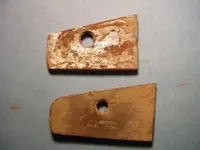
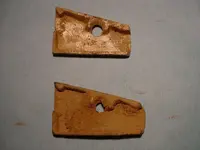
I dug both of these pieces on an early site that appears to date around 1820's-?
They are made of brass and one still has silver plating on it.
They both read W.E. Arnold PAT. 184?
They are two inches long and and inch tall and 3/16 " thick.
Does anyone know what they are?

Thanks Hill
 

Attachments

  • whatsit 005.webp
    whatsit 005.webp
    51 KB · Views: 382
  • whatsit 007.webp
    whatsit 007.webp
    68.2 KB · Views: 378
Can't find the patent, but a W.E. Arnold patented an "Endless Chain Coupling" on May 2, 1854, Pat. Number 10,852

Whether it is relevant or not to your find, I don't know????
 
Upvote 0
creskol said:
Can't find the patent, but a W.E. Arnold patented an "Endless Chain Coupling" on May 2, 1854, Pat. Number 10,852

Whether it is relevant or not to your find, I don't know????

I did find 2 links of chain made of brass. :dontknow:
Thanks, keep looking. I can't find any patents under that name.
I figured this would be a hard one to solve.
 
Upvote 0
daroofa said:
I found 1 patent in 1849 for WM. E. Arnold. Its part of a window sash. Nothing stands out as exactly matching you pieces, but it is a possibility.

http://tiny.cc/ln5om

I don't see the exact piece there but it does sound like it may be it.
After reading the patent, I'm not sure I understand how it works.
Thanks for your help Roofa
 
Upvote 0
I would almost say it looked like the inside of an old utility knife but the shape isn't exact :dontknow:
 
Upvote 0
Actually, I think others were on the right track with this one. The link above for the widow sash locks doesn't show a design which matches what you dug. It looks like the patent year is correct (1849) according to the post up above, but I can't find an 1840s patent for a sash lock (which may have the correct design). Either way, here's one from the 1860s... with a better shot of the lock itself. The patent is a later patent (1860s) but the casing looks similar to your pieces (open on both ends, and held together with a screw--See FIGURE 2).

http://www.google.com/patents?id=Ug...s&cad=1#v=onepage&q=William E. Arnold&f=false
 
Upvote 0
Upvote 0

Users who are viewing this thread

Back
Top Bottom