What's new

Lost treasure of RMS Indus 1885 Shipwreck

Crow

Silver Member
Joined
Jan 28, 2005
Messages
4,748
Reaction score
13,548
Golden Thread
0
Location
In a tax haven some where
Detector(s) used
ONES THAT GO BEEP! :-)
Primary Interest:
Other
Been kind of quiet here of late?

Perhaps a little treasure yarn is in order. So grab your favorite brew and sit by and enjoy the yarn.


In the history of nineteenth century voyages, one of the most invaluable cargoes to go missing comprised a cache of rare, ancient Buddhist sculptures, gold coins, statues and photographs of Indian archaeological sites.

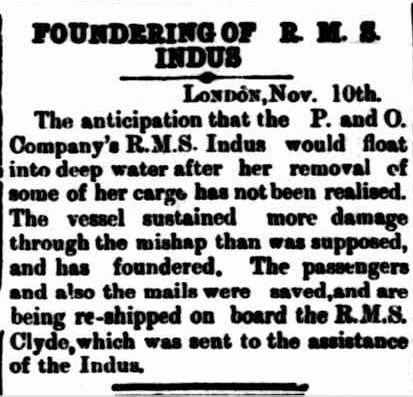
The cargo was on board the SS Indus, the P&0 (Peninsula & Orient Company) steam vessel that was wrecked off the rugged eastern coastline in proximity to Mullaitivu on November 8,1885.

In the next few days there were detailed reports of this tragic incident at sea in the Times of Ceylon and the Ceylon Observer, at a time when communication between Mullaitivu and Colombo was almost non-existent. The sinking of the SS Indus was widely reported in the Times of Ceylon of November 12,13,15 and17 and on December 1, 1885. It was also reported in the Ceylon Observer of November 14, 1885.
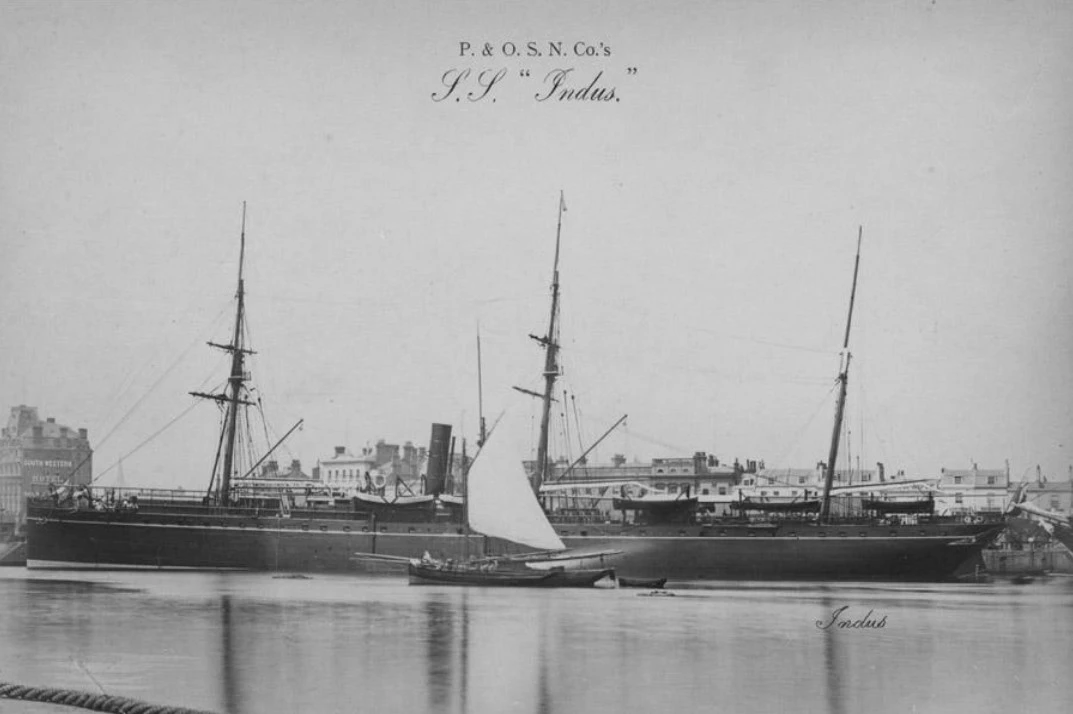
Screenshot 2026-02-15 165950.webp


Here is the newspaper below.

Screenshot 2026-02-15 170349.webp


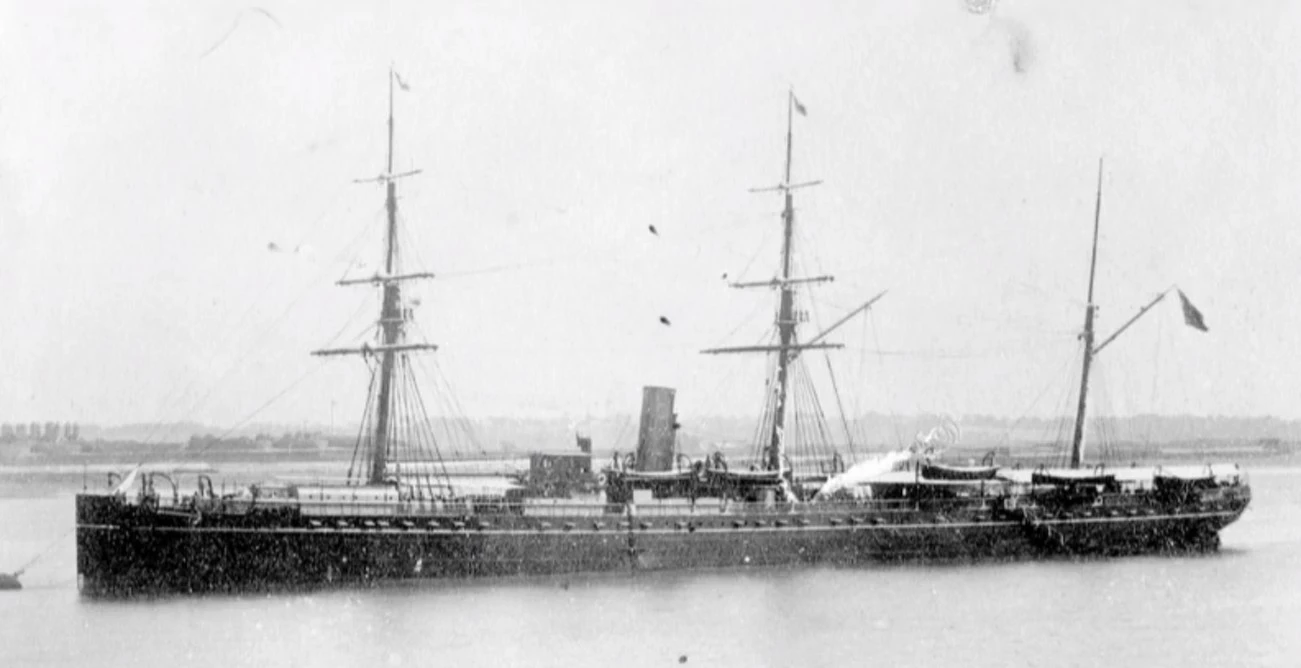
Here is another picture of the ship below.
Screenshot 2026-02-15 170609.webp


This is where there is a mystery do the wreck contain treasure or was it salvaged? The answer it not quite clear.

Crow
 
The RMS
Indus was a Peninsular & Oriental (P&O) iron-hulled steamship that sank off the north-east coast of Sri Lanka (then Ceylon) in November 1885. The ship is famous for carrying a "lost treasure" consisting of priceless 3rd-century BC Buddhist sculptures from the Bharhut Stupa, collected by Sir Alexander Cunningham. below

Screenshot 2026-02-18 190753.webp


The SS Indus was carrying a large consignment of tea and about 200 chests of indigo, as well as the valuable lifetime collection of personal items belonging to Sir Alexander Cunningham (1814-1893), the first Director-General of Archaeological Survey of India who had just retired in September 1885.

His collection of valuable artifacts to be shipped to England included artifacts from the excavation of the ancient Buddhist site of Bhahrut in North India which supposedly included relic caskets, sculptures and other related items. These were destined to the British Museum in London.

Among the consignment were items of great personal and historic value much of it collected during his travels in Northern India, present-day Pakistan and Afghanistan.

Bhahrut’s link with the early history of Buddhism is undeniably important with its unique Buddhist stupa built around 250 BC. It is known among Indian historians for each of the panels on the base were explicitly inscribed in Brahmini characters stating what each panel depicted. Cunningham visited the site in 1873 and conducted an archaeological dig there in 1874.

During the early phase of archaeological exploration under the British, there existed an unusual arrangement under which the Director was entitled to a share of the excavated items and could retain some of the artefacts unearthed. It was only in 1871, a few years after Cunningham was appointed as Director General that this unusual procedure was prohibited by a new regulation that came into force. Cunningham had amassed a lifetime’s collection of gold coins, seals, statuary, stone implements, and above all valuable photographs of various sites.

So what happened to the Bhahrut sculptures? In a letter Cunningham wrote in August 13, 1886, to Gertrude Murray Thompson (guardians of Cunningham’s grandchildren), he gave a description of part of the salvaged material that was delivered to him. He had received 18 boxes from the wreck of the SS Indus and virtually all his photographs (except a portrait of his wife), slightly damaged books and other damaged items. But of the sculptures he noted “Some half a dozen contained sculptures and old stones. The sculptures are apparently uninjured and the ancient stone implements are good as new.”

Had he been referring to the items that he had excavated from Bhahrut and part of the cargo he sent to England on the SS Indus?

Screenshot 2026-02-18 192054.webp


Screenshot 2026-02-18 192121.webp


Screenshot 2026-02-18 192155.webp


Screenshot 2026-02-18 192224.webp


But he was not 100 percent clear on what was lost and what was recovered. He recovered at least 18 water-damaged boxes of items. But it appears the coins were lost. And maybe some of the statues were lost.

Crow
 
The ‘Lost’ Treasure
Ever since the wrecking of “Indus” there was some sort of mystery surrounding the fate of Cunningham’s baggage. R.B. Whitehead, a member of the Indian Civil Service, who is better known as a numismatist, made some enquires in 1949 and received the following reply from
the P&O Company: It is not clear that any of the cargo was salved, and passengers seem to have got away with light baggage only.

You can see the letter below.

Screenshot 2026-02-18 191220.webp


Screenshot 2026-02-18 191241.webp


Crow
 
The cargo included masterpieces of early Buddhist art, including sculptures, panels, and inscriptions from the Bharhut Stupa in Madhya Pradesh, India. Most of these artifact was heavy as peice was being brought to the British Museum. Here are photographs of the scultptures be dating from the 1870s.

Screenshot 2026-02-18 184048.webp


Screenshot 2026-02-18 184343.webp


Screenshot 2026-02-18 184443.webp


Screenshot 2026-02-18 184547.webp


Sir Alexander Cunningham (1814-1893), the first Director-General of Archaeological Survey of India escavated the site. After escavation the locals robbed the site of stone to build houses. So many of these sculptures no longer exist today. There is the possibility some of these missing sculptures are only the Indus shipwreck?

Crow
 
In the 1960s, the Archaeological Commissioner of Ceylon, Charles E. Godakumbura in the annual report noted that attempts had been made by Arthur C. Clarke who led an underwater expedition to recover some of the valuable objects lost with the sinking of the SS Indus. In 1964, in his account he reported that it was not worth investing in further undersea exploration and it was likely the valuables had been already recovered.

Screenshot 2026-02-18 203039.webp


Yet that was true in part. But not in part.

Sir Alexander Cunningham noted in his letter that in his 18 boxes, three coins cased were broken and empty.

They could been looted or damaged when the ship sank with coins spilling into ships floor? An interesting piece of evidence about Cunningham’s collection on this ship comes from the pen of the Charles Godakumbura, the Archaeological Commissioner of Ceylon. In the Administration Report of the Archaeological Commissioner for the Financial year 1962-63, while reporting the work carried out by his Department in Underwater Archaeology, he writes:

The possibility of doing more undersea archaeology in Ceylon in the near future takes our mind to the invaluable collection of works of art from the Stupa of Bharhut (2nd century BC) lost of 1885 in the wreck of the P & O linerIndus that ship aground on a shoal known as Mulaitivu 50 miles North of Trincomalee. It is known that some salvage operations were attempted at thetime, with what results, we do not know. We shall therefore be thankful if anyone with information on this matter would pass on the same to Mr. Arthur C. Clarke or to us.

So by the 1960 interest in whether there was any remaining treasure of the shipwreck faded.

Crow
 
The ship went down near Mullaithivu on the north-east coast of Sri Lanka.

Screenshot 2026-02-15 175317.webp


In 2013, a report by the leader of the team S.M. Nandadasa of the Maritime Archeological Unit of the Central Cultural Fund (CCF) who had conducted a dive and survey of the area revealed very little new information. This writer’s inquiries from amateur deep sea divers who have made attempts on shipwrecks off the coast added no new information.

In 2013, a team led by S.M. Nandadasa, Research Officer of the Maritime Archaeology Unit of the Central Cultural Fund (CCF), Sri Lanka, conducted a survey of the area and claimed to have zeroed on the exact wreck site of SS Indus. (Nandadasa 2014). Later, in 2014, at the 2nd
Asia-Pacific Regional Conference on Underwater Cultural Heritage, Honolulu, Hawaii (12-16 May 2014), Nandadasa presented a paper with misleading title, ‘The Discovery of SS Indus (1885) with Cargo of the 3rd Century BC Bharhut Sculptures in Sri Lankan Waters’.

The claim by Sri Lankan archaeologist was highlighted by Pakistani newspaper, Dawn. A report filed by Sadia Qasim Shah, and published on 8 July 2014, said: The latest Sri Lankan maritime exploration and an ongoing search for rare sculptures collected by Sir Alexander Cunningham that got lost in a shipwreck in 1885 have revived the hopes about recovery of some of the antiquities from Jamal Garhi, an archaeological site of Gandhara.
However, it is unfortunate that unlike Sri Lanka and India, Pakistan has not shown any interest in taking part in this search for the lost archaeological treasure so far.

However, the interest faded again.

Crow
 
Interest in wreck official has fallen by the wayside. But it might if it was correct shipwreck, still have more heavy artifacts buried in the buried hull of the wreck. The early Indian gold coin could be quite valuable.


Screenshot 2026-02-18 192750.webp


Screenshot 2026-02-18 192828.webp


Screenshot 2026-02-18 192857.webp


Screenshot 2026-02-18 192929.webp


Screenshot 2026-02-18 192955.webp


Screenshot 2026-02-18 193019.webp


Screenshot 2026-02-18 193042.webp


If some of the early gold coins were lost in a wreck then it might be worth looking deeper into the wreck.

Crow
 
It was not Sir Alexander Cunningham's only collection of coins. But it makes one wonders on how much he lost?

Screenshot 2026-02-18 193105.webp


Screenshot 2026-02-18 193334.webp


Screenshot 2026-02-18 193353.webp


Screenshot 2026-02-18 193417.webp


Screenshot 2026-02-18 193437.webp


Screenshot 2026-02-18 193503.webp


Screenshot 2026-02-18 193525.webp


Screenshot 2026-02-18 193603.webp


Screenshot 2026-02-18 193635.webp


If rare gold coins are still lost in the vessel. Perhaps there is still a fortune inside the cargo hold of the shipwreck of Indus. And of course, priceless statues. Nothing is clear, of course, but the lure of forgotten treasure remains elusive.

Crow
 
That''s a lot of good research. It's strange, if they know where it is, that they don't try to salvage it. Unless of course it already has been.
 
That''s a lot of good research. It's strange, if they know where it is, that they don't try to salvage it. Unless of course it already has been.
I look at 60/40 that it was salvaged. But Sir Alexander Cunningham's was not 100 percent clear what was actually shipped. He did retrieve 18 boxes, but it is unclear if that was all of his cargo. It certainly was not his entire collection.

Alexander Cunningham arrived in India aged 19, enlisted in the army and served in several military campaigns in remote parts of the country.
During his early years, Cunningham was stationed in Kolkatta and appointed ADC to Lord Auckland, the Governor General in 1836. He then was to encounter the great intellectual and scholar of Indian history, James Prinsep. This four-year interlude gave Cunningham a fantastic opportunity to spend much time with Prinsep and their close friendship laid the foundation of Cunningham’s life and shaped his future as a fervent archaeologist.

When in 1838, Prinsep suddenly left for England due to a serious illness, Cunningham stayed on in Kolkatta, but his time there was also cut short when he was transferred to a new military outpost. By September 1839, Cunningham had the opportunity of visiting Kashmir and its ancient sites and had amassed a huge collection of rare ancient coins dating back to the medieval times. By 1839 he married Alicia Maria Whish and planned to have a family. But sadly, only a few of his children would live beyond their infancy and his wife died aged just 31.

Cunningham put his whole mind to every activity he was called to carry out –as engineer, surveyor, military officer, or civil administrative officer. Often he was posted to remote almost inaccessible corners of India such as the valleys of Kangra and Kulu, the frontiers of Ladakh and Tibet.
By 1848 Cunningham was an active member of the Archaeological Society of Delhi and undertook the restoration of the ruins of Delhi after the Great Indian Rebellion of 1858.

Here are some maps of archeological sites he explored and excavated.

Screenshot 2026-02-18 192558.webp


Screenshot 2026-02-18 192437.webp


Crow
 
Last edited:
Excavating archaeological sites of India... Temples were built with hidden chambers (rather than escape tunnels) while homes in part of India had escape tunnels. Traditional Hindi families around Mumbai (in recent times) rather than let children hang out at beaches during warm season, took them to the stone caves to sit meditating early as 3:30 AM in the morning.
 

Users who are viewing this thread

Latest Discussions

Back
Top Bottom