What's new

Musket Ball Cache Found!!!!!!!! Yeah!!!!!!!!

alderan33

Full Member
Joined
Oct 15, 2010
Messages
249
Reaction score
40
Golden Thread
0
Location
Greenville, NC
Detector(s) used
Whites Spectra V3I
Garrett Pro Pointer
Minelab Etrac
Primary Interest:
Relic Hunting
Yesterday I asked permission to hunt some private land near an old Fort and the owner's very kindly granted me permission. I thanked them, parked in some shade, grabbed my gear and off I went.
I immediately recognized my first mistake as I swept my coil through the foot-high grass and billions of mosquitoes rose to attack and feed. I had no repellent. That sucked.
About 20 minutes into my search, my V3I gave me a solid +50 at two inches. I started digging with my trusty tool and out popped a small, perfectly round metal ball. I thought "no way". I was very excited because I have never found anything of any significance. I put it in the keeper pouch and waved my pin-pointer at the hole. It went crazy... Then I went crazy.
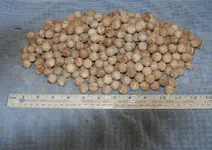
My little pouch was soon full and too heavy so I had to walk back to the truck to find something else to put them in. All I could find was an empty Gatorade bottle and a 1 gallon zip-lock bag. After 45 minutes of dodging ants (did I mention I was digging in an ant bed?) and mosquitoes I finally dug out all 427 Musket Balls. They were all together in the hole. There were no signs of any container so either the container completely disintegrated or someone dug a shallow hole and poured them in it.
My theory is that the Musket Balls were placed there as an emergency cache in case the Indians overran their position at the Fort.
I also found an Army/Navy button about 20 feet from the cache. It has an Eagle on the front. Anyone know what it is specifically?
After about four hours of hunting and nothing else to show for it, I took my finds to the house to show the owner what I had found. I grabbed one of the Musket Balls and showed it first to the man's wife. She looked at it and said, "oh you found a marble". I told her I think it's a Musket Ball. She didn't know what that was so I explained it to her. She told me her husband might want to talk to me about it so she went and got him. He came back alone and I told him I found a bunch of Musket Balls and offered him more of them. He declined and said the one is enough for him.
He took me inside to show me his collection of things he has found on his land over the years. Arrow heads, spear heads, bullets. They were very nice and said I could come back any time as long as I stop and let them know I'm there.
My dad has been encouraging me lately to "keep digging, you'll find something good". In my opinion it's the find of a lifetime.
Thanks for looking.
 

Attachments
  • finds six twenty five eleven batch two 002.webp
    finds six twenty five eleven batch two 002.webp
    285.4 KB · Views: 2,136
Upvote 0
Awesome story and finds!Congrats :icon_thumright:
 
Congratulations! Great find. How often are round balls found out west? I see you are in Wyoming. I would think smoothbore muskets would be rare out there because of the time period for the forts.
 
Hello all. Thanks for the kind words. Here are answers to some of your questions. The balls measure 5/8" as I don't have any calipers. They are all the same size. I took one to the Deli and it weighed .06 lbs. When I got home with them I put them on the bathroom scale together and they collectively weighed 25 lbs.
As far as how many have been recovered in Wyoming, I don't know. I haven't seen any in any museums or heard of any finds. I haven't had a chance to talk to the guy that sold me my detector who has been detecting for like 45 years so I will get back to you on that. As far as I can tell I found a needle in a haystack the size of the western half of the United States. We were still just a Territory during the Civil War. The Forts were to protect settlers and Oregon/California/Mormon Trail travelers from Indians.
 
In my 10yrs of hunting?...I found one. great find :thumbsup:
 
humm at 5/ 8 th of an inch * that is about .625 of an inch roughly .62 /.63 caliber ( a bit small for musket smoothbore springfeild rifle balls -- but great for cannon grape shot)-- smoothbore springfeild rifles were .69 caliber with the round musket balls they used just a tiny bit smaller than .69 caliber (so as to fit down the barrel smoothly and come out the barrel easily when fired- without hanging up )--- grape shot was large amount of musket type round balls in a cloth bag that was shoved onto a cannon barrel in front of a strong powder charge * and fired at a massed enemy force * sort of like a giant massive shot gun -- it was deadly to the max --mowing down any men or horses within range .-- the cloth bag full of shot might have just rotted away leaving the massed load of shot behind in a large group-- thus "no container" as you say. - :wink:

the button is a general service eagle type --any wording on the back or marks ?--often time range and manufactor can be found from wording or markings on the rear. :icon_thumright:

oh great find by the way.
 
Mind blowing! I'm voting banner. :icon_thumleft:
 
Because of where they were found it would make more sense that they were shot for exploding shells like the ones seen in this link: http://www.campsiteartifacts.com/mattlongwithborman.html

Takes nothing away from a fantastic find though whether they are shot or musket balls!

Congrats again!
 
rjs123 said:
Because of where they were found it would make more sense that they were shot for exploding shells like the ones seen in this link: http://www.campsiteartifacts.com/mattlongwithborman.html

Takes nothing away from a fantastic find though whether they are shot or musket balls!

Congrats again!

OK but these are either .62 or .63 Caliber. Would they have made the exploding shells with the smaller caliber?
 
I'm not sure. Never measured any and all mine are in storage right now.
 
OK, I think you guys are missing the boat. I think those have fur trade written all over them. The standard size fur trade round ball was .54 caliber. But that is just the most common pre-cast size bullet the company's brought out to trade, so if your gun was a larger caliber, then you had to melt and cast balls the size for your rifle. The western fur trade started about the time Lewis and Clark got back to St. Louis and lasted until 1840 when the beaver were about trapped out and the style of hats changed to silk. That's darn near 40 years. 25 lbs of lead would be a lot for a man to carry, so it could possibly be a cache to be retrieved later by an Indian or Mountain Man. The beaver men did a lot of that. .54 caliber means the gun fired a ball that weighs 1/2 half ounce, or 32 balls to the pound, which is how bore size was figured in those day. 5/8's equals .62 caliber and fires balls that weighs 20 to the pound. I forget the caliber for a one ounce ball, but 12 gage is 12 balls to the pound. Anyhow, Indian trade muskets were of a larger bore, I'm thinking .58 caliber, and I'm thinking that's 16 balls to the pound, or 16 gage, but I'm taxing my memory. Your best bet is to not take my word for it, but do some research on fur trade firearms, like Hawken or Lehman, and also Indian trade muskets. The round balls in an explosive shell fired from artillery would not be what these balls are. The percussion cap and the elongated bullet came into use toward the end of the fur trade in the 1840's. Keep in mind that Wyoming, Montana, Idaho, and Oregon were huge in the fur trade, with the Hudson Bay Company, the American Fur Company and the Rocky Mountain Fur Company among others of lesser size and impact, then later the trappers or Mountain Men, like Kit Carson, moved into Mexico, which is now Colorado and New Mexico, and the Santa Fe trade started. Odds are, in my book, is that you found a fur trade, mountain man cache. If the fort was an Indian wars fort, I would guess the round balls were placed there before the fort was even thought of. Just my humble opinion.

 
BosnMate said:
OK, I think you guys are missing the boat. I think those have fur trade written all over them. The standard size fur trade round ball was .54 caliber. But that is just the most common pre-cast size bullet the company's brought out to trade, so if your gun was a larger caliber, then you had to melt and cast balls the size for your rifle. The western fur trade started about the time Lewis and Clark got back to St. Louis and lasted until 1840 when the beaver were about trapped out and the style of hats changed to silk. That's darn near 40 years. 25 lbs of lead would be a lot for a man to carry, so it could possibly be a cache to be retrieved later by an Indian or Mountain Man. The beaver men did a lot of that. .54 caliber means the gun fired a ball that weighs 1/2 half ounce, or 32 balls to the pound, which is how bore size was figured in those day. 5/8's equals .62 caliber and fires balls that weighs 20 to the pound. I forget the caliber for a one ounce ball, but 12 gage is 12 balls to the pound. Anyhow, Indian trade muskets were of a larger bore, I'm thinking .58 caliber, and I'm thinking that's 16 balls to the pound, or 16 gage, but I'm taxing my memory. Your best bet is to not take my word for it, but do some research on fur trade firearms, like Hawken or Lehman, and also Indian trade muskets. The round balls in an explosive shell fired from artillery would not be what these balls are. The percussion cap and the elongated bullet came into use toward the end of the fur trade in the 1840's. Keep in mind that Wyoming, Montana, Idaho, and Oregon were huge in the fur trade, with the Hudson Bay Company, the American Fur Company and the Rocky Mountain Fur Company among others of lesser size and impact, then later the trappers or Mountain Men, like Kit Carson, moved into Mexico, which is now Colorado and New Mexico, and the Santa Fe trade started. Odds are, in my book, is that you found a fur trade, mountain man cache. If the fort was an Indian wars fort, I would guess the round balls were placed there before the fort was even thought of. Just my humble opinion.

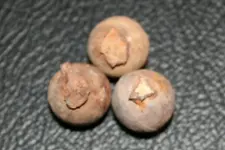
Wow that gives me a lot to chew on. But what about the US Cavalry Service Button I found 20 feet from the cache? I mean, that kind of said to me, "Military". But here is another angle. I noticed that there are some small pieces of metal fused to some of the balls that might shed some light on what they could be also. Here's the picture.
 

Attachments

  • finds six twenty five eleven batch four 004.webp
    finds six twenty five eleven batch four 004.webp
    112 KB · Views: 977
Fantastic find. I get excited if I find just one. Congrats.
 
Wow!!, great find. The tails on some are probably just untrimmed lead slag? While were on the musket ball forum Guys, Has anyone ever found a chewed musket ball? I found one and have seen others.
 
yes I have a chewed musket ball, the fused metal could be from a canister round it used a coffee can like can to hold the balls.
 
Fantastic Find! This is truly the find of a lifetime, and then some. Really enjoyed hunting with you over the Memorial Day weekend alderan33. Look forward to another hunt someday.

Jack
 
BosnMate said:
OK, I think you guys are missing the boat. I think those have fur trade written all over them. The standard size fur trade round ball was .54 caliber. But that is just the most common pre-cast size bullet the company's brought out to trade, so if your gun was a larger caliber, then you had to melt and cast balls the size for your rifle. The western fur trade started about the time Lewis and Clark got back to St. Louis and lasted until 1840 when the beaver were about trapped out and the style of hats changed to silk. That's darn near 40 years. 25 lbs of lead would be a lot for a man to carry, so it could possibly be a cache to be retrieved later by an Indian or Mountain Man. The beaver men did a lot of that. .54 caliber means the gun fired a ball that weighs 1/2 half ounce, or 32 balls to the pound, which is how bore size was figured in those day. 5/8's equals .62 caliber and fires balls that weighs 20 to the pound. I forget the caliber for a one ounce ball, but 12 gage is 12 balls to the pound. Anyhow, Indian trade muskets were of a larger bore, I'm thinking .58 caliber, and I'm thinking that's 16 balls to the pound, or 16 gage, but I'm taxing my memory. Your best bet is to not take my word for it, but do some research on fur trade firearms, like Hawken or Lehman, and also Indian trade muskets. The round balls in an explosive shell fired from artillery would not be what these balls are. The percussion cap and the elongated bullet came into use toward the end of the fur trade in the 1840's. Keep in mind that Wyoming, Montana, Idaho, and Oregon were huge in the fur trade, with the Hudson Bay Company, the American Fur Company and the Rocky Mountain Fur Company among others of lesser size and impact, then later the trappers or Mountain Men, like Kit Carson, moved into Mexico, which is now Colorado and New Mexico, and the Santa Fe trade started. Odds are, in my book, is that you found a fur trade, mountain man cache. If the fort was an Indian wars fort, I would guess the round balls were placed there before the fort was even thought of. Just my humble opinion.

Correct me if I'm wrong here but caliber has nothing to do with weight. It's the measurement of the bore in thousandths of an inch. .54 cal means .54 of an inch....etc. Bullet weight is measured in grains, and you can have one caliber of slug in a variety of weights.

Great find, are the rusted bits attached to the sprue on the ball or have the sprues all been cut? It's possible they were stashed in a tin can, and what you have is the remnants of that can. Also civilian guns were made in all sorts of different calibers. When you bought a gun, you got a bullet mold with it, You couldn't just stop at the store back then and get ready made ammunition like you can today. So with early musket balls there's no telling what sizes you might find.
 

Users who are viewing this thread

Latest Discussions

Back
Top Bottom