What's new

Musket Ball Cache Found!!!!!!!! Yeah!!!!!!!!

alderan33

Full Member
Joined
Oct 15, 2010
Messages
249
Reaction score
40
Golden Thread
0
Location
Greenville, NC
Detector(s) used
Whites Spectra V3I
Garrett Pro Pointer
Minelab Etrac
Primary Interest:
Relic Hunting
Yesterday I asked permission to hunt some private land near an old Fort and the owner's very kindly granted me permission. I thanked them, parked in some shade, grabbed my gear and off I went.
I immediately recognized my first mistake as I swept my coil through the foot-high grass and billions of mosquitoes rose to attack and feed. I had no repellent. That sucked.
About 20 minutes into my search, my V3I gave me a solid +50 at two inches. I started digging with my trusty tool and out popped a small, perfectly round metal ball. I thought "no way". I was very excited because I have never found anything of any significance. I put it in the keeper pouch and waved my pin-pointer at the hole. It went crazy... Then I went crazy.
My little pouch was soon full and too heavy so I had to walk back to the truck to find something else to put them in. All I could find was an empty Gatorade bottle and a 1 gallon zip-lock bag. After 45 minutes of dodging ants (did I mention I was digging in an ant bed?) and mosquitoes I finally dug out all 427 Musket Balls. They were all together in the hole. There were no signs of any container so either the container completely disintegrated or someone dug a shallow hole and poured them in it.
My theory is that the Musket Balls were placed there as an emergency cache in case the Indians overran their position at the Fort.
I also found an Army/Navy button about 20 feet from the cache. It has an Eagle on the front. Anyone know what it is specifically?
After about four hours of hunting and nothing else to show for it, I took my finds to the house to show the owner what I had found. I grabbed one of the Musket Balls and showed it first to the man's wife. She looked at it and said, "oh you found a marble". I told her I think it's a Musket Ball. She didn't know what that was so I explained it to her. She told me her husband might want to talk to me about it so she went and got him. He came back alone and I told him I found a bunch of Musket Balls and offered him more of them. He declined and said the one is enough for him.
He took me inside to show me his collection of things he has found on his land over the years. Arrow heads, spear heads, bullets. They were very nice and said I could come back any time as long as I stop and let them know I'm there.
My dad has been encouraging me lately to "keep digging, you'll find something good". In my opinion it's the find of a lifetime.
Thanks for looking.
 

Attachments
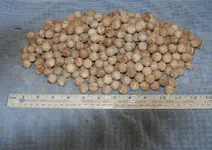
  • finds six twenty five eleven batch two 002.webp
    finds six twenty five eleven batch two 002.webp
    285.4 KB · Views: 2,136
Upvote 0

the iron color might be from a thin walled iron canister (sort of like a giant coffee can) that held the cannon shot making it easy to load down the cannon barrel --until it fired --upon firing the can ruptured spewing the shot out. -- for repelling massed numbers of men / horse troops --it was deadly --like a massive shotgun blast
 
Correct me if I'm wrong here but caliber has nothing to do with weight. It's the measurement of the bore in thousandths of an inch. .54 cal means .54 of an inch....etc. Bullet weight is measured in grains, and you can have one caliber of slug in a variety of weights.

Great find, are the rusted bits attached to the sprue on the ball or have the sprues all been cut? It's possible they were stashed in a tin can, and what you have is the remnants of that can. Also civilian guns were made in all sorts of different calibers. When you bought a gun, you got a bullet mold with it, You couldn't just stop at the store back then and get ready made ammunition like you can today. So with early musket balls there's no telling what sizes you might find.
[/quote]

Weight has everything to do with it. A round ball can only be made heavier by increasing it's size, what we call caliber today. Elongated bullets can be made heavier by increasing their length, leaving caliber the same. In the days of all bullets being round balls, calibers were not measured by 100ths of an inch, but by weight, or so many balls to the pound. If you find an old round ball bullet mold, many times they are marked with a number. The number relates to the number of balls per pound, ie: .54 caliber in those days was 32 balls to the pound, or as a mountain man might say, "This har rifle gun throws a half ounce a galena plumb center." Also, artillery on the western frontier did not fire 25 lbs of round balls in a can. The canister I'm familiar with was 27 round iron balls in a tin can, total weight 12 lbs, seeing as how the most common artillery or howitzer on the frontier was a 12 pounder, which means it fired a round solid iron ball of about 4 inches, weighing 12 pounds. The tab on the lead balls is called the spru, and those are caused by the hole in the mold where the lead is poured in when the ball is cast, the extra lead then being cut off, leaving the spru on the ball. My guess -- the is the small bits of metal stuck to the balls is the remains of the container they were buried in. The military button was not necessarily lost during, or at the same time as the balls were buried, and I think that it wasn't. I'm not a button expert, but it looks just like the one I found in Nevada which would date to the Civil War, and the same uniform button was still in use in the 70's during the Indian Wars. However, the Indian wars of the 70's were fought with the army being armed with the model 1873 single shot Springfield cartridge rifle. All that said, before using the 73, the Army used the same Springfield's used in the Civil War, which also fired the elongated .69 caliber Minnie Balls, not round balls. There were army posts on the frontier before cartridge rifles. Perhaps the place to start research is the history of the fort that was located close by. When was it built and manned, and for how long? That will tell you a lot about the firearms use at the post. Again, I'm working from faulty memory, and I haven't researched a word I've said, so don't take it as Gospel, but I think I've got you started on the right foot. In my opinion, those balls are not artillery, and I sure don't think they have anything to do with the military. I shoot a .62, and it's kind of an odd size caliber. Military round balls for muskets tended to be much larger, .69 to .75 caliber -- which .75, or 12 gage, or 12 to the pound, was the size of the revolutionary war Brown Bess musket. It seems to me the most common American military caliber round ball was .69, with .58 caliber taking second place. A round ball is ballistically a very poor excuse for a bullet, because it sheds energy very fast. In my 30 years experience shooting muzzleloaders, I started hunting with a .50 caliber, and although I killed a number of deer with it, I found it to be unsatisfactory as a deer hunting rifle, because it had limited range and was affected a lot by the wind. I found the .62 takes more powder to get it going, but once moving, the heavier ball bucks the wind better, carries more terminal energy, and shoots further, with a flatter trajectory than the smaller caliber. Which is neither here nor there as far as this discussion, except to say I have a little personal experience. I will concede that 25 lbs of balls could possibly be two cans of balls for use in a cannon, but I also have researched artillery in the past, and for the life of me, I can't remember canister being made up that way, especially by the time of the Civil War and later. "Shot" is a solid iron ball, "shell" is an explosive shot. A hollow cast iron round ball was filled with round lead balls, then hot sulphur was poured into the cavity. When the sulphur set up solid, a hole was drilled into the lead, and a bursting charge of black powder was placed in that cavity, and the hole plugged with a fuse. The fuse was supposed to be timed to explode in front of and above advancing infantry. So, now if nothing else, you know what Lord Tennyson meant when he said the Light Brigade was "Stormed at with shot and shell."
 
cellar dweller said:
Wow!!, great find. The tails on some are probably just untrimmed lead slag? While were on the musket ball forum Guys, Has anyone ever found a chewed musket ball? I found one and have seen others.

Ive found quite a few in CW camps. However, most all Ive found were chewed by rodents and not people.
 
Unbelievable! Awesome! Sure hope you didn't hurt yourself lugging them to and from the truck.

Once again, Awesome find!

J~
 
I take back what I said about the artillery and canister shot. I googled "canister shot ammunition," and the first hit was photos of an actual one, found on a sunken pirate ship from the looks of it. Anyhow, apparently it was called "case shot," and was a can packed with round lead balls and sawdust. So 25 lbs of balls could very well be the remains of two of the case shot for a 12 pound howitzer or a Napoleon cannon. At this point the theory of artillery ammunition makes the most sense. Please disregard all my blabber about mountain men, I shouldn't of been so lazy and looked first. Sorry about that.
 
Check this site out. < http://www.militaryheritage.com/caseshot.htm > He says use of canister and case shot was pretty much over by 1866, and that it wasn't used in Howitzers, and effective range was 100 to 200 yards, 300 yards being about the farthest. Anyhow, that still makes my mountain man or Indian theory possible. Also, that was sure a great find, I think I'd go crazy if I found something like that. Also, thanks for sharing, it's sure got me poking around, which I enjoy doing.
 
Well there are a lot of theories abounding. I still haven't made up my mind but I will definitely do some more research. In my excitement I forgot to mention that I found one fired musket ball about a mile from the cache so now I am leaning back toward that direction but we may never know. I do know for a fact that at one Fort in Wyoming they used a Mountain Howitzer to repel an Indian attack in at least one documented instance. So....who knows. I'm going back this weekend to dig around some more and I will post my findings. Thanks again to everyone for all the amazing insight.
 
the back marks on the button could help in figgering out the possible "time frame" as far as pre war civil war vs post civil war era war --or even during civil war.
 
Congrats on all the round balls.
 

Users who are viewing this thread

Latest Discussions

Back
Top Bottom