What's new

My best find this year!

rockheadhunter421

Sr. Member
Joined
Mar 25, 2014
Messages
350
Reaction score
193
Golden Thread
0
Primary Interest:
All Treasure Hunting
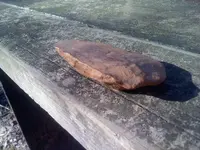
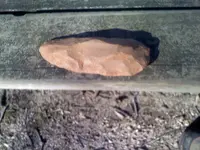
I found this awesome blade in Surry Co., NC, near Pilot Mountain. Back in February, we had a few winter storms come through. One day after the snow/ice had melted, I decided to make a venture to the park. Sometimes I will jog/walk up to 3 miles a day. I never thought I was going to find this. If it wasn't for seeing that smooth flat surface, I probably would have passed right by it. I should have took an insitu but I was so excited I ran to the nearest creek and rinsed off the mud. Once I finished jogging, I took the picture of it sitting on a bridge at this public/recreational park. Actually, this is the best blade I've ever found!
 

Attachments
  • 0311141646.webp
    0311141646.webp
    180.7 KB · Views: 157
  • 0311141647.webp
    0311141647.webp
    375.8 KB · Views: 133
Last edited:
Upvote 0
Here's a rhyolite chipped celt that is similar to yours. Like the rest said yours looks more like an adze. It was in with the cache pictured with makes it easier to date.
View attachment 975670

Looks like an early cache. I like those serrated Kirks. The drill looks sweet too. Thanks for sharing those!
 
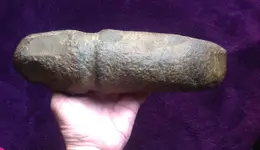
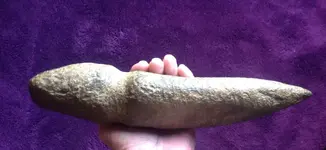
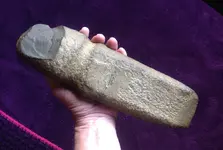
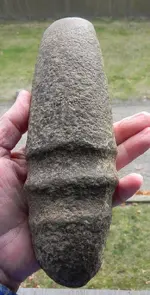
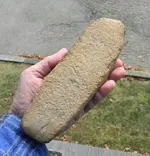
In New England, most of our adzes are ground hardstone, not flaked into shape. Here is a full groove and a double groove adze. Both made from basalt.....
 

Attachments

  • image.webp
    image.webp
    244.4 KB · Views: 72
  • image.webp
    image.webp
    191.6 KB · Views: 80
  • image.webp
    image.webp
    265.8 KB · Views: 68
  • image.webp
    image.webp
    109.3 KB · Views: 66
  • image.webp
    image.webp
    74.8 KB · Views: 57
Those are great examples of grooved adzes.They definetely help show the concept of hafted adzes.They can't be very common as I have many adzes and none are hafted .Thanks for the view Charles.Won't be long now 60s by Monday yes yes yes....mjm
 
Because yours are not grooved does not mean they were not hafted.
It's just the same difference between a grooved Axe and a celt.. over time the method of manufacturer changed that's all
 
I totally agree I meant to put grooved.Its just that the grooved ones leave little doubt...mjm
 
I do not believe all were hafted do to their smaller size...mjm
 
Wouldn't you call them axes? When I first saw them that's what I thought. However, I do see the smooth bits that would say they were used as an adze also.
 
Axes are a much heavier tool for chopping trees where as an adze is used for more delicate work such as shaping...mjm
 
Wouldn't you call them axes? When I first saw them that's what I thought. However, I do see the smooth bits that would say they were used as an adze also.

No, not axes. You determine what use by looking at the bit head on. An axe or celt will have a straight edge. An adze will have a curved edge without a scoop, or at best, a very mild scoop. A gouge, still another woodworking tool, will have a curved bit and a scoop. Here is the bit end of the double grooved adze shown above. Also an adze(left) and gouge aside each other showing the different bit end. Looking at the bit, you can see it was not used as an axe. On an adze, one face is beveled to create the curvature in the bit....
 

Attachments

  • image.webp
    image.webp
    149.4 KB · Views: 57
  • image.webp
    image.webp
    258.7 KB · Views: 81
I've never collect hardstone before. The closest I've collected before is a small granite celt from a creek. Here is a pic of it.
 

Attachments

  • 0410140903.webp
    0410140903.webp
    120.3 KB · Views: 69
  • 0410140904.webp
    0410140904.webp
    46.8 KB · Views: 61
Ok I see what you saying. I learned something new. I really didn't know how to tell the difference until now so I assumed they all had a straight edge like the celt I have here. I see the beveling you are talking in the first pic. I appreciate the help!
 
Last edited:
Ok I see what you saying. I learned something new. I really didn't know how to tell the difference until now so I assumed they all had a straight edge like the celt I have here. I see the beveling you are talking in the first pic. I appreciate the help!

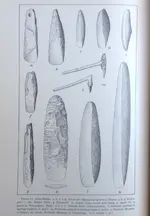
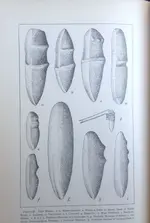
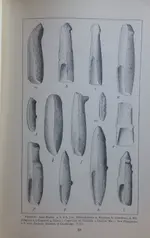
You're welcome, man. Here are some nice illustrations from Charles Willoughby's "Antiquities of the New England Indians"(1935), showing many varieties of the adze and gouge tool form, including a flaked adze like the one you just found.
 

Attachments

  • image.webp
    image.webp
    161.1 KB · Views: 60
  • image.webp
    image.webp
    244.9 KB · Views: 64
  • image.webp
    image.webp
    172.1 KB · Views: 57
Ok yall figured it out for me. My 1st flaked adze! Lol! WOOHOO!
 
Scrocks are you referring to the larger tool you have in there.The smaller one next to it looks like an adze but can't tell from here...mjm
Yes I was referring to the large one. You may be right on the smaller one. It may be some type adze tool I just don't know for sure. Goodyear and some other very knowledgeable collectors have looked at the cache but l just didn't think at the time to ask what they thought that piece was. When I get a chance one day I'll post some better pictures and get your and others opinion. - Thanks
 
Sure I would guess it was if not another Celt or preform...mjm
 
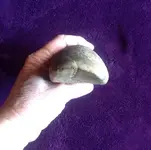
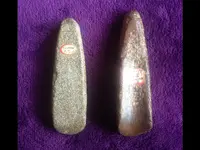
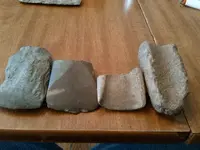
Here's a small Celt.The next is the bit of a really well made adze.I have yet to find an adze that was pecked to be this well polished.The last two are of course gouge bits the last of the two I believe to be full channeled

ForumRunner_20140410_105321.webp
 

Users who are viewing this thread

Back
Top Bottom