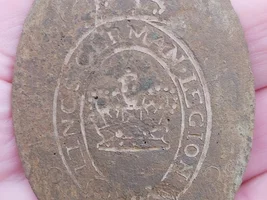
If your detector picks up on those rocks, I'm almost wanting to say meteorite chunks. Some of the cracking/'apparent' crystallization on the outside hints very strongly at this.
Best way to find out - saw one in half. If you see metal grain going in all sorts of differing directions, you've almost guaranteed got yourself space metal!
Now, for the amorphous blob of metal you found - let's get a density test performed on that! Get a container big enough for the entire sample to fit into, with a tiny bit of room overhead. Put tat container in a larger container. Fill the inner container with water up to the rim, a little surface tension dome at the top. Put your sample in the water and let the water overflow into the larger cotainer. You wil measure the water that overflowed, that's the displacement of the object in mL. You take the weight of the object in grams, and divide it by the number of mL it displaced. That gives you the density of the object. Once we have that number, we can check it versus other known densities to try identifying the metal. This will also help you in identifying those dark rocks.