What's new

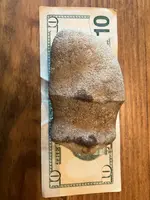
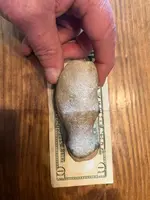
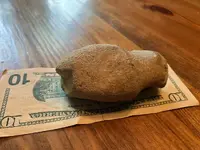
My Tennessee Stone Ax Head... found in 95'

Limitool

Gold Member
Joined
Jun 9, 2013
Messages
7,955
Reaction score
12,322
Golden Thread
0
Location
Middle TN. area
Detector(s) used
White XLT Spectrum E-Series
Primary Interest:
Metal Detecting
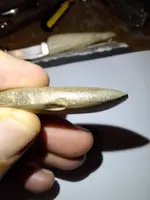
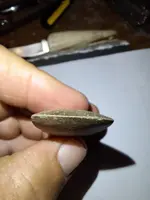
Well I'm calling it an ax head but I totally admit I most certainly am no expert. When I was asked this morning on the other ax head thread to go find it... I did. And when I did I remembered where I found it. I found the stone I mentioned in the other ax head thread in yard but this one was back at the cave I discovered in 94'.

If this is an ax head it appears to have hit something and chipped the leading edge. There was many artifacts lying around the mouth of the cave and up and down the ridge it was on. I posted many stories and pics of this cave long ago here on Tnet. My avatar is of one of the mud mounds within the cave.

But what do you folks think.... is this an ax head you think? And if so any idea who made or possibly how old...?

AX 1 Shows leading edge chipped.
AX 2 Lying on one side
AX 3 Lying on other side
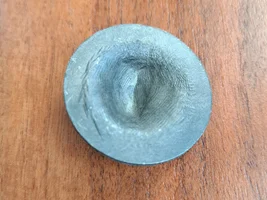
AX 4 Top view
 

Attachments
  • AX 1.webp
    AX 1.webp
    86.2 KB · Views: 433
  • AX 2.webp
    AX 2.webp
    214.3 KB · Views: 274
  • AX 3.webp
    AX 3.webp
    220.3 KB · Views: 266
  • AX 4.webp
    AX 4.webp
    136.1 KB · Views: 261
Last edited:
Upvote 21
Todd what time period is that sir ?Im guessing not late woodland ?
The earliest axes were full grooved. Started in the early archaic around 7500 BC. Then came the 3/4 groove that lasted through the rest of the archaic period. Around 1000 BC during late archaic/early woodland celts came on the scene. Hafted differently and no need for the groove.
 
YES... I'm trying to figure out how to approach this correctly. I'm a woodworker, have lot's of tools but mounting this doesn't realistically require that approach.

So any suggestions from you all would be greatly appreciated....!!!
It most certainly us an ancient tool to be sure. Found a couple up here in MN near the Mississippi. Ancient Dakotah villages dotted the shorelines all up and down right up until 1862-63 after the U.S-Dakotah wars ended. Lots of stuff here but have to be careful and respectful didn't do any digging these were found walking along some of the backwaters in the rocks. Illegal to hunt or dig known sensitive sites and there everywhere up here.
My advice is a simple wooden angle plate, preferably something native to your area(up here we have nice black walnut and red oak or ash) give it some oil for color, some router mill edges, glue some felt on the bottom, then glue the maul on it and leave it just like that. Simple, plain and easy. Then set it on a desk, your toolbox or work bench. I guarantee it'll be a conversation starter. Plain is good.
 
The earliest axes were full grooved. Started in the early archaic around 7500 BC. Then came the 3/4 groove that lasted through the rest of the archaic period. Around 1000 BC during late archaic/early woodland celts came on the scene. Hafted differently and no need for the groove.
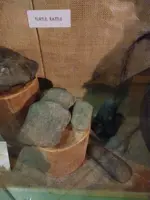
Is this a full groove axehead in the display? Took this in niagara falls.
 

Attachments

  • 20260324_113652.webp
    20260324_113652.webp
    506.2 KB · Views: 58
Is this a full groove axehead in the display? Took this in niagara falls.
Yes, but that particular type is called a trophy axe. Notice how the bit is square. They are usually not sharp like a normal axe. They are also usually made of a particular type of quartzite. Unusual and not very common type.
IMG_2982.webp
IMG_2983.webp
 
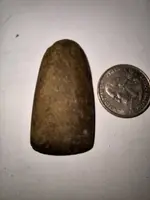
Here is a small greenstone celt found in north central Fla. How far did it travel to get here? Trade item from others? Source of greenstone?
 

Attachments

  • celt.webp
    celt.webp
    36.3 KB · Views: 44
  • celt1.webp
    celt1.webp
    38.2 KB · Views: 45
  • celt2.webp
    celt2.webp
    39.2 KB · Views: 45
Here is a small greenstone celt found in north central Fla. How far did it travel to get here? Trade item from others? Source of greenstone?
Axes in the Midwest are commonly made from igneous rocks that are sometimes green colored. These are not made of greenstone. Catoctin Greenstone is a metamorphic rock from the Blue Ridge Mtns of VA, MD and PA. It is actually metabasalt. Very tough material, great for celts. The material is knapped like flint then polished. If your celt is greenstone is was imported from a good distance. 👍🏻
 

Users who are viewing this thread

Latest Discussions

Back
Top Bottom