
You are using an out of date browser. It may not display this or other websites correctly.
You should upgrade or use an alternative browser.
You should upgrade or use an alternative browser.
Nails!?!? OMG
- Thread starter GoingDown
- Start date

villagenut
Gold Member
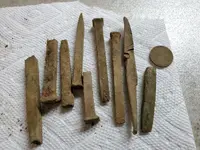
Look like spikes to me....shipbuilding. Are they bronze or forged iron?
Upvote
0

Tony in SC
Gold Member
- Joined
- Jun 8, 2006
- Messages
- 6,428
- Reaction score
- 9,296
- Golden Thread
- 0
- Location
- Upstate South Carolina
- Detector(s) used
- Whites, Minelab, Tesoro, and custom machines
- Primary Interest:
- Metal Detecting
The first and third kinda look gibb keys?
Upvote
0

- Joined
- Jun 15, 2008
- Messages
- 36,575
- Reaction score
- 20,227
- Golden Thread
- 0
- Location
- Pennsylvania (USA)
- Primary Interest:
- All Treasure Hunting

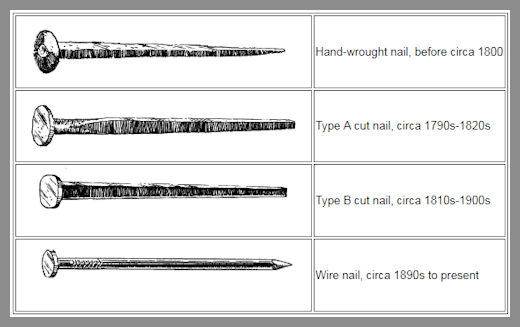
University of Vermont - Nails: Clues to a Building's History
Nails provide one of the best clues to help determine the age of historic buildings,
especially those constructed during the nineteenth century...
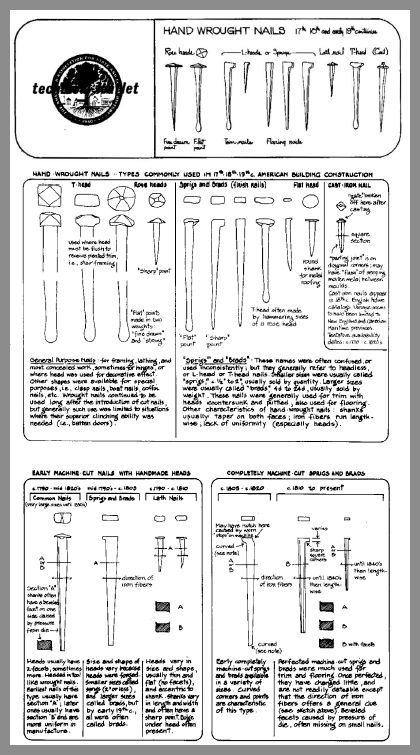
Nail Chronology - National Park Service
 PDF File 1.37MB
The National Park Service in its historic structures restoration
program has developed some research techniques...
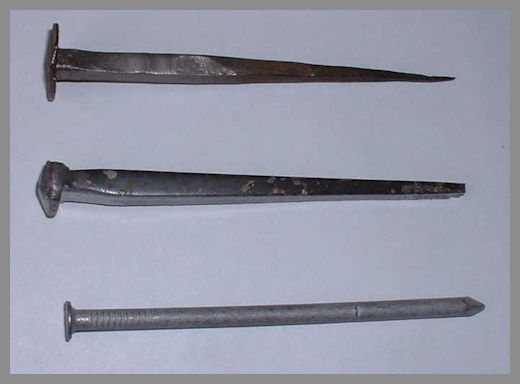
The History of Nail Making
History does not record who it was, but the incredible results of that
inspirational moment are all around us - in the houses we live in,
the bridges we cross, the furniture we sit on...
Your Online Source for Identifying Fakes and Reproductions
Nails As Clues to Age
Most everyone knows that handmade nails are older than machine made nails...
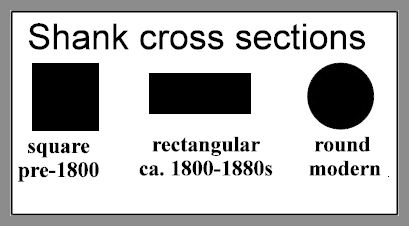
Nails provide one of the best clues to help determine the age of historic buildings,
especially those constructed during the nineteenth century...
Nail Chronology - National Park Service
The National Park Service in its historic structures restoration
program has developed some research techniques...
The History of Nail Making
History does not record who it was, but the incredible results of that
inspirational moment are all around us - in the houses we live in,
the bridges we cross, the furniture we sit on...
Your Online Source for Identifying Fakes and Reproductions
Nails As Clues to Age
Most everyone knows that handmade nails are older than machine made nails...
Upvote
0

GoingDown
Sr. Member
- Joined
- Jul 8, 2005
- Messages
- 356
- Reaction score
- 108
- Golden Thread
- 0
- Detector(s) used
- Minelab Explorer II
- #5
Thread Owner
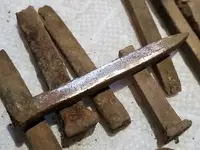
Thanks all for your input. Bronze or iron....how would i tell the difference? Here's a pic of one nail which I filed down a side. It was definitely yellowish on first look but with a flash seems "whiter". As I mentioned in the orig post ... they are from the front lawn of a huge 1830's estate ... smack dab in the middle in fact. I found all within a 100 sq foot area (a gazebo or small building perhaps?). Finally, the signal was that of a strong penny. Any further thoughts/comments?
Thanx ... GD
Thanx ... GD
Attachments
Last edited:
Upvote
0

TheCannonballGuy
Gold Member
- Joined
- Feb 24, 2006
- Messages
- 6,614
- Reaction score
- 13,465
- Golden Thread
- 0
- Location
- Occupied CSA (Richmond VA)
- Detector(s) used
- White's 6000, Nautilus DMC-1, Minelab
- Primary Interest:
- Relic Hunting
GoingDown asked:
> Bronze or iron....how would i tell the difference?
Use a magnet. (Doh!)
> Bronze or iron....how would i tell the difference?
Use a magnet. (Doh!)
Upvote
0

GoingDown
Sr. Member
- Joined
- Jul 8, 2005
- Messages
- 356
- Reaction score
- 108
- Golden Thread
- 0
- Detector(s) used
- Minelab Explorer II
- #10
Thread Owner
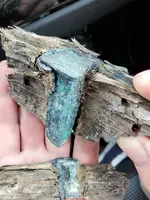
Hey Tamrock ... your spike is substantially thicker than my "nails" .... would these bronze/brass nails also be used in shipbuilding? Estate is overlooking Hudson River.
Upvote
0

bradyboy
Silver Member
- Joined
- Apr 15, 2007
- Messages
- 3,530
- Reaction score
- 1,361
- Golden Thread
- 0
- Location
- Clearwater, FL
- Primary Interest:
- All Treasure Hunting
imo, seems more like tools, chisels
stone cutting? brick laying
lead packing?
brady
stone cutting? brick laying
lead packing?
brady
Upvote
0

tamrock
Platinum Member
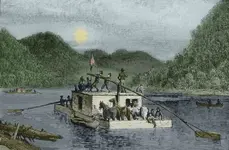
Hard for me to really say what those brass spikes were made for, but some boats were assembled with them. I wasn't thinking in terms of ship building, but during the 19th century before improved roads and railways farmers would build a one-way flat boat to take their goods to market in the cities downstream. I read after they delivered and sold their cargo they even sold the whole boat to be disassembled for the cut timbers and then hike it all the way home with their earnings. That I found real interesting as those early 19th century farmers on the Ohio River networks went all the way to sell their harvest in New Orleans and walk home. That all sounded like an awfully treacherous journey to me. You just have to wonder how many of them never returned home with the earnings and maybe got bumped off by highway men.Hey Tamrock ... your spike is substantially thicker than my "nails" .... would these bronze/brass nails also be used in shipbuilding? Estate is overlooking Hudson River.
Attachments
Upvote
0

- Joined
- Feb 3, 2009
- Messages
- 52,471
- Reaction score
- 208,247
- Golden Thread
- 1
- Location
- Eastern Ontario Canada
- 🥇 Banner finds
- 1
- Detector(s) used
- Deus, Deus 2, Minelab 3030, E-Trac,
- Primary Interest:
- Relic Hunting
What type of magnet?OMG....i forgot!!
DONE!!! Not picked up by a magnet!!! Not iron ...must be bronze?,,,,,brass
The pictures can't be enlarged for some reason, and the shine on the cleaned one is hard to determine the colour of the metal.
Upvote
0
GoingDown
Sr. Member
- Joined
- Jul 8, 2005
- Messages
- 356
- Reaction score
- 108
- Golden Thread
- 0
- Detector(s) used
- Minelab Explorer II
- #14
Thread Owner
MORE!!!!
Thanks so much for the detailed discussion and possibilities about these nails.
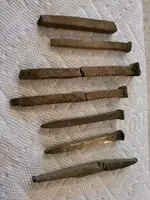
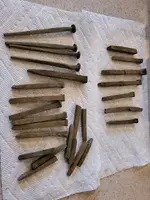
I hammered the small area on the estate's front lawn again yesterday and in the attached pics they are the larger group on the bottom. (tamrock ... ty so much ... in the attached pick also note the four different nails on the left)
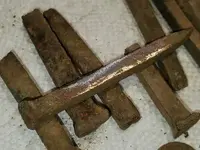
I also attempted to accurately photograph the actual "gold colored" tint on the one nail that I filed down. (Pepperj ... I used a round large magnet which is attached to a pole for picking up nails in yards)
Any other thoughts are certainly appreciated. Thanks so much!!
GD
Thanks so much for the detailed discussion and possibilities about these nails.
I hammered the small area on the estate's front lawn again yesterday and in the attached pics they are the larger group on the bottom. (tamrock ... ty so much ... in the attached pick also note the four different nails on the left)
I also attempted to accurately photograph the actual "gold colored" tint on the one nail that I filed down. (Pepperj ... I used a round large magnet which is attached to a pole for picking up nails in yards)
Any other thoughts are certainly appreciated. Thanks so much!!
GD
Attachments

Last edited:
Upvote
0

PetesPockets55
Bronze Member
- Joined
- Apr 18, 2013
- Messages
- 1,739
- Reaction score
- 3,151
- Golden Thread
- 0
- Location
- Indian River Co., Fl
- Detector(s) used
- AT MAX & Carrot, Nokta Pulse Dice (:
- Primary Interest:
- All Treasure Hunting
Nice group and image showing the brassy color since the color wasn't noticeable in the first images.
Upvote
0

NOLA_Ken
Gold Member
- Joined
- Jan 4, 2011
- Messages
- 5,221
- Reaction score
- 4,180
- Golden Thread
- 0
- Location
- Formerly New Orleans.. Now Pueblo Co
- Detector(s) used
- several, mostly Garrett
- Primary Interest:
- All Treasure Hunting
Hard for me to really say what those brass spikes were made for, but some boats were assembled with them. I wasn't thinking in terms of ship building, but during the 19th century before improved roads and railways farmers would build a one-way flat boat to take their goods to market in the cities downstream. I read after they delivered and sold their cargo they even sold the whole boat to be disassembled for the cut timbers and then hike it all the way home with their earnings. That I found real interesting as those early 19th century farmers on the Ohio River networks went all the way to sell their harvest in New Orleans and walk home. That all sounded like an awfully treacherous journey to me. You just have to wonder how many of them never returned home with the earnings and maybe got bumped off by highway men.
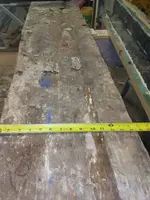
In New Orleans you still find barge board houses, most of the board I salvaged from renovation when I lived there was poplar, and I've had planks that were 2 feet wide, three inches thick and 15 feet long, they sold for a very nice price. The one in this pic is a little smaller than that and came from an 1830's house. The earlier barges had wood pins holding them together, you can see the cut off pins just above and below the tape measure. I never found brass spikes in any of the houses I worked on of any age. I did find iron spikes though, and I suspect that since the boats were designed to have a pretty short life span and not going to sea that brass and bronze were not necessary and that cheaper iron spikes were typically used. Just my opinion based on my personal experience, but I would think these came from a ship that was more substantial and more expensive than a river barge
Last edited:
Upvote
0
tamrock
Platinum Member
Yeah I was just attempting to surmise the possible situation on how those may have come to be. In researching these river boats it was mentioned that they were built with wooden dowels and at times hand forged iron nails. How interesting there are homes still around that were constructed of these disassembled flat badges and that you've salvage them. I've never heard that before. That plank is sure a testament to how tough and resourceful the early American pioneers had to be. I often wonder what all those hard working folks of our past would think of all these boohoo crybabies we have here today.In New Orleans you still find barge board houses, most of the board I salvaged from renovation when I lived there was poplar, and I've had planks that were 2 feet wide, three inches thick and 15 feet long, they sold for a very nice price. The one in this pic is a little smaller than that and came from an 1830's house. The earlier barges had wood pins holding them together, you can see the cut off pins just above and below the tape measure. I never found brass spikes in any of the houses I worked on of any age. I did find iron spikes though, and I suspect that since the boats were designed to have a pretty short life span and not going to sea that brass and bronze were not necessary and that cheaper iron spikes were typically used. Just my opinion based on my personal experience, but I would think these came from a ship that was more substantial and more expensive than a river bargeView attachment 1865084
Upvote
0



Featured Treasure Finds
Featured Treasure Finds
Similar threads

- Question
- Replies
- 1
- Views
- 863


Users who are viewing this thread
Total: 1 (members: 0, guests: 1)















