
You are using an out of date browser. It may not display this or other websites correctly.
You should upgrade or use an alternative browser.
You should upgrade or use an alternative browser.
✅ SOLVED Nothing is sexier that a point!
- Thread starter rock
- Start date
 Thanks, rock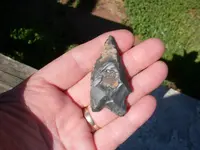

curious kat
Bronze Member
- Joined
- Nov 10, 2013
- Messages
- 2,302
- Reaction score
- 2,824
- Golden Thread
- 0
- Location
- New Mexico
- Detector(s) used
- ....eyes.....
- Primary Interest:
- All Treasure Hunting
...rock it's "type" is "very nice"! And it's usually the "headline" that get's them in....so what can I say...it worked & good job 

- Joined
- Jan 27, 2009
- Messages
- 19,213
- Reaction score
- 12,632
- Golden Thread
- 1
- Location
- South East Tennessee on Ga, Ala line
- 🥇 Banner finds
- 1
- Detector(s) used
- Tesoro Conquistador freq shift
Fisher F75
Garrett AT-Pro
Garet carrot
Neodymium magnets
5' Probe
- Primary Interest:
- All Treasure Hunting
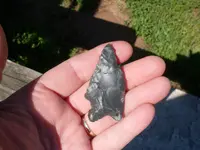
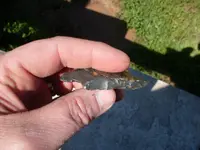
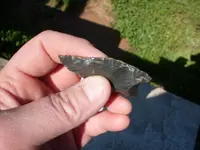
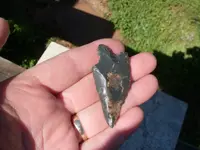
Well deserved find sir. Of course it would have to be a hard one to identify. It is bifurcated with a ground base and lobed ears right but a weak notch?If the bevel was the other way it would give them the opportunity to knock off the dimple but that is not what they were doing so the heavy bevel as you said was for a reason. The dimple does not look like fire pop..  In picture two the tip gives you the style of flaking it was supposed to have. It is only notched on one side so they either used it like it was or built another. I keep saying the same type lately in I.D'S but it is all guess work. The flaking plus the bevel says Buzzard Roost. Maybe I have Buzzard Roost on the brain!
  Either that or Big Sandy like Gator said. I wish I was more help!
The ears seem weak for maccorkle. I could be wrong.
Hopefully some more people will chime in. Good luck!
In picture two the tip gives you the style of flaking it was supposed to have. It is only notched on one side so they either used it like it was or built another. I keep saying the same type lately in I.D'S but it is all guess work. The flaking plus the bevel says Buzzard Roost. Maybe I have Buzzard Roost on the brain! Either that or Big Sandy like Gator said. I wish I was more help!The ears seem weak for maccorkle. I could be wrong.
Hopefully some more people will chime in. Good luck!

rock
Gold Member
- #23
Thread Owner
Well at least you tried and I thank you. Ive never seen anything like it. I dont believe we have tang knifes here that I know of? Unless it was a lefty that made it or it was hafted upside down in a handle if it is a tang knife and the stem being the hafted section. Not saying it is a tang knife though just thinking out loud. The inclusion is kinda neat and Im shocked it wasnt broken in that section. I didnt even have to clean it when I found it. No creek stain on it at all so it must of not been in the creek long. I will have to take it to the show in Aug if I cant get a ID on it. Maybe some others will chime in and give it a go. rock
Last edited:

Road Dog
Hero Member
Palmer Bevel? Palmers don't have bevels. Don't forget St. Albans possibility.
rockheadhunter421
Sr. Member
- Joined
- Mar 25, 2014
- Messages
- 350
- Reaction score
- 193
- Golden Thread
- 0
- Primary Interest:
- All Treasure Hunting
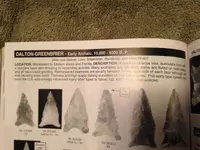
I know I said Palmers have bevels but what I really mean is some have a twist in the blade overall. This may not be the case b/c I know not everything was made the same throughout the state. However, I have 2 nice examples of a Palmer type that have a twist in the blade. There is other Palmers in my friend's collection that has the same characteristic too. Then I have a St. Albans (serrated) and a Kirk that lays completely flat on a surface (no twist). Rock, consider checking out a Dalton-Greenbrier. I read in the Overstreet description that resharpened examples are usually beveled on the right side although left side beveling does occur. It is spread over most of the U.S. and strongly influenced many other types to follow. I saw some in the pictures that look very similar to your type also. This is my final opinion. I'll let you decide now what you want the type to be. If you have any questions for me about what is in my Overstreet book, just let me know. Thanks and good luck!
Road Dog
Hero Member
I'm with you on the MacCorkle type.

olroy70
Hero Member
- Joined
- Feb 3, 2011
- Messages
- 735
- Reaction score
- 260
- Golden Thread
- 0
- Location
- gainesville, tx
- Detector(s) used
- Garret 250
- Primary Interest:
- All Treasure Hunting
Rock, you posted -->
Nothing is sexier that a point!
~~~~~~~~~~~~~~~~~~
Hmmm haven't you ever seen a well flung together gal in a Bikini or one in a 1937 - 39 Chrysler Imperial sport coup?----
You 'need' OiRiSH coffee \__/.
Don Jose de La Mancha

at MY age, the gal in the old car would work for me!!!!!!!!!!!!!!!!!!

rockheadhunter421
Sr. Member
- Joined
- Mar 25, 2014
- Messages
- 350
- Reaction score
- 193
- Golden Thread
- 0
- Primary Interest:
- All Treasure Hunting
I'm with you on the MacCorkle type.
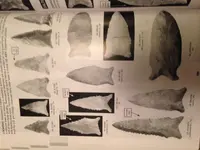
Yeah bud. My initial guess was the MacCorkle so I checked my Overstreet book to see if Northern GA falls in the region it is normally found, and it does. Then I was just doing some research on a another type and just happened to read about the Dalton-Greenbrier, which very much looks like a Hardaway too, and I found it interesting what it said. Especially since Rock's example here has that unique beveling and how that the Dalton-Greenbrier strongly influenced many other types to follow (probably a MacCorkle type also). Here's a picture I took from my Overstreet book also. Check out that point in the top-right corner for comparison. I hope this helps wraps it all up.
Attachments
rockheadhunter421
Sr. Member
- Joined
- Mar 25, 2014
- Messages
- 350
- Reaction score
- 193
- Golden Thread
- 0
- Primary Interest:
- All Treasure Hunting
I think I'm going to puke if I see Overstreet one more time.
Take into consideration other points found in the same area.. look at the material that was used.. and also the flaking... This point is ground on the base.. Don't forget that either.
It's very easy to get turned around in circles without local knowledge and just flipping through a book.
Also...a "twist" in a point is created by beveling... alternate beveling.
Hmm ok.....did you not read that description or you just jumping in acting like a monkey? I am taking into consideration other points; however, there is a culture of origin that many early types evolved from. I listed many that are similar to the Dalton-Greenbrier already or they were probably influenced by that culture. I see someone said a Big Sandy and a Buzzards Roost. I am speculating that the Dalton or Greenbrier cultures may have been an influence to make those too. I have no local knowledge but I do have one of the most popular arrowhead collector's guides in hand. It's a learning experience for everyone in this forum. I don't mind a debate but please give logical reason and sited resources. That's is so that anyone who is confused can see what is trying to be explained from another point of view. Thanks for your help!
rockheadhunter421
Sr. Member
- Joined
- Mar 25, 2014
- Messages
- 350
- Reaction score
- 193
- Golden Thread
- 0
- Primary Interest:
- All Treasure Hunting
Overstreet is not a big new learning experience for many of us.
So I guess I'm just a monkey
I had a photo of that point on my phone before he even got home that day.
I guess I'm not worthy. Lol thanks for your contribution. Don't forget to check yourself for ticks!
Last edited:
wvwildman
Silver Member
- Joined
- Jan 3, 2013
- Messages
- 2,975
- Reaction score
- 772
- Golden Thread
- 0
- Location
- fayette county wv
- Detector(s) used
- Garrett AT PRO, 5X8 DD, white's coin master pro, 4X6 DD, garrett propointer
- Primary Interest:
- Metal Detecting
nice finds man congrats HH

GatorBoy
Gold Member
- Joined
- May 28, 2012
- Messages
- 14,812
- Reaction score
- 6,156
- Golden Thread
- 0
- Primary Interest:
- All Treasure Hunting
I guess I'm not worthy. Lol thanks for your contribution. Don't forget to check yourself for ticks!
Its all good.. I appreciate your enthusiasm. :-) .. No need to thank me for chipping in on "rocks" thread

- Joined
- Jan 27, 2009
- Messages
- 19,213
- Reaction score
- 12,632
- Golden Thread
- 1
- Location
- South East Tennessee on Ga, Ala line
- 🥇 Banner finds
- 1
- Detector(s) used
- Tesoro Conquistador freq shift
Fisher F75
Garrett AT-Pro
Garet carrot
Neodymium magnets
5' Probe
- Primary Interest:
- All Treasure Hunting
They say Buzzard Roost falls under Benton's. Overstreet is a good guide to start with. Many people get in a tissy because a few points are mis named and they acknowledge a snapped base Kirk. Funny how that drives people crazy. Then it;s a price guide too.Hothem and others never came close to what Bob Overstreet did in trying to ID and publishing. If you want specific stick to your local dig reports. Hothem shows a similar one as a St. Albans but mostly only gives examples from Va and N.C for the South East and no other clues.Nothing n Ga
The pottery around here is even named after bridges and roads and Islands. Here our time frames are called the Dallas Period in late Mississipian times.Local yocal knowledge. These things makes no sense if you are a googler.
A local show will be a good bet Rock. Even then from table to table you might get different views,lol.
I think Hippy is pretty good at point I.D and can usually say why. I can not do that. It is easy to click in and type "geofact" It is harder to try and nail something down and very easy to be wrong…
. Overstreet is a good guide to start with. Many people get in a tissy because a few points are mis named and they acknowledge a snapped base Kirk. Funny how that drives people crazy. Then it;s a price guide too.Hothem and others never came close to what Bob Overstreet did in trying to ID and publishing. If you want specific stick to your local dig reports. Hothem shows a similar one as a St. Albans but mostly only gives examples from Va and N.C for the South East and no other clues.Nothing n GaThe pottery around here is even named after bridges and roads and Islands. Here our time frames are called the Dallas Period in late Mississipian times.Local yocal knowledge. These things makes no sense if you are a googler.
A local show will be a good bet Rock. Even then from table to table you might get different views,lol.
I think Hippy is pretty good at point I.D and can usually say why. I can not do that. It is easy to click in and type "geofact" It is harder to try and nail something down and very easy to be wrong…



Featured Treasure Finds
Featured Treasure Finds
Similar threads

- Replies
- 2
- Views
- 454

- Suggestion
- Replies
- 22
- Views
- 1K


- Suggestion
- Replies
- 36
- Views
- 3K

Users who are viewing this thread
Total: 1 (members: 0, guests: 1)















