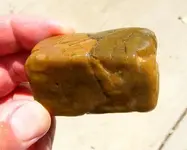
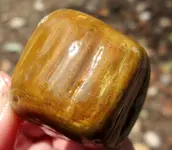
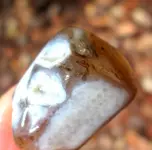
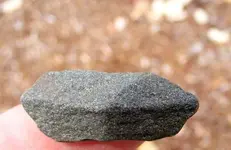
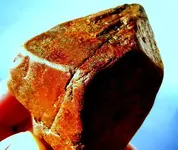
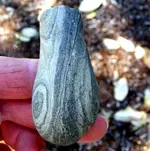
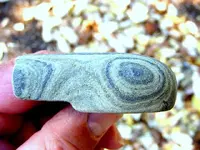
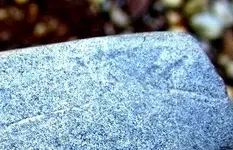
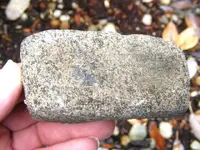
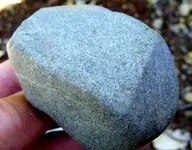
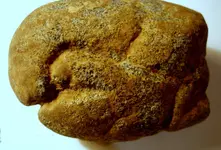
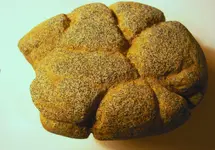
Charl, I totally agree with that part of your statement about needing help - not being able to discern shapes is a sign of dyslexia. In order to help you, point out any agate or jasper rock of your choice in your photo that you think resembles a cube shape & we'll discuss.
If you are having problems figuring out what a water worn agate or jasper cube looks like, refer to the example below:
View attachment 1081095
You obviously need help in identifying beach agates and jaspers, and lack knowledge about their cleavage, hardness, or breakage patterns.
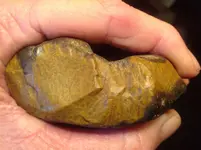
We only have one deposit of jasper in RI. It's yellow and golden brown and visually indistinguishable from Pa jasper of the same shades. The cobble I showed was dropped out of the glacier and was part of a boulder train of cobbles originating in the Cumberland region of RI, mostly Cumberlandite, which identifies the boulder train, but also the less common chunk of jasper now and then. So, not much experience finding raw jasper anywhere in RI in our glacial outwash, but the chunk I showed is most certainly Limerock jasper from Cumberland, since it is a glacial outwash deposit. I could always use more experience, scepter, but I have no problem identifying this chunk of jasper lying on a beach, so I don't really know what you are talking about. Are you saying it isn't jasper, because if so, you are mistaken. If it isn't a perfect cube, thanks for pointing out the obvious(?), my point was it is not the shape you claim it should be if Mother Nature alone was responsible. Are the other examples you show, such as the rectangular example in your first photo a cube? Is you so-named casket example a cube? You claimed they would weather into a round shape, so I showed you an example that did not weather into that shape at all. I never said my example was a cube, nor was I specifically comparing my example with your cube, that is a claim that you just assumed off the top of your head, for no apparent reason whatsoever, you said it, not me. After all, you did show other examples did you not, so your clever medical diagnosis does not apply. Do not pass go and return to medical school. But, guess what, any rock, including jasper can end up in any shape by nature alone. Your medical diagnosis of dyslexia is way off base and mistaken. I was simply showing you a jasper cobble, found on a beach, that was far from round. Never said it was a perfect cube. So, thanks for your help, but you really need help far more then I do, since you lack any and all ability to distinguish a rock from an artifact. I wish you the best of luck in overcoming that regrettable handicap! It can be overcome with experience. Where your knowledge is lacking is your inability to distinguish between jasper that has not been worked by man and jasper that has been reduced by knapping. All of the pieces you show are natural and give no real indication that they were shaped by man. As noted, I can never reach the point where no further experience is needed, but I am certainly correct in showing you a raw chunk of glacially deposited and water worn jasper. I had absolutely no problem identifying it at all. Regardless of the cleavage, hardness, and breakage patterns, you lack knowledge of how a mineral that was buried in a formation many thousands of feet thick for tens of millions of years, assume the shapes, by nature alone, that they can assume, strictly at the hands of Mother Nature. You show me anywhere on your jasper cobbles where human alteration is very clear and apparent. If you want to know how other chunks of raw jasper appear after transport by glacier and X amount of time in a tidal zone, you can refer to the example I showed you. Still has quite a bit of surface where the cortex is still present. And again, if you are saying I have misidentified a rock that is not jasper, your wrong. Of course it's jasper. I do not need any help identifying beach agates and Jasper's at all. Might be a lot rarer then where you are, because we only have one area where jasper and agate outcrop, utilized from Paleo-Woodland times. But I have no problem identifying jasper and agate when I find it, so your concern is misplaced. Help someone else, please. A close friend of mine has many jasper pebbles and cobbles from our beaches; I only collect real nice examples, but his examples are water worn into all kinds of shapes, square, round, oblong, you can pretty much name it. Not a one got that way through the hands of man.
So, thanks for showing that nice cube again. It is a cube, that's for sure. Now you show me the evidence of work by man on that stone. And demonstrate the signs of human alteration on the other examples you show as well. Point out where you see all the tool marks, etc. Don't use the argument that they can only break in a certain way; show me the proof if you can that those are shaped by man. And if you say, well those clues are all washed away by the water, well, isn't that convenient......
This is Limerock jasper. I don't need any help at all identifying jasper on the beach.....