What's new

Ok all you FARMERS out there

worldtalker

Platinum Member
🥇 Charter Member
Joined
May 11, 2011
Messages
21,617
Reaction score
31,162
Golden Thread
0
Location
Western Mass.
Detector(s) used
XP Deus
Primary Interest:
Other
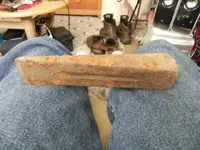
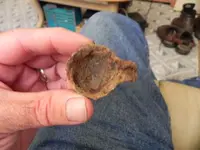
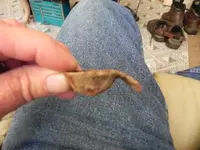
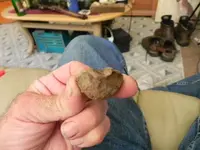
My son wanted to go out today,MAN it was HOT!he found it in an old field they turned into a park,it used to be a farm field for the jail in Springfield,Mass.to feed the inmates,quite big,tore that down too!This cup has me intrigued.Any thoughts Boys? girls too
 

Attachments

  • 035.webp
    035.webp
    69.6 KB · Views: 565
  • 037.webp
    037.webp
    29 KB · Views: 569
  • 036.webp
    036.webp
    62 KB · Views: 572
  • 038.webp
    038.webp
    25.5 KB · Views: 556
top one is a splitting wedge, the bottom looks like some kind of grease cup.
 
Upvote 0
Knew the wedge,grease cup went through my mind.
 
Upvote 0
I Got a couple Of those wedges that I use....
 
Upvote 0
NOLA_Ken said:
The cup looks like an iron ladle for melting lead. Imagine it with a longer handle.
That went through my mind too!
 
Upvote 0
Use some electrolysis on them. They'll clean up. Love the wedge!
 
Upvote 0
Definately a wood-splitting wedge, without the handle for some reason. The whole tool would look similar to an axe. Used to split wood rounds (sections of trunk or branch) into smaller pieces for the fireplace. Should be a hole underneath it where the wooden handle would have fit in.

There are similar-shaped splitting wedges, but those are typically smaller than this. Splitting wedges are solid, have no holes for handle attachment. They are placed in the crack already started then hit with the hammer-portion of the splitting maul. For very large rounds, several wedges can be used together to assure the round splits completely.

I'd tentatively agree the small cup would be a crucible for melting lead or tin. The lip would assist in pouring the lead or tin into a mold, such as for making lead weights or for making lead bullets. After the mold had cooled, it would be split and the newly created lead weights or bullets could be trimmed for use from any excess lead to make them more aerodynamic. Any lead left over would be used again and again.

Seems to be from 2 different centuries here. The lead crucible would be from the 1700-1860 period, when automation made it easier and cheaper to buy pre-formed bullets. The splitting wedge looks to be mostly iron, which most recently has been replaced with a variety of cheaper and lighter components, including fiberglass. If iron, then likely from 1850-1950 period.
 
Upvote 0
It looks like a splitting wedge to me not the head of a splitting maul. I heated my previous house for 20 years with wood, started with a sledge hammer and wedges, later went with hydraulic log splitter. the taper on it is less than the newer ones(they are still made but say made in china on them) that taper is much more effective than the newer ones--splits wood rounds easier. No idea on the age .
 
Upvote 0
I think the cup is for pouring lead joints,plumbing. they fill the cast iron joint with oakum and pour lead to seal the joint water tight. I agree it had a long handle.
 
Upvote 0
Getty said:
I think the cup is for pouring lead joints,plumbing. they fill the cast iron joint with oakum and pour lead to seal the joint water tight. I agree it had a long handle.

I think it is too small and thin-walled for smelting lead.

 
Upvote 0
creskol said:
Getty said:
I think the cup is for pouring lead joints,plumbing. they fill the cast iron joint with oakum and pour lead to seal the joint water tight. I agree it had a long handle.

I think it is too small and thin-walled for smelting lead.

It may be a bit small to be a plumbers ladle, but not too small for casting bullets.
 
Upvote 0
I have some of those wedges. They are avaiable today at most large hardware stores. TTC
 
Upvote 0
Just for fun, can we have the measurements on the cup-thingy and if you have calipers, the wall thickness too, please. Thanks
 
Upvote 0
I have a wood splitting wedge twice or more the size of the one you have . My grandfather used
it to split American Chestnut logs before the blight killed them .
I think the remainder of the ladle you have was for pouring Babbitt bearings .
 
Upvote 0
worldtalker said:
1.500 dia. .100 thk.

That is tiny .. and by scale, it must only be 1/2 inch deep or less, and at only 3/32 of an inch thick , I have my doubts that it was used for smelting.
 
Upvote 0
Not all splitting wedges have handles! I've used these wedges foe splitting wood for many years. They are also used to help guide a treecut and and also other tasks.
 
Upvote 0
I use a splitting wedge exactly like the one found.
 
Upvote 0
I agree with all the "splitting wedge" people. I have two and have occasionally driven them to full depth. Cottonwood is a mean, sucky, fiberous wood, especially if it has grown near the water. Definitely no handle or handle holes. All steel, I suppose, rather than iron, but whatever.
 
Upvote 0

Users who are viewing this thread

Back
Top Bottom