What's new

Please help identify this...

smartmoney

Full Member
Joined
Dec 4, 2011
Messages
115
Reaction score
8
Golden Thread
0
Location
Lower Hudson Valley
Detector(s) used
Etrac, Whites V3i
Primary Interest:
All Treasure Hunting
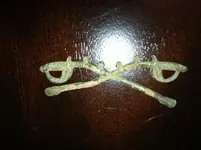
I found this about 15 years ago in an old city park. I also found mucket balls and 3 rings bullets here as well. It measures about 2" long.
 

Attachments

  • 006.webp
    006.webp
    126.6 KB · Views: 931
It is a US Army cavalryman's insignia. You didn't include any size-measurements, nor include a photo of its back ...so at the moment, all I can tell you about its time-period is that it appears to be from sometime later than the civil war, and might even be from the 20th-Century. If you want specific time-period dating, please provide exact measurements, and a photo of its back.
 
Upvote 0
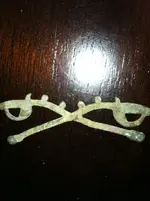
Hi there, it measures 1/2" high and just under 2" long. Here is a pic of the back...
 

Attachments

  • 007.webp
    007.webp
    98.9 KB · Views: 956
Upvote 0
Thank you for providing the measurements and the back-photo.

At the time of the civil war, and a few years after, the US Cavalryman's insignia was made of thin "stamped" sheet-brass. Your insignia is thicker, being cast-brass. That dates it from the mid-to-late Indian Wars era at the earliest, and could go as late as the present. To narrow down that very wide date-range, we rely on the insignia's "form of attachment" and details of the emblem's design.

Your US Cavalry crossed-sabers insignia's back shows small spots of solder on the ends of sabers' scabbards. The solder was used to attach a pin-&-clasp fastener. See the photo at the end of this post.

The back-photo shows tiny brazing spots on the back of the two scabbard-rings near the junction of the sabers. Those brazing spots held the upper corners of a wide letter (such as an H), which is now broken off. Again, see the photo.

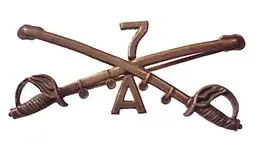
About the details of the emblem's design. Note that on your insignia, the saber's handle (called the "grip") shows parallel ridges. The saber's guard shows two thin branches. Also, there is no "saber knot" on the lower part of the saber's guard. The sabers' scabbards are narrow/thin in comparison to other variations. Carefully noting such design-characteristics, I believe the photo shows the exact insignia-design and attachment-method, listed as being a US Cavalry Officer collar-insignia, from the "early 20th-Century." Scroll about halfway down the page at the following website: http://hglanham.tripod.com/uscavalry/cavalryinsignia.html
 

Attachments

  • insignia_POSTWAR_Cavalry_US_clasp-pin-attachment_early-20th-century_front.webp
    insignia_POSTWAR_Cavalry_US_clasp-pin-attachment_early-20th-century_front.webp
    11 KB · Views: 719
Upvote 0
Thank you Cannonballguy. I think this is now solved. What a great site!!
 
Upvote 0
TheCannonballGuy said:
Thank you for providing the measurements and the back-photo.

At the time of the civil war, and a few years after, the US Cavalryman's insignia was made of thin "stamped" sheet-brass. Your insignia is thicker, being cast-brass. That dates it from the mid-to-late Indian Wars era at the earliest, and could go as late as the present. To narrow down that very wide date-range, we rely on the insignia's "form of attachment" and details of the emblem's design.

Your US Cavalry crossed-sabers insignia's back shows small spots of solder on the ends of sabers' scabbards. The solder was used to attach a pin-&-clasp fastener. See the photo at the end of this post.

The back-photo shows tiny brazing spots on the back of the two scabbard-rings near the junction of the sabers. Those brazing spots held the upper corners of a wide letter (such as an H), which is now broken off. Again, see the photo.

About the details of the emblem's design. Note that on your insignia, the saber's handle (called the "grip") shows parallel ridges. The saber's guard shows two thin branches. Also, there is no "saber knot" on the lower part of the saber's guard. The sabers' scabbards are narrow/thin in comparison to other variations. Carefully noting such design-characteristics, I believe the photo shows the exact insignia-design and attachment-method, listed as being a US Cavalry Officer collar-insignia, from the "early 20th-Century." Scroll about halfway down the page at the following website: http://hglanham.tripod.com/uscavalry/cavalryinsignia.html
Cannonballguy this is what makes this forum so great ,That you took the time to give this new B such a good answer.
Jonnie
 
Upvote 0

Users who are viewing this thread

Back
Top Bottom