rockcollect
Full Member
- #21
Thread Owner
AI-overzicht
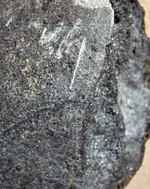
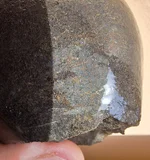
Chinese Writing Stone (also called Chinese Writing Rock) typically has a Mohs hardness of 5 to 6, though some sources note the overall composite rock can range anywhere from 5 to 7.5 depending on its exact composition. [1, 2, 3, 4]
The hardness varies because the stone is a porphyry (usually a basalt or limestone matrix) containing contrasting white crystal inclusions. For cutting and polishing, it is considered reasonably tough, but lapidary artists must be careful because the contrasting crystals often have a different hardness than the surrounding rock, leading to undercutting
AI-overzicht
A streak test on Chinese Writing Stone typically leaves a white to very pale grayish streak on an unglazed porcelain streak plate. Because the stone is a composite, both the dark basalt/limestone matrix and the light feldspar/andalusite crystals will produce a light streak. [1, 2]
AI-overzicht
Basalt porphyry generally measures between 6 & 7 and
on the Mohs Hardness Scale. This level of hardness—derived from the coarse crystals (phenocrysts) set within a dense, fine-grained matrix—makes it an exceptionally tough and durable rock capable of withstanding heavy wear, high compressive stress, and weathering.
Key Hardness Properties
It is hard enough to easily scratch a copper penny and will scratch glass.
The streak test of basalt porphyry typically produces a white or colorless streak. Although the stone is dark in color, the larger crystals (phenocrysts) consist mainly of light minerals such as feldspar, and the porphyry rock itself is usually harder than the porcelain of a standard streak slab.
Chinese Writing Stone (also called Chinese Writing Rock) typically has a Mohs hardness of 5 to 6, though some sources note the overall composite rock can range anywhere from 5 to 7.5 depending on its exact composition. [1, 2, 3, 4]
The hardness varies because the stone is a porphyry (usually a basalt or limestone matrix) containing contrasting white crystal inclusions. For cutting and polishing, it is considered reasonably tough, but lapidary artists must be careful because the contrasting crystals often have a different hardness than the surrounding rock, leading to undercutting
AI-overzicht
A streak test on Chinese Writing Stone typically leaves a white to very pale grayish streak on an unglazed porcelain streak plate. Because the stone is a composite, both the dark basalt/limestone matrix and the light feldspar/andalusite crystals will produce a light streak. [1, 2]
AI-overzicht
Basalt porphyry generally measures between 6 & 7 and
on the Mohs Hardness Scale. This level of hardness—derived from the coarse crystals (phenocrysts) set within a dense, fine-grained matrix—makes it an exceptionally tough and durable rock capable of withstanding heavy wear, high compressive stress, and weathering.
Key Hardness Properties
It is hard enough to easily scratch a copper penny and will scratch glass.
The streak test of basalt porphyry typically produces a white or colorless streak. Although the stone is dark in color, the larger crystals (phenocrysts) consist mainly of light minerals such as feldspar, and the porphyry rock itself is usually harder than the porcelain of a standard streak slab.
Last edited: