What's new

Questionable-age button or converted coin

Almy

Bronze Member
Joined
Mar 18, 2011
Messages
2,061
Reaction score
4,078
Golden Thread
0
Location
Maritime Provinces
Detector(s) used
Tesoro Cibola
Primary Interest:
Other
Got out for a hunt yesterday on a slope among very old apple trees. I have found a 1813 Wellington halfpenny token a few years ago nearby. For a site near an old homestead and having the apple trees, the finds have been sparse. But it's close and a nice place, so I go there once in awhile.
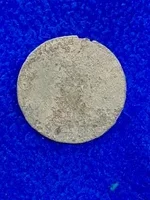
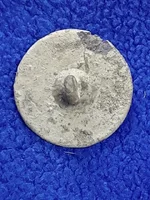
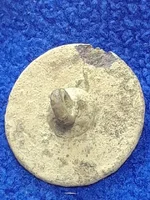
This time I found a forged nail and a button. The button is 1" diameter and 70 thousands (about 1/16") thick. It's green corrosion suggests copper content.
When I was getting ready to photograph it, I dropped it onto a concrete floor. That caused the chip in the edge. The chip showed either the button was made of pewter or its copper-based alloy has corroded all the way through. The soldered-on loop supports copper.
The button top seems to have a figure like Brittania, some lettering above Brittania's head and a line and place for a date underneath. But it's all very faint and I might be imagining things. It seems too thin to have been a coin converted to a button, but what I think I see on the surface makes me wonder. The back with the loop seems plain.
If it weren't for the chip and the vague figure and lettering, I would have concluded that it is a plated brass or copper button from the early 1800s. But the unusual features make me wonder. I would appreciate insight from others.
 

Attachments
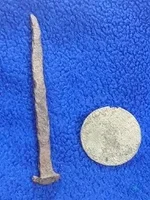
  • Front field nail and button.webp
    Front field nail and button.webp
    18.2 KB · Views: 37
  • Button front field (1).webp
    Button front field (1).webp
    15.7 KB · Views: 30
  • Button front field (2).webp
    Button front field (2).webp
    81.1 KB · Views: 31
  • Button front field.webp
    Button front field.webp
    92.1 KB · Views: 30
Upvote 10

Got out for a hunt yesterday on a slope among very old apple trees. I have found a 1813 Wellington halfpenny token a few years ago nearby. For a site near an old homestead and having the apple trees, the finds have been sparse. But it's close and a nice place, so I go there once in awhile.
This time I found a forged nail and a button. The button is 1" diameter and 70 thousands (about 1/16") thick. It's green corrosion suggests copper content.
When I was getting ready to photograph it, I dropped it onto a concrete floor. That caused the chip in the edge. The chip showed either the button was made of pewter or its copper-based alloy has corroded all the way through. The soldered-on loop supports copper.
The button top seems to have a figure like Brittania, some lettering above Brittania's head and a line and place for a date underneath. But it's all very faint and I might be imagining things. It seems too thin to have been a coin converted to a button, but what I think I see on the surface makes me wonder. The back with the loop seems plain.
If it weren't for the chip and the vague figure and lettering, I would have concluded that it is a plated brass or copper button from the early 1800s. But the unusual features make me wonder. I would appreciate insight from others.
A nice find Almy. I would guess pewter, based on the way it chipped. What was the VDI like? Higher or lower?
 
I use an older Cibola point and beep detector, so no VDI.
If pewter, maybe it was originally plated with a copper alloy that caused the green corrosion?
It's so fragile that I hesitate to scratch or try to remove some of the corrosion.
 
I use an older Cibola point and beep detector, so no VDI.
If pewter, maybe it was originally plated with a copper alloy that caused the green corrosion?
It's so fragile that I hesitate to scratch or try to remove some of the corrosion.
I'd leave it be. I'm afraid to tell you how many coins/ relics I have wrecked by being too aggressive in the cleaning process. Your button is great as it is.
 
Looks like a typical 18th C button to me.
 
Thank you for the replies and for your shared wide experience, Cru. i have recently found articles stating that pewter buttons were sometimes copper plated to enhance their wearability. That's what I think this one is. It's significant for the site which is of particular interest and the more information about dating the better.
 
Got out for a hunt yesterday on a slope among very old apple trees. I have found a 1813 Wellington halfpenny token a few years ago nearby. For a site near an old homestead and having the apple trees, the finds have been sparse. But it's close and a nice place, so I go there once in awhile.
This time I found a forged nail and a button. The button is 1" diameter and 70 thousands (about 1/16") thick. It's green corrosion suggests copper content.
When I was getting ready to photograph it, I dropped it onto a concrete floor. That caused the chip in the edge. The chip showed either the button was made of pewter or its copper-based alloy has corroded all the way through. The soldered-on loop supports copper.
The button top seems to have a figure like Brittania, some lettering above Brittania's head and a line and place for a date underneath. But it's all very faint and I might be imagining things. It seems too thin to have been a coin converted to a button, but what I think I see on the surface makes me wonder. The back with the loop seems plain.
If it weren't for the chip and the vague figure and lettering, I would have concluded that it is a plated brass or copper button from the early 1800s. But the unusual features make me wonder. I would appreciate insight from others.
Nice!!! Congrats!!!
 

Users who are viewing this thread

Back
Top Bottom