What's new

Shaped like Ears

katieadkins

Full Member
Joined
Oct 5, 2012
Messages
135
Reaction score
38
Golden Thread
0
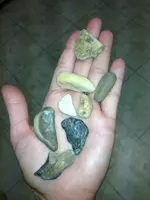
These are very smooth -except the one that doesn't look like the rest...
Anything? Some look like 'oils' from touching (before I found it)

image-605366828.webp
 
Upvote 0
Hard to tell. The bottom ones look to have some desert polish on them from the blowing sands. I'm guessing you're out in the west somewhere?
 
Twitch said:
Hard to tell. The bottom ones look to have some desert polish on them from the blowing sands. I'm guessing you're out in the west somewhere?

No east coast, tidewater region of Virginia
 
Ok from my hunting experience you should get your eyes focused on any other type of stone than those. I have that type here in Ga and they did not use that type to make artifacts with. You have to train your eyes to ignore that type of stone. Look for quartz and hard stone. Check out some of the others post on the color and type of rock from NC and Va. Once you get your eyes to focus on other types you should score then. Just a tip, rock
 
rock said:
Ok from my hunting experience you should get your eyes focused on any other type of stone than those. I have that type here in Ga and they did not use that type to make artifacts with. You have to train your eyes to ignore that type of stone. Look for quartz and hard stone. Check out some of the others post on the color and type of rock from NC and Va. Once you get your eyes to focus on other types you should score then. Just a tip, rock

I really appreciate the info! So the "green stone" (limestone?) is too soft? It's very light weight and smooth.
In my back yard I found oogles of white stone and yellow (clay colored) clear stone (looks like citron minus color) shaped in the round, oval and oblong. I do google my findings, but was way off on the intuition recently. I found a 'bone' but it was I.D.'ed as a broken piece of village pipe....:/
Lots to learn! I'm excited to go to my mom's to dig soon. She lives in the heart of Varina (Henrico, Va) can't wait!:)
Thank you again!!
 
I really appreciate the info! So the "green stone" (limestone?) is too soft? It's very light weight and smooth.
In my back yard I found oogles of white stone and yellow (clay colored) clear stone (looks like citron minus color) shaped in the round, oval and oblong. I do google my findings, but was way off on the intuition recently. I found a 'bone' but it was I.D.'ed as a broken piece of village pipe....:/
Lots to learn! I'm excited to go to my mom's to dig soon. She lives in the heart of Varina (Henrico, Va) can't wait!:)
Thank you again!!
Anything near water is good to start. Look for flakes (not broken rocks). The flakes will be small even smaller than a dime usually then look uphill from the flakes till they get bigger and so on. Sometimes at the end of the trail will be a point or tool. But the key is the flakes, if you find them you are in the rite spot. Oh by the way I pick up all the flakes I find and I have a good memory as to where they were at so I can go back to that spot at a later time. Good Luck, rock
 
rock said:
Anything near water is good to start. Look for flakes (not broken rocks). The flakes will be small even smaller than a dime usually then look uphill from the flakes till they get bigger and so on. Sometimes at the end of the trail will be a point or tool. But the key is the flakes, if you find them you are in the rite spot. Oh by the way I pick up all the flakes I find and I have a good memory as to where they were at so I can go back to that spot at a later time. Good Luck, rock

Awesome tip, thank you!! (keep em comin'!)
 
Hi Katie-
yeah- you're looking for 'interesting looking' rocks- and I do that too, sometimes. If something looks weird enough, I'll pick it up and try to figure it out. But I live in the land of a million river cobbles- many of which look a heck of a lot like 'tools' or 'tools of convenience' (at least that's what I call them- meaning they've been so worked by water/ice and friction over time that they often look like the most common hardstone tools shown here on this and other sites). And in regards to the ear-like shapes you're finding, I wonder. Found in water-related area? That aside, keep in mind when you're looking around- don't look for polished rocks- smooth to the touch. 9 times out of ten- and probably more like 90 times out of 100- they're not man-made. They make me scratch my head a lot, but I'm not fooled anymore. Of course, I do have a (badly sagging) table of 'probably just geofacts' in my back yard...just in case I find out something down the road explaining my finds;)
I live on the Bay side of the Eastern Shore. I have the incredible good fortune of haveing a tone of great places to look- all tidewater- which I find a huge advantage. Tide in, tide out, erosion, shore prizes at low tide! But it does take some time 'training your eye' as Rock said. I spent a lot of time convincing newbies NOT to pick up triangular rocks, just because they're triangular. And there are a lot of folks on this site who started out showing us pictures of geofacts they were SURE were tools because they 'fit their hand just right'. Let me tell you, when you actually find a hardstone tool, you'll know it. Now, the points are a little easier. Around here- and in your area too (I used to live in Charlottesville), there's a ton of quartz- not the ideal stone to knap. However, I (and many others here) have found some excellent examples of quartz points. My very first point ever was a tiny milky quartz dart (a no-name variety), and the ONLY way to recognize that it was a point and not just a little fragment of quartz was the 'ripple' of knapping marks along each side- little indentations where (they) pressure-flaked the edges to sharpen it. Once you can recognize that tell-tale ripple, you're onto it! As a side-line comment, I remember reading on this site, years ago, a guy who said fairly specifically, NOT to pick up every flake you find- not to strip the site of all evidence. I think the guy was looking to the future generations who might come across the site years from now and perhaps do further research. I try to keep that in mind, although I do pick up flakes, and I do- absolutely- look for them as evidence of a 'working area'- a place they sat around making points. Often they are within a community- or on the outskirts. Many items found in such places, I believe, are 'seconds'- or perhaps beginners' work. The good stuff would be carried on a hunt, possibly lost by accident- a drop or a mis-shot or the target animal ran away and never found- with the point still embedded. But to be clear, there will nearly always be stuff when flakes are found- unless someone got there first...
Have you found anything beyond what's in your hand? You asked about the light green stone- being too soft... keep in mind too, that some stones will change over time. Some rocks oxidize and change color, some degrade and become porous (and seemingly unsuitable for a tool, although at one point they were find- although perhaps not 'ideal'. Quartz doesn't do anything other than errode in sandy/watery circumstances, grow moss/algae, aquire a 'patina' due to pollution-- like many flints and cherts. If you're looking for points in a stream in the woods (or near trees) at this time of year, you're ging to get sick and tires of poking at leaves- which look mighty similar in water- or in the dim light of a forest. Also, one last thing (I know..Finally!) go on line and check out known areas where Native Americans settles and had communities. Then look for the source of fresh water (a google map or mapquest or whatever). Look there. If in streams, look on the down-stream side of a larger rock or boulder-- or where sand and pebbles have washed up during a flood. And good luck. Sorry for being long-winded. I don't get on this site often, and always have too much to say when I do...:tongue3:
 
yakker said:
Hi Katie-
yeah- you're looking for 'interesting looking' rocks- and I do that too, sometimes. If something looks weird enough, I'll pick it up and try to figure it out. But I live in the land of a million river cobbles- many of which look a heck of a lot like 'tools' or 'tools of convenience' (at least that's what I call them- meaning they've been so worked by water/ice and friction over time that they often look like the most common hardstone tools shown here on this and other sites). And in regards to the ear-like shapes you're finding, I wonder. Found in water-related area? That aside, keep in mind when you're looking around- don't look for polished rocks- smooth to the touch. 9 times out of ten- and probably more like 90 times out of 100- they're not man-made. They make me scratch my head a lot, but I'm not fooled anymore. Of course, I do have a (badly sagging) table of 'probably just geofacts' in my back yard...just in case I find out something down the road explaining my finds;)
I live on the Bay side of the Eastern Shore. I have the incredible good fortune of haveing a tone of great places to look- all tidewater- which I find a huge advantage. Tide in, tide out, erosion, shore prizes at low tide! But it does take some time 'training your eye' as Rock said. I spent a lot of time convincing newbies NOT to pick up triangular rocks, just because they're triangular. And there are a lot of folks on this site who started out showing us pictures of geofacts they were SURE were tools because they 'fit their hand just right'. Let me tell you, when you actually find a hardstone tool, you'll know it. Now, the points are a little easier. Around here- and in your area too (I used to live in Charlottesville), there's a ton of quartz- not the ideal stone to knap. However, I (and many others here) have found some excellent examples of quartz points. My very first point ever was a tiny milky quartz dart (a no-name variety), and the ONLY way to recognize that it was a point and not just a little fragment of quartz was the 'ripple' of knapping marks along each side- little indentations where (they) pressure-flaked the edges to sharpen it. Once you can recognize that tell-tale ripple, you're onto it! As a side-line comment, I remember reading on this site, years ago, a guy who said fairly specifically, NOT to pick up every flake you find- not to strip the site of all evidence. I think the guy was looking to the future generations who might come across the site years from now and perhaps do further research. I try to keep that in mind, although I do pick up flakes, and I do- absolutely- look for them as evidence of a 'working area'- a place they sat around making points. Often they are within a community- or on the outskirts. Many items found in such places, I believe, are 'seconds'- or perhaps beginners' work. The good stuff would be carried on a hunt, possibly lost by accident- a drop or a mis-shot or the target animal ran away and never found- with the point still embedded. But to be clear, there will nearly always be stuff when flakes are found- unless someone got there first...
Have you found anything beyond what's in your hand? You asked about the light green stone- being too soft... keep in mind too, that some stones will change over time. Some rocks oxidize and change color, some degrade and become porous (and seemingly unsuitable for a tool, although at one point they were find- although perhaps not 'ideal'. Quartz doesn't do anything other than errode in sandy/watery circumstances, grow moss/algae, aquire a 'patina' due to pollution-- like many flints and cherts. If you're looking for points in a stream in the woods (or near trees) at this time of year, you're ging to get sick and tires of poking at leaves- which look mighty similar in water- or in the dim light of a forest. Also, one last thing (I know..Finally!) go on line and check out known areas where Native Americans settles and had communities. Then look for the source of fresh water (a google map or mapquest or whatever). Look there. If in streams, look on the down-stream side of a larger rock or boulder-- or where sand and pebbles have washed up during a flood. And good luck. Sorry for being long-winded. I don't get on this site often, and always have too much to say when I do...:tongue3:

ThAnk you for taking the time to be so generous with your seasoned experience!!! I truly am learning as I go but love it!!
We used to camp in Mathews county and that's the smoothed out ' green rocks came
from . I also found a big bone that I
was a whale none. Well thank you again! I'd love to get opinions on The sightings!! ;)

Katie 'plays with dirt' Adkins
 
Well done Yakker! You could travel the world using that info and be consistently successful.
 
GatorBoy said:
Well done Yakker! You could travel the world using that info and be consistently successful.

:)

Katie 'plays with dirt' Adkins
 
You're welcome Katie-Plays-with-Dirt. And good luck. And thanks Gator. 'Preciate that. Happy Huning All! Yakker
 
yakker said:
You're welcome Katie-Plays-with-Dirt. And good luck. And thanks Gator. 'Preciate that. Happy Huning All! Yakker


image-3606778961.webp

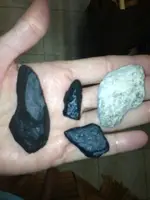
How bout these? Found these black to light gray, looks like slate but light and smooth.

Katie 'plays with dirt' Adkins
 
Hi Katie PWD, if you want to know what kind of rocks those are, you'd better go to the rock forum. As far as tools and artifacts are concerned, to my eye, the only rock in your hand which could possibly be worked is the one on the left. Black and looks to be whacked by another rock on purpose. Maybe. Your samples are wet, so it's hard to tell about the other pieces. The one resting on your pinky looks like it could have sparkly bits of crushed rock+mica or shell, but I can't be sure at all. The way to see if something is pre-historic pottery is to not only look at the broad surface but at the edge- where it was broken. It will have a rough, layered porous look, and there would be inclusions of crushed shell or stone for tempering the clay. And it depends on where you're looking. If there's any construction rock- crush+run/fill. it will be broken/have edges too, but will be pretty obviously commercial. I run into that sort of thing all the time where I live...
cheers!
Yakker
 
yakker said:
Hi Katie PWD, if you want to know what kind of rocks those are, you'd better go to the rock forum. As far as tools and artifacts are concerned, to my eye, the only rock in your hand which could possibly be worked is the one on the left. Black and looks to be whacked by another rock on purpose. Maybe. Your samples are wet, so it's hard to tell about the other pieces. The one resting on your pinky looks like it could have sparkly bits of crushed rock+mica or shell, but I can't be sure at all. The way to see if something is pre-historic pottery is to not only look at the broad surface but at the edge- where it was broken. It will have a rough, layered porous look, and there would be inclusions of crushed shell or stone for tempering the clay. And it depends on where you're looking. If there's any construction rock- crush+run/fill. it will be broken/have edges too, but will be pretty obviously commercial. I run into that sort of thing all the time where I live...
cheers!
Yakker

Hi Yakker! Those pieces that I have,I guess when I find certain shapes, I think there's a 'reason' like, you know, same size, shape, look, but maybe different material. I have ALOT to learn no matter what! I look at the stuff that I find and (I guess) my artsy-fartsy mind sees (oh! imprints!) not so much. Lol. Like this huge rock i found has two holes in it, the size smaller than pencil erasers about an inch.5 apart. Probably nothing, but my mind said so lol. Then rocks I shouldn't even pick up, because of their shape, and they look like toasters. Like two parallel slashes in each of them. I google all these rocks to I.d, them before putting them on here, even got rock/ mineral books to compare.
Beanman seemed to get negative attention/feedback from his earlier posts. I see dome of my finds have looked like his. i havent seen The latter posts yet. I'm not the sharpest tool in the shed, but am willing to learn. :)

Katie 'plays with dirt' Adkins
 

Users who are viewing this thread

Back
Top Bottom