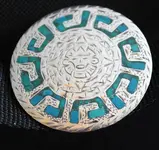
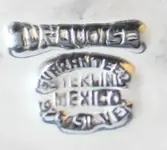
Gulf Coast Pirate and Doubter in MD are correct that the mark is ‘GUADMEX’ for Guadalajara, Mexico together with ‘PLATA 925’ for sterling silver… shown as a reverse stamp as Cudamark says.
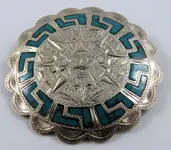
Lots of companies and individual silversmiths made (and still make) these as tourist-ware brooches or necklace pendants, inset with turquoise. Mackaydon is correct that the design is loosely borrowed from ‘Mexica’ calendars, sunstones and such used by the Aztecs and other Pre-Columbian peoples of central Mexico.
It’s not “
very modern post 1985” though. Around 1980 Mexico adopted silver marks based on letters and numbers with the first letter identifying the city of production, the second letter giving the first or last name of the maker, and the number denoting the maker’s registration. The mark here predates that change. I read the maker mark as ‘GOG’, which I’m not familiar with, but there are many smaller makers whose marks are not reliably documented.
From 1948 the Mexican Government
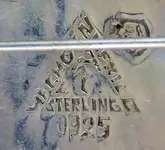
began promoting the use of ‘Eagle marks’ including a number to identify manufacturer but the system was widely disrespected, leading to it being abandoned and replaced by the letter and number system in the 1980s. In the first half of the 20th century (and into the earlier part of the post-1948 period when eagle marks began to be introduced) pieces were just marked "silver" (“plata” in Spanish), usually with a fineness indication, or "sterling", and a town name. The maker’s initials or other identification may or may not be present. The mark on this item is typical for that period.
Here's a couple of similar vintage items with pre-1980s marks. Note that the second one has an ‘Eagle mark’ to the right, so that puts it in the 1948-1980s region.
View attachment 2076594 View attachment 2076596 View attachment 2076597 View attachment 2076598