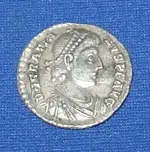
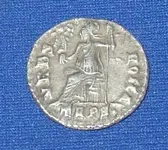
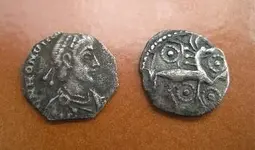
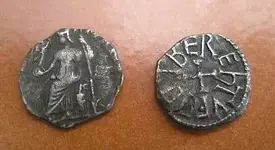
I have often thought the reason that so many are found clipped, was to pass as a saxon sceat in size and weight, I pointed this out to a Archy who defunked the idea, I'm still not conviced, most found are clipped and normally the same size as a sceat. Check out these two found on the same field, one 4thc roman and one saxon sceat of the same period.
Stunning silver Cru.

SS
Cru'Dad found one of the sources (Detailed below) for the Roman period clipping, in summary;
The Hoxne Hoard containing
15,565 Siliquae (98%+ were clipped) will help in understanding the archaeological conclusions. These were buried way before Saxons were around and one could even advance a view that the Siliqua may even have influenced the size of the Sceat (rather than the other way around!).
''The Hoxne Treasure included 15,234 gold and silver coins struck mainly at the western mints of the Roman Empire during the late fourth and early fifth centuries. The long-vanished wooden chest contained 579 gold
solidi, 60 silver light
miliarenses, at least 14,565 silver
siliquae (including imitations), five silver half-
siliquae and 24 bronze coins. The gold coins were all found together in one area of the treasure, which suggests that they had been kept together in a container or bag of organic material that had perished. Most of the silver coins, on the other hand, seem to have been poured into the chest after the other objects had been fitted in, as they were found scattered indiscriminately over the whole area of the find.
The nature and scale of the treasure make it one of the largest hoards of gold and silver from the entire late Roman world, though it is now clear that the burial and non-recovery of disproportionately large numbers of hoards in the later fourth and early fifth centuries was a phenomenon peculiar to Britain. Although other parts of the empire produce hoards from this period, these are few and far between and there are considerably more Romano-British hoards of gold, silver and bronze objects, including coins, than from the rest of the ancient world at this time. It is believed that the end of Roman Britain as a political entity occurred around 410 when the imperial administration was expelled by the island’s population: a unique event in Late Antiquity and perhaps related to the campaigns on the continent of the British usurper, Constantine III, with the last troops from Britain.
Therefore, the Hoxne Treasure is a significant piece of evidence for the shadowy history of the fifth century, particularly the nature and effects of the formal end of Roman Britain. Also, the 15,234 coins are by far the largest collection of gold and silver denominations produced by the empire in the second half of the fourth century (hoards of gold coins are extremely rare from this period) and they have a great deal to tell us about the production of high value coins by the late Roman state.
The Hoxne Treasure provided a unique opportunity to examine the chronology, production and supply of Roman coinage, especially of the silver
siliqua, in the late fourth and early fifth centuries. It was possible to refine the chronological development of the
siliqua between 355 and 408, which, combined with the results of a major programme of metallurgical analysis undertaken by the British Museum, has provided a much clearer picture of how the production of this coin changed during this important period of history. Furthermore, the detailed examination of the Hoxne Treasure’s 428
siliqua copies, as well as the phenomenon of coin-clipping, has revealed a great deal about how coins were perceived and used in Britain during the final years of the Roman period and, most probably, beyond.
COINS FROM THE HOXNE TREASURE
The silver siliquae
The
siliqua was the only common silver coin in circulation in the Roman Empire during the late fourth century, although it is certain that it was not called by this name at the time (the word
siliqua means ‘carob seed’ and originally seems to have been used as a measurement of weight). The
siliqua, or more properly the
argentiolus, was the descendant of the
argenteus introduced at the end of the third century by the emperor Diocletian. This denomination had been struck at the weight of 1/96th of a Roman pound of silver and was exchangeable for 1/25th of a gold
solidus.
The coinage reform in 355 reduced the weight of this silver coin and from this time the
siliqua, as it should continue to be called, seems to have been struck in considerable numbers. Subsequently the
siliqua is found on excavations of late Roman settlements and appears in hoards, particularly from Britain. For the first time in over a century-and-a-half Roman silver coins were available to the population of the provinces in sufficient quantities to have been used and hoarded as a relatively common coin. Unfortunately, it is difficult to estimate the purchasing power of the
siliqua in everyday terms as we do not know how much commodities cost at the end of the fourth century. From the few near-contemporary historical snippets to survive, however, we learn that a soldier earned the equivalent of 25-30
solidi per year and it can be calculated that there must have been something like 30-32
siliquae to the gold
solidus. Therefore a single
siliqua represented something like half a day’s pay for (more probably the cost of) a soldier around AD 400.
Together the Hoxne Treasure’s 14,136 official
siliquae are by far the largest collection of this silver denomination from the late Roman world. Only one of these coins predates the reform of 355, the rest are reduced
siliquae struck between this date and 408. It is probable that the mints were striking 144
siliquae to the pound of silver, giving a notional weight of 2.25gm for this coin. Unlike the gold
solidus, the production of
siliquae was not restricted to the
comitatus mint, and many of the empire’s
Sacrae Monetae (at cities such as Arles, Trier and Milan among many others) issued large quantities of this silver denomination. It is likely, therefore, that the
siliqua was issued to supply demand for silver, rather than to provide the donatives to celebrate the numerous imperial anniversaries.
More than 98% of the Hoxne
siliquae had been clipped in antiquity, though the 212 unclipped coins show that the average weight of the
siliqua immediately after the 355 reform was between 1.9gm and 2.0gm. The
siliqua’s weight remained relatively stable until 388 when the Milan
siliquae alone were reduced further to 1.50gm-1.60gm. This is a most unusual phenomenon and it is hard to explain how coins of the same denomination, but different weight standards, could have circulated together without the heavier coins rapidly disappearing. Yet this did not happen, and during the period 388-395 the mints at Trier and Lyons continued to issue
siliquae at the old standard, while those from Milan were still approximately 20% lighter.
The weight of individual unclipped
siliquae varied widely, which indicates that the mints were more concerned with producing a set quantity of coins from a pound of silver than ensuring that every coin was issued at the same weight. The degree of deviation from the average weight increased towards the end of the fourth century so that, by 395-402, more than half the
siliquae from Milan weighed 20% more or less than the notional average. This pattern for
siliquae is unlike that seen for the gold
solidus or the silver
miliarensis, both of which were struck to a carefully maintained weight standard.
This suggests that the large quantities of
siliquae being struck precluded their production to a closely controlled weight and one wonders whether this means that the
siliqua circulated by weight rather than as an individual coin that could be exchanged directly for another
siliqua, or indeed other denominations. If this was the case it might resolve the problem of the Milan mint striking lighter
siliquae than the mints in Gaul.
The
siliqua was produced with a range of reverse types, often specific to particular mints, although they also changed episodically over time. The sequence of reverses on
siliquae was rather more complex than for
solidi and
miliarenses, with types changing frequently and specific types dedicated to certain emperors. For example, between 378 and 383 the VICTORIA AVGGG reverse was introduced at Trier for Valentinian II, while Theodosius is found with CONCORDIA AVGGG and Gratian with VIRTVS ROMANORVM. Aside from instances such as these, the
siliquae from the Hoxne Treasure are divided primarily between the various VRBS ROMA issues of the Valentinianic period and the VIRTVS ROMANORVM
siliquae that replaced these as the most common types from 378. These main types showed the personification of Rome sitting either on a throne or a cuirass holding a globe and Victory in one hand and a sceptre or spear in the other.
The silver half-siliquae
The Hoxne Treasure contained five examples of the rare half-
siliqua, all from the last years of the fourth century. Four of these have the victory reverse type traditional for this denomination, while the fifth is an example of the undated anonymous issue from Trier showing an X in a wreath on the reverse. These coins appear infrequently in British hoards, although the hoards from Bishops Cannings and Whitwell both produced single anonymous half-
siliquae. The Hoxne Treasure half
siliquae were struck from between 96% and 98% pure silver, the same standard as contemporary
siliquae.
PRODUCTION OF SILIQUAE AT THE WESTERN MINTS, 355 TO 408
Types and legends: Cataloguing late Roman silver coins
Until the discovery of the Hoxne Treasure all hoards of
siliquae were catalogued by the emperor shown on the obverse of the coin, a tradition that reflected the lack of detailed numismatic knowledge about how this silver denomination developed over the 50 years after its introduction in 355.
A significant breakthrough for numismatists studying the fourth century occurred with the publication of
Late Roman Bronze Coinage (
LRBC) in 1960, which classified bronze coins by their reverse types rather than by obverse legends. It was found that the fourth-century bronze coinages could be arranged according to the succession of currency reforms instituted at various intervals throughout the century. Each reform was followed by the introduction of a new coinage in which the coins were invariably larger at first than older coins in circulation and which, crucially for numismatists, were always distinguished by new reverse designs and legends. The adoption of
LRBC as the standard work of reference meant that the obverse legend was seen to be less useful for dating purposes than the reverse type and, to a lesser extent, the mint-mark showing where a coin had been struck.
The chronological arrangement of fourth-century coins according to reverse types has been refined with the subsequent publication of three volumes of
Roman Imperial Coinage dealing with the period up to Jovian’s death in 364 (volumes VI, VII and VIII). It has proved possible to extend this classificatory system to gold and silver denominations as well and the reforms of 313, 330, 348, 364, 378 and 388 are key events in the history of fourth-century coinage. The only section missing in the chronology of fourth-century reverse types was for gold and silver coins produced between 364 and 395. Unfortunately, this is the period when most of the
siliquae from the Hoxne Treasure were struck, and without a better knowledge of the sequence of
siliqua issues the catalogue would have been limited to the outdated scheme of arranging the
siliquae by emperor. This is a major difficulty with
siliquae from British hoards in particular, as most coins have suffered some clipping around their edges. This tends to remove most of the obverse and reverse legends, as well as the mint-mark in the exergue, leaving only an anonymous bust of an emperor and the reverse type for numismatists
to identify. In such cases it is normally only possible to suggest that the coin was struck during the reigns of two or three near-contemporary emperors.
It was decided, therefore, to use the study of the Hoxne Treasure as an opportunity to refine the chronology of the silver
siliqua between 364 and 395 by studying the development of obverse legends and reverse types. Studying the obverse legends found in combination with
siliqua issues provides a very good impression of when these coins were being struck. For example, if a particular issue was struck with obverses of Valens and Gratian, but not Valentinian II, then it might be supposed that production of these
siliquae had ceased by the time Valentinian II was elevated to the rank of Augustus in November 375. As ever, this type of analysis must proceed with some caution as the situation at the Roman mints was rarely so straightforward (i.e. Valentinian II might be absent from a particular
siliqua issue not because its production had already ceased, but because his obverses were being combined exclusively with another reverse type altogether).
Roman mints at this period were usually organised into two, three, and occasionally four
officinae, or workshops. Most
siliquae struck before 368 have mint-marks that incorporate the
officina number, usually in the form P, S or T in front of the abbreviated mint name. For example,
siliquae struck between 355 and 361 at the Arles mint were produced by all three
officinae and bear the mint-marks PCON, SCON or TCON. These coins from Arles are a good example of how the responsibility for striking coins might be divided among these mint workshops: coins struck for Constantius II are confined to the first and second
officinae, while the third was solely responsible for producing
siliquae for Julian as Caesar. The coinage reform of AD 368 introduced a series of new mint-marks which included the letters PS after the mint abbreviation. These are understood to mean
pusulatum (a late Latin word meaning ‘refined’), indicating that the coins were struck with 98% pure silver, the improved standard introduced by the reform. For the remaining years of the fourth century TRPS, LVGPS and MDPS continue as the normal mint-marks used on
siliquae from Trier, Lyons and Milan,
omitting
officinae.
Although die-engravers must have worked to a series of guidelines when producing new dies, the
siliquae from each mint invariably share certain distinguishing features in their design that, taken together, present a distinctive house style. Die-engravers generally produced dies for a single mint, but occasionally it is possible to see how engravers from one mint were used to produce dies for another mint elsewhere. During Eugenius’ usurpation between 392 and 394, for example, the close similarity of
siliquae from Trier and Milan suggests that engravers from Trier produced the
siliqua dies for both mints. It is unclear whether this involved physically moving the Trier engravers to Milan, or whether the dies were cut in Trier and later sent to northern Italy. It is also worth considering what happened to the original engravers at Milan, but this is an exceptional case and it is otherwise normal to find the work of these highly skilled craftsmen confined to one mint alone. Mint styles were rarely static and would change over time, certain distinctive features seeming to appear and disappear even within a single issue. This is crucial for numismatists attempting to reconstruct the chronology of a mint’s
siliqua output, as the identification of such varieties for the important
siliqua issues (within reverse types in particular) provides the framework with which to construct a more accurate picture of both the absolute chronology and the lengths of each period of issue. For many
siliqua issues the succession of reverse varieties was clearly not simply a result of
random differences appearing sporadically in the design over time. The complexity and regularity of these sequences suggests that they were probably a recognised part of the design, perhaps serving as tally-marks for the mint authorities, or as a method of distinguishing official
siliquae from contemporary forgeries.
In general it seems that the longer an issue was in production, the greater the number of varieties that have been identified. For the second VIRTVS ROMANORVM issue from Trier, in production between 391 and 394, six separate reverse varieties can be distinguished. In this case the identification of these slight differences significantly improved our understanding of the internal chronology of these
siliquae. For example, it is clear that the production of this issue at Trier was most intensive between 392 and 394 when the mint was controlled by the usurper Eugenius.
However, even though Eugenius’ rule was never acknowledged by the legitimate emperors,
Theodosius and his son Arcadius, the usurper’s Trier mint actually struck about three times as many
siliquae for the two legitimate eastern emperors as for Eugenius himself.
Roman Imperial Coinage volume IX allocated two references to the second VIRTVS ROMANORVM issue from Trier, as it was in production before and after Valentinian II’s premature death in May 392 and Eugenius’ usurpation in August of the same year.
Siliquae of this issue with obverses of Theodosius were normally catalogued with both reference numbers because it was known that these coins were struck under Valentinian II as well as Eugenius. In the case of the Hoxne
siliquae this uncertainty would account for a third of the coins from this Trier issue, but by looking at the sequence of reverse varieties it is possible to distinguish the Theodosian
siliquae struck by Valentinian II from those produced during Eugenius’ rule. Although the chronology of this issue is still not fully understood, the proportion of the
Trier VIRTVS ROMANORVM
siliquae from the Hoxne Treasure that needed to be catalogued with both
RIC references fell to 10% of the total after taking account of the small differences in the reverse design.
Dating and the production of siliquae
The Hoxne Treasure included 14,799 official coins struck at mints around the empire, of which 5,204 date to the years between 395 and 402. Only 102 coins have been identified that were struck after 402, and 94 of these are examples of the relatively rare gold
solidus. The remaining eight post-402 coins are silver
siliquae, which are also the latest coins from the Hoxne Treasure, struck in 407-408.
Six were produced at the Italian mints of Aquileia and Ravenna in the names of the legitimate
emperors, Arcadius and Honorius. The other two
siliquae were struck at Lyons by the usurper
Constantine III during his ill-fated campaign against Honorius. Coins of Constantine III are
exceptionally rare and examples have been identified from only a handful of finds in the British Isles.
Nevertheless, it is these eight
siliquae that provide the
terminus post quem of 407-408 for the burial of the Hoxne Treasure. In fact, the terminal dates of many hoards from the end of Roman Britain can now be collectively reassessed in the light of the Hoxne Treasure’s evidence. The six
siliquae providing the
terminus post quem of 407-408 account for only 0.04% of the official silver coins from the Treasure. As all other Romano-British
siliqua hoards of this period contain far fewer coins that Hoxne, it is evident that some could well have been buried some time after 408, but without the addition of any coins struck after 402. These
siliqua hoards contain an average 225 coins, and if the figures are adjusted using the Hoxne ratio of coins for 395-402 to those of 407-408, an average of one-sixieth (0.016) of a
post-402
siliqua would be added to each hoard. The North Mendip hoard, which was previously the largest collection of
siliquae from Roman Britain, only contained 2,013 coins. Even in this case it is still statistically unlikely that a
siliqua of Constantine III would be present in it if the Hoxne proportions are a reliable indicator of the actual coins in circulation.
These late Romano-British hoards are not, however, entirely homogeneous. The assumption was that they were all much the same until recently, when it became apparent that the proportions of
siliquae struck for different emperors vary to an extent that suggests either regional or chronological differences within an otherwise similar group of hoards. Finds made in the future will modify the picture, but at this stage the chronological explanation is preferable: it seems that some hoards and treasures were buried ‘early’ in the first years of the fifth century, and others later. How many were buried early or later, and how late was late, is where our knowledge of this period plainly becomes inadequate. Nevertheless, the Hoxne Treasure does not appear to be one of the very late Romano-British hoards (in which Milan
siliquae of 395-402 greatly outnumber earlier coins from Trier), and it is estimated that at least one-third of hoards containing coins of 395-402 could have been concealed after 407-408. Precisely how long after this date hoards such as Hoxne might have been buried
remains uncertain, although proposed dates range from very soon after 408 to 430, or even the later fifth century. There is little scope, however, for refining the dating of late Romano-British hoards until more examples are recorded in detail and more thought is given to the problem of dating in the fifth century in general.
Coins struck at the mints of Gaul and Italy predominate among the Hoxne
siliquae. The two main mints at Trier and Milan account for over 80%, while coins from Arles, Lyons, Rome and Aquileia contribute a further 15%. From 355 to 367, during the reigns of Constantius II and Julian as Augustus, the most productive mints were Arles, Lyons and, to a lesser extent, Trier. The first three years of Valentinian I’s joint reign with Valens saw a notable shift of
siliqua production away from the Gallic mints and back to Rome, presumably owing to the abandonment of Gaul as an imperial residence after the death of Jovian in 364 while Valentinian I continued to rule from Italy. This situation would last until 367 when Gratian moved his court to Trier after his elevation to the rank of Augustus.
For the next 30 years Trier was the most important mint in the western empire for the production of
siliquae, particularly between 367 and 378. However, when Milan came under the control of the usurper Maximus the production of
siliquae was also introduced there. Following Theodosius’ reconquest of the west in 388 Lyons and Milan increased their output of
siliquae, though these coins are still not as common in Hoxne as
siliquae from Trier. During Eugenius’ usurpation, between 392 and 394, the quantity of
siliquae struck at Trier increased considerably. In 395 Honorius’ imperial residence moved to Milan where the mint produced
siliquae from 397 to 402. There was no longer an emperor residing in Gaul, therefore no
siliquae were struck at the Gallic mints from this time. Apart from two Lyons
siliquae of 407-408 issued by the usurper Constantine III, the few coins in Hoxne from the years 402-408 were struck at Rome and Aquileia during Honorius’ visits to those cities.
The Hoxne Treasure provided an opportunity to investigate the composition of the late fourth- and early fifth-century Roman silver coinage in some detail, in particular the
siliqua denomination and its imitations. There is particular interest in coins issued during the period 364-378 when a new series of mint-marks appeared on both the gold and silver coins. These marks were PS (
pusulatum) on the silver
miliarenses and
siliquae and OB (
obryzum) on the gold
solidi, indicating refined silver and gold respectively, and implying that the finenesses of both coinages were reformed at that time.
In total, 132 coins were examined and analysed from six different mints. They consisted of 102
siliquae, four half-
siliquae, twenty-one unofficial imitations and five plated forgeries. The official coins were struck at Trier, Lyons, Arles, Milan, Aquileia and Constantinople, which provided good coverage of the main mints during their main periods of production.
The analyses of the Hoxne
siliquae show that from 355 to 368 the
siliqua was produced with 94%-95% silver, the rest consisting mainly of copper and lead. In 368 the fineness of the
siliqua was improved to about 99%, and, as with the
solidus and
miliarensis, the improvement was announced as a part of the mint-mark. From this date PS was added to the mint abbreviation to indicate that the coin was struck from refined silver. The
siliqua’s silver content remained at the reformed level for 10 years before gradually declining to
c. 97% by 395-402. The usurper Constantine III, who ruled in Britain and Gaul between 407 and 411, was unable to produce
siliquae at the same high standard as those from the mints in Italy: Constantine’s mint at Lyons issued
siliquae at 94% fine, while Honorius’ Aquileian mint was striking the same denomination with 98% pure silver.
The clipped and imitation siliquae from the Hoxne Treasure
Almost every
siliqua from the Hoxne Treasure had been clipped to some extent along its edge. This was done with a great deal of care to ensure that the roundness of each coin was maintained. Altogether about 98.5% of the
siliquae had seen some clipping, while only six of the sixty
miliarenses were clipped. It is clear that those who undertook this clipping must have cut the
siliquae with the obverse side of the coins facing upwards, as care had been invariably taken to avoid causing damage to the imperial bust, while the reverse design was inevitably truncated. Most of the Hoxne
siliquae had been clipped to such an extent that they were obviously underweight and undersized, though the degree to which individual coins had been clipped varied significantly (some were clipped very lightly, while others were left with only the obverse bust remaining, the legend having been entirely removed). The impression of how this process worked is that the coins’ edges were trimmed repeatedly with a shear-like tool and the resulting angles rounded with a file.
Analysis of the
siliquae from Hoxne showed that the degree to which these coins were clipped
remained constant throughout the later fourth and early fifth centuries. It seems, therefore, that the clipping of
siliquae did not happen as a short-lived event. Had this been the case, we would expect the latest
siliquae to be more extensively clipped than earlier coins, yet similar proportions of lightly and heavily clipped examples were recorded among coins of every issue period. Furthermore, although clipped
siliquae were reduced to a consistent size their average weights show a steady, but continuous, decline from 355 to 408. This is a consequence of the correspondingly gradual decline in the weights of these coins when issued from the mints, and these patterns are convincing evidence against the suggestion that
siliquae were clipped in order to achieve a consistently lighter weight standard.
In Britain, periods when
siliquae were in short supply saw the production of imitations struck with locally-made dies and using silver of the same fineness as the regular coins. Some copies can be identified by bungled legends or incorrect combinations of obverse and reverse dies, although the majority are distinguishable only on stylistic grounds. The
siliqua imitations from the Hoxne Treasure are sub-divided into four heavily die-linked groups that probably represent discrete episodes of copying when the irregular mints in Britain produced large quantities of coins, usually for a short period of time. The absence of die-links between these groups indicates that they were produced intensively on separate occasions during the late fourth and early fifth centuries.
In general, the imitators of
siliquae seem to have chosen the most recent official coins to copy. Whether this was because new coins were more commonly available in circulation at the time is unclear, although it means that the four groups of copies can be dated to the period after the prototype obverse and reverse types were introduced at the mints (the 360s and early 370s, 380-83, the mid 390s, and finally after 402). Taken together, the irregular
siliquae from Hoxne show that the cycle of copying mirrored the output of official coins: fewer copies were struck when
siliquae were being issued in large quantities, and vice versa. The demand for copied
siliquae in fact seems to have been stimulated rather easily, and new copies would appear soon after any decrease in the supply of new
siliquae into circulation. Roman Britain at the turn of the fourth and fifth centuries appears to have been a place where the temporary silver shortages produced a tangible reaction.
Nineteen
siliqua copies from the Hoxne Treasure were the first imitations from the late Roman period to be analysed metalurgically in order to measure the fineness of the silver from which they were made. These copies had been struck from very pure silver (94% to 98%), and they are metallurgically indistinguishable from official coins (in fact, they could have been manufactured from melted-down official
siliquae). The high silver content of the Hoxne Treasure’s 428
siliqua copies indicates that they were intended to be used alongside official coins, while the die-study of these imitations suggests that they were produced episodically, as the need arose, rather than continuously as a regular supply.
A handful of imitation
siliquae were produced as genuine forgeries and contained far less silver than official coins. Some of these unusual pieces are known as cliché forgeries and were manufactured by rubbing thin sheets of silver foil onto a regular coin, and then wrapping these around a copper alloy or iron core. The edges then were folded over and heated to disguise the joins of the silver sheets and any obvious evidence of the forgery.
It is proposed that clipping took place in Britain in order to provide a source of silver to produce the provincial imitations. The association of clipping and copying, if proven, would suggest that both activities took place at the end of the Roman period, at times when the imperials mints substantially reduced their output of
siliquae and demand outstripped supply. Yet, whoever ordered the stocks of
siliquae to be supplemented with imitations was also concerned to maintain the overall number of coins in circulation. It is likely that the purpose of clipping was to produce a greater number of
siliquae from the same amount of silver metal, although this inevitably reduced the weight of those coins already in circulation. The impression from this is that, in the immediate post-Roman period in Britain,
siliquae were exchanged as individual pieces of varying weights, in much the same way as had probably been the case for many years.''


 Never would have found it otherwise.