What's new

🔎 UNIDENTIFIED Symbols For Translation

Cariboo5

Bronze Member
Joined
Oct 27, 2011
Messages
1,114
Reaction score
2,658
Golden Thread
0
Primary Interest:
Prospecting
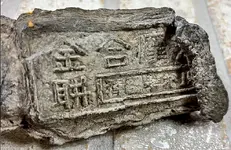
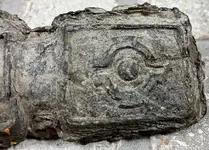
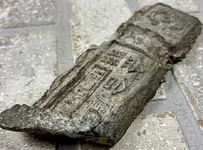
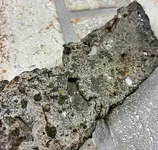
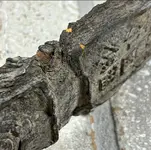
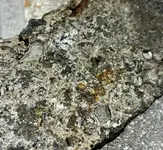
I am watching this item and cannot figure out what the symbols mean and what this may have been a piece from ( off of etc )
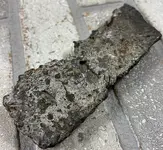
Looks like cement with a small bit of wood and from the pictures I cannot tell if the cement looks old or more modern. All help appreciated....
 

Attachments

  • Symbol 1.webp
    Symbol 1.webp
    102.2 KB · Views: 88
  • Symbol 2.webp
    Symbol 2.webp
    119.6 KB · Views: 79
  • Symbol 3.webp
    Symbol 3.webp
    109.5 KB · Views: 75
  • Symbol 4.webp
    Symbol 4.webp
    105 KB · Views: 77
  • Symbol 5.webp
    Symbol 5.webp
    127.8 KB · Views: 76
  • Symbol 6.webp
    Symbol 6.webp
    155.8 KB · Views: 72
  • Symbol 7.webp
    Symbol 7.webp
    126.3 KB · Views: 70
  • Symbol 8.webp
    Symbol 8.webp
    213.5 KB · Views: 64
Interesting item!

Although there are some exceptions, traditional Chinese is usually written vertically from top to bottom, starting from the right side and moving left; modern Chinese is written horizontally from left to right, top to bottom.

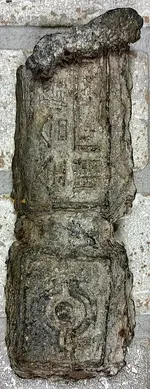
In your second picture, I can’t make out all of the characters but top left appears to be 金 (Jīn), meaning “Gold / Metal” followed by 合 (Hé), meaning “Combine / Together”. Bottom left might be 聯 (Lián), meaning “Link / Join”.

I have no idea what it might be. If it were not for your description of the material, I would have thought it to be some kind of ingot (or tally) and possibly currency or trade related.

If our member @Yang Hao sees this, perhaps he can add some more (or you could PM him). He’s very good on this kind of thing.
 
Last edited:
Upvote 0
Red-Coat my description was only a guess, this could very well be cast metal. I also thought Chinese symbols and posted this on an Asian site.

creskol .. one of my thoughts also but as far as I know sycee are as a rule usually silver.... It would be nice..

Thanks to both for your input ....

 
Upvote 0
Red-Coat my description was only a guess, this could very well be cast metal. I also thought Chinese symbols and posted this on an Asian site.

creskol .. one of my thoughts also but as far as I know sycee are as a rule usually silver.... It would be nice..

Thanks to both for your input ....
You are correct. My thoughts were that it wasn't a sycee per say, but rather a casting of one.
 
Upvote 0
I also thought Chinese symbols and posted this on an Asian site.
Sorry late to the post. Is there any update from the Asian site on what it could be? The three character on top are 金 jīn合hé 摩mó (I think it is 摩). The bottom character could be 䎴gēng or shèng which is rarely used in modern Chinese.

If it is in ancient or classical Chinese that requires different translating. Each character has its own meaning.

摩 mó: rub, scour, grind; friction
合 hé: combine, unite, join; gather
金 jīn: gold; metals in general; money
䎴 gēng or shèng :a legendary spirit; immortal, sage, sacred; holy

As for what it is, I'm not sure. It could be modern or old. It could be religious because of 䎴 gēng/shèng. 䎴 gēng/shèng appears in two old Chinese "dictionaries" one was written during the Ming Dynasty 1368–1644 AD and the other during the Northern and Southern Dynasties 420 to 589 AD,. It's also in The Qing Dynasty Kangxi dictionary.

Hope this helps.
 
Upvote 0
Sorry late to the post. Is there any update from the Asian site on what it could be? The three character on top are 金 jīn合hé 摩mó (I think it is 摩). The bottom character could be 䎴gēng or shèng which is rarely used in modern Chinese.

If it is in ancient or classical Chinese that requires different translating. Each character has its own meaning.

摩 mó: rub, scour, grind; friction
合 hé: combine, unite, join; gather
金 jīn: gold; metals in general; money
䎴 gēng or shèng :a legendary spirit; immortal, sage, sacred; holy

As for what it is, I'm not sure. It could be modern or old. It could be religious because of 䎴 gēng/shèng. 䎴 gēng/shèng appears in two old Chinese "dictionaries" one was written during the Ming Dynasty 1368–1644 AD and the other during the Northern and Southern Dynasties 420 to 589 AD,. It's also in The Qing Dynasty Kangxi dictionary.

Hope this helps.
Yang Hao ... I received no replies or comments from the Asian site on this. In my research I also came across suggestions this may be old and then others that were not quite.
Appreciate your input and help. Thanks again Yang Hao & have a good one .......
 
Upvote 0

Users who are viewing this thread

Back
Top Bottom