What's new

✅ SOLVED Test your skills on this one! Spent years trying to ID this.

musclecar

Full Member
Joined
Oct 15, 2006
Messages
132
Reaction score
1
Golden Thread
0
Location
Nampa Idaho
Detector(s) used
White MXT
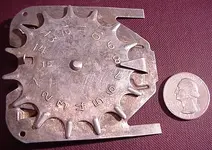
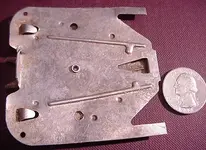
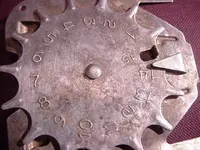
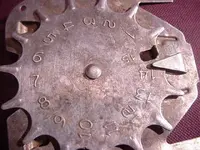
I found this in Alaska about 10 years ago, and have never been able to ID it. It is an aluminum piece, about 3 inches square. It has 15 teeth and is numbered 1-15. There is a stop preventing it from spinning freely. The back has two tabs that may have been used to mount it. ANY GUESSES?

Thanks,

MC

PS The quarter used for size was found yesterday! 1935S Yeah!
 

Attachments

  • dial1.webp
    dial1.webp
    67.3 KB · Views: 40,963
  • dial2.webp
    dial2.webp
    61.3 KB · Views: 39,002
  • dial3.webp
    dial3.webp
    60.1 KB · Views: 39,019
GoodyGuy said:
mavrick03 said:
I am still going with 15 day clock movement part

this is a picture of an 8 day not exactly the same but very close

Mav

I like the way you think, but there is no way anything can attach to the points of the wheel as in your picture.

GG~
I like the idea. Look closely. It appears that the lever pushes the points of the star wheel to the next day number. The wheel doesnt attach to anything. I would like the idea better if it were brass but it could be... Lets see some more pics.
 
Upvote 0
Two things come to mind: #1 Speed adjustment/control dial for an Antique Phonograph and #2 Cold/temperature adjustment for a vintage refrigerator. Breezie
 
Upvote 0
As rtde suggested something pushes here I think. It may not be a finger. It could be the clock movement day lever. But I dont know how it resets after 15 days because it has a stop?
 

Attachments

  • Counter1.webp
    Counter1.webp
    8.5 KB · Views: 309
  • Counter1.webp
    Counter1.webp
    8.5 KB · Views: 306
Upvote 0
Dear Musclecar

:sign13: Have you ever taken the item to a clock maker/shop/museum ?

If not, it might be worthwhile. If they can say definitively "yea" or "nay" one way or the other, it would put to rest the clock part controversy. And don't settle for some dummy behind the counter who says, "I dunno, my boss is out to lunch." :icon_scratch: Find someone who really knows what they're talking about!

Just a suggestion. And if you have already done this, please give us an update.

Thanks much, :notworthy:

Bob
 
Upvote 0
I am thinking old 15 exposure camera counter. I looked for a while but could not confirm. :dontknow:
 
Upvote 0
OK I know what it is! It’s a thing found way back in 2006 that no one can identify. Its been sold on Ebay to someone that had no idea what it was, but bought it anyway.
Another 3 years of my live having dreams about this thing has taken its toll on me, so I say BANNER on the most annoying what is it to date. And if they put it on the banner maybe some alien will see it and say what it really is.
 
Upvote 0
Just today I forwarded this link to a world renound "ANTIQUE CAMERA EXPERT," and if anyone can make a connection between it and a camera, he will ... providing, of course, that he responds and doesn't think its below his level of integrity, and that he doesn't think we're all nuts ! :laughing9:

If he should contact me personally with a confirmation, I will pass the info along with my request for that bottle of wine. :hello2:
 
Upvote 0
is there any spring loaded mechanism to reset the count
hits 15 then resets to 1 ?
 
Upvote 0
i believe if my idea of how it attaches to a rod flat or round or jointed then the measuring device would go either direction . that's why measure of temp. makes sense.

the bent up part at 15 cn be made to move around and back and forth with 1 to 15.

why not a temperature setting device for old ice boxes or very early refrigerators? in this case a finger would set the number by moving the points.

mike
 
Upvote 0
I'm still leaning toward the camera exposure counting idea - but, as yet, do not have any definitive proof to support my claim. However, I have made some observations that may be of interest. ( I have not read every one of the 894 comments already posted - and apologize if the following topics have already been discussed).

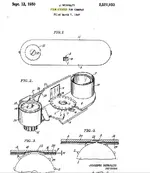
1. Take a close look at the backside photo, and you will notice the two pressed in features that look like two minature golf clubs. These were clearly intended to keep the back of the device away from a flat surface so as to allow the center pivot to spin freely. I suspect the flat surface was metal and not wood. Many of the older, antique type cameras had tin or metal housings.

2. The reason I believe the flat surface was metal is evident by the two mounting prongs at the top that are typical of a design that would have gone through holes and then bent down to secure it in place. Additionally, the two extension flanges at the bottom likely fit into a couple of slots to secure the bottom portion in place.

4. Incidentally, aluminum was invented in 1886.

3. I can see no evidence whatsoever that indicates the device was connected to any other moving part such as a rod or additional wheels, etc. Which leads me to believe it was independent from whatever it was attached to, and that it's sole purpose was for keeping track of something - say, like the number of exposures on an older type of camera.


5. Many of you have probably already done this, but try reducing the zoom level to 50% for a more accurate idea of it's actual size. 60% would be better yet, but most computers jump from 50% to 75%.

Lastly, I admit there are a couple of flaws in my "Counting Device" theory.

A. Most cameras and the accompanying film came in exposures of 12 - 24 - 36.
B. If it was intended for keeping track of something as important as the exposures, you would think it would click and lock in place, as opposed to being so easily bumped/moved out of sinc.

I'm not sure how much my observations will help, but maybe they will trigger further ideas in this never-ending quest for life - liberty, and the pursuit of ... what the heck is that darn thing, anyway?
 
Upvote 0
intimer said:
i believe if my idea of how it attaches to a rod flat or round or jointed then the measuring device would go either direction . that's why measure of temp. makes sense.

the bent up part at 15 cn be made to move around and back and forth with 1 to 15.

why not a temperature setting device for old ice boxes or very early refrigerators? in this case a finger would set the number by moving the points.

mike
Sorry I still dont understand your theory. There is no way a wire or spring or rod could attach to the stop at #15 IMO and properly turn. It would have to attach in the center rivet and it appears that nothing is broken off.

It sure looks like an old propane refrigerator control, but again the electronics would have to connect at the center rivet. Just like the control knob on your metal detector needs to connect to the center shaft of the potentiometer.
 
Upvote 0
SODABOTTLEBOB said:
I'm still leaning toward the camera exposure counting idea - but, as yet, do not have any definitive proof to support my claim. However, I have made some observations that may be of interest. ( I have not read every one of the 894 comments already posted - and apologize if the following topics have already been discussed).

1. Take a close look at the backside photo, and you will notice the two pressed in features that look like two minature golf clubs. These were clearly intended to keep the back of the device away from a flat surface so as to allow the center pivot to spin freely. I suspect the flat surface was metal and not wood. Many of the older, antique type cameras had tin or metal housings.

2. The reason I believe the flat surface was metal is evident by the two mounting prongs at the top that are typical of a design that would have gone through holes and then bent down to secure it in place. Additionally, the two extension flanges at the bottom likely fit into a couple of slots to secure the bottom portion in place.

4. Incidentally, aluminum was invented in 1886.

3. I can see no evidence whatsoever that indicates the device was connected to any other moving part such as a rod or additional wheels, etc. Which leads me to believe it was independent from whatever it was attached to, and that it's sole purpose was for keeping track of something - say, like the number of exposures on an older type of camera.


5. Many of you have probably already done this, but try reducing the zoom level to 50% for a more accurate idea of it's actual size. 60% would be better yet, but most computers jump from 50% to 75%.

Lastly, I admit there are a couple of flaws in my "Counting Device" theory.

A. Most cameras and the accompanying film came in exposures of 12 - 24 - 36.
B. If it was intended for keeping track of something as important as the exposures, you would think it would click and lock in place, as opposed to being so easily bumped/moved out of sinc.

I'm not sure how much my observations will help, but maybe they will trigger further ideas in this never-ending quest for life - liberty, and the pursuit of ... what the heck is that darn thing, anyway?
The camera idea is the best yet IMO as a 12 exposure always has a few more pics. The problem here is that a member actually opened up a roll of old film and tried to match the advance holes in the film with the sprocket and sadly it did not match up. Check out reply #657. This may need a second look because I think it was a great idea. Maybe the film can advance without holes because the older film didnt have any I think.. :dontknow:
 

Attachments

  • film counter.webp
    film counter.webp
    53.9 KB · Views: 255
  • film-side.webp
    film-side.webp
    5.9 KB · Views: 238
  • film-side.webp
    film-side.webp
    5.9 KB · Views: 240
  • film counter.webp
    film counter.webp
    53.9 KB · Views: 242
Upvote 0
bigcypresshunter said:
intimer said:
i believe if my idea of how it attaches to a rod flat or round or jointed then the measuring device would go either direction . that's why measure of temp. makes sense.

the bent up part at 15 cn be made to move around and back and forth with 1 to 15.

why not a temperature setting device for old ice boxes or very early refrigerators? in this case a finger would set the number by moving the points.

mike
Sorry I still dont understand your theory. There is no way a wire or spring or rod could attach to the stop at #15 IMO and properly turn. It would have to attach in the center rivet and it appears that nothing is broken off.

It sure looks like an old propane refrigerator control, but again the electronics would have to connect at the center rivet. Just like the control knob on your metal detector needs to connect to the center shaft of the potentiometer.
But a bimetal temperature coil sensor may attach! :sign13: bimetal temperature coil.webp

This type of sensor would require no indentations on the numbers because the bimetal coil holds it in place and it moves back and forth with the temperature change. I think you are onto something maybe. But why a number 1-15 refering to temperature ? -1 to -15 degrees icebox?

ADDED: Problem is that tis type of bimetal coil would have to sit right on top. Parts to hold it in place may be missing.
 
Upvote 0
I"m still going with my orignal idea: Cold/temperature adjustment for a vintage refrigerator. It seems like I remember ours looking like that back in the early1950's when I was a young child. Breezie
 
Upvote 0
TheBreeze426 said:
I"m still going with my orignal idea: Cold/temperature adjustment for a vintage refrigerator. It seems like I remember ours looking like that back in the early1950's when I was a young child. Breezie
Yes it sure does resemble the old Ammonia refrigerator controls Breeze (i used to repair them) but it has no way of connecting to a control or anything else for that matter. Imagine the dial on your metal detector. It needs to connect via a shaft to the control inside. There is NO shaft on this widget.
 
Upvote 0
Yes it sure does resemble the old Ammonia refrigerator controls Breeze (i used to repair them) but it has no way of connecting to a control or anything else for that matter. Imagine the dial on your metal detector. It needs to connect via a shaft to the control inside. There is NO shaft on this widget.
[/quote]

Mmm, if there is no place to connect to anything, and no way to reset, then the counter has to be hand/manual. So what counts manually to 15 other than a Billiard game? (this thing is driving us all nuts; lol) Breezie
 
Upvote 0
GoodyGuy is there a small space under rivet head, as if something under it is missing? :sign13: ...such as a spring or bimetal coil? It looks as if the rivet head is high in the pic. There is also a lot of scratches. I think a spring or bi-metal coil could have been attached to the rivet and pushed on the stop._3_jpg.webp
 

Attachments

  • bimetal temperature coil.webp
    bimetal temperature coil.webp
    1.2 KB · Views: 1,239
  • bimetal temperature coil.webp
    bimetal temperature coil.webp
    1.2 KB · Views: 1,236
Upvote 0
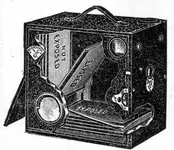
I fully realize I'm going out on a limb this time - but thought I would post the attached photo anyway. It was sent to me by a antique camera collector, and out of respect for his interest in this topic, I wanted to share it with you. The photo is of what he called a "Drop Plate" camera from around the turn of the century. And if I understand correctly, the "Counter" (attached to the upper left corner of the camera) did not actually advance the plates, but was used only to keep track of how many of them had been exposed. Apparently, lots of the old-old cameras had these counters in variation.

I realize the counter on the one in the photo is not exactly like the one in question, but it may be a clue to help promote additional research. :read2:

P.S. I will say one thing; Until now I never heard of a Drop Plate camera. So I guess its still true that you learn something new every day.

P.S. - P.S. I'm just hang'n in there and shooting for the 1000th post. Didn't someone say the 1000th post wins a prize? :tongue3:
 

Attachments

  • Quick Shot Antique Camera.webp
    Quick Shot Antique Camera.webp
    24.9 KB · Views: 1,260
Upvote 0

Users who are viewing this thread

Back
Top Bottom