Interesting Story Behind The Coin
Trade dollar -- From Wikipedia, the free encyclopedia
The United States Trade Dollar is a silver dollar coin that was issued by the United States Mint and minted in Philadelphia, Pennsylvania, Carson City, and San Francisco from 1873 to 1885.[1] Business strikes ended in 1878.
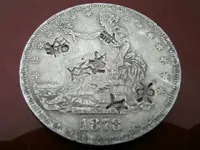
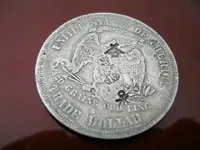
Many Trade Dollars have what are called "chop marks" on them. The Chinese merchants would stamp the coins as a way to check their authenticity and to add their advertising logo.
Collectors are warned that recently a large number of U.S. trade dollars, of various quality have been made in China. Purchasing from known dealers or buying sealed and certified coins may be necessary to avoid these fakes.
United Kingdom
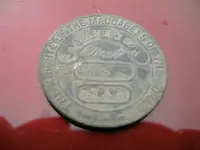
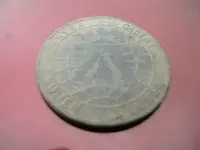
British Trade Dollar B Mint Year 1900 With the extension of British trading interests in the East, especially after the founding of Singapore in 1819 and Hong Kong in 1842, it became necessary to produce a special Dollar so as to remove the reliance of a British Colony upon the various foreign coins then in circulation. The Picture is a Trade Dollar from the reign of Victoria. It is a 1900 B mint.
China Trade, Silver Dollars were a direct result of the Opium Wars (1839-1843, 1856-1860), which began when China tried to stop Britain from selling opium to its citizens. The loser, China, had to open up a number of ports to British trade and residence, and cede Hong Kong to Britain. In the decades that followed, merchants and adventurers flocked to these areas, and international trade flourished. Foreign banks were established, and large silver coins from all over the world began arriving to pay for tea, silk, and Chinese porcelain to be shipped abroad.
Trade Dollar (United States coin) -- From Wikipedia, the free encyclopedia
History
The Trade Dollar was produced in response to other Western powers, such as Great Britain, Spain, France, and particularly Mexico, circulating large, crown size silver coins in Asia. Trade Dollars had a slightly higher silver content than the regular circulation Seated Liberty Dollars and Morgan Dollars, to compete with these foreign trade coins. Most Trade Dollars ended up in Asia during their first two years of production, where they were very successful. Many of them exhibit chopmarks which are counterstamps from Asian merchants to verify the authenticity of the coins. Many trade coins of the Western powers and large silver coins from China, Korea, and Japan also bear these chopmarks. While most chopmarked coins are generally worth less than those without, some of the more fascinating chopmarks can actually give the coin a modest premium.
Trade Dollars did not circulate in the United States initially, but were legal tender for up to $5. Things changed, however, in 1876, when the price of silver spiraled downward as Western producers dumped silver on the market, making the Trade Dollar worth more at face value than its silver content. That resulted in Trade Dollars pouring back into the United States, as they were bought for as little as the equivalent of 80 US cents in Asia, and were then spent at $1 in the United States. This prompted Congress to revoke their legal tender status, and restrict their coinage to exportation demand only.




 Hardrock