What's new

use wear or tumbled in a creek?

naturegirl

Bronze Member
Joined
Mar 21, 2009
Messages
2,356
Reaction score
405
Golden Thread
0
I would love to see a discussion and pictures and examples of the way edges on tools look. Or maybe they aren't tools, just creek tumbled. AND my biggest question is can you tell if a sharp edge was not flaked, but still used, is that "use wear" ?

thanks!!!
 
Upvote 0
Do you have any examples to get the thread started?
 
Generally use wear is only on the working edge of the tool, and occasionally from friction with the handle or hafting. Creek tumbling is usually uniformly distributed across and artifact. I have decent examples but unfortunately no pictures.
 
I have found some black flint nodules in the creek broken from tumbling against cobbles. If there is no flaking or some kind of secondary flaking I throw them back in the current. Usually the broken ones from tumbling will have quite a bit of cortex still present.
 
I have found some black flint nodules in the creek broken from tumbling against cobbles. If there is no flaking or some kind of secondary flaking I throw them back in the current. Usually the broken ones from tumbling will have quite a bit of cortex still present.

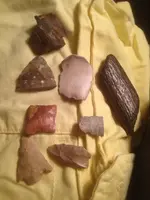
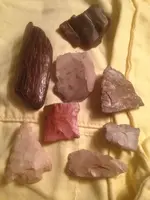
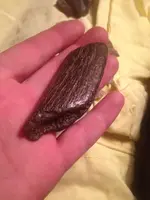
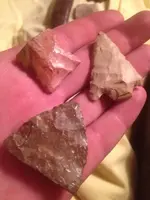
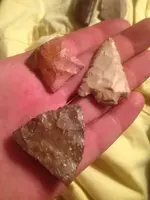
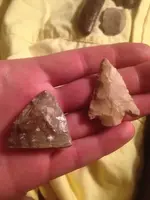
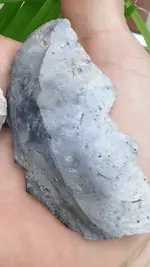
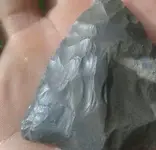
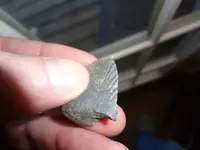
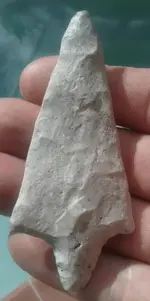
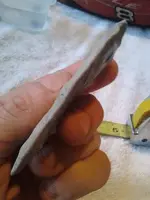
I totally am with you guys!! Check these!! These were all creek or river found or tumbled. So enjoy and throw a little knowledge it the these beautiful finds including this heavy, beautiful, possible mammoth or mastedon bone from archaic period especially with the cream colored very early Hafted.
 

Attachments

  • image-3270592680.webp
    image-3270592680.webp
    43.2 KB · Views: 137
  • image-128040807.webp
    image-128040807.webp
    41.4 KB · Views: 124
  • image-754825578.webp
    image-754825578.webp
    33.5 KB · Views: 125
  • image-2428859622.webp
    image-2428859622.webp
    32.5 KB · Views: 123
  • image-74864403.webp
    image-74864403.webp
    31.6 KB · Views: 120
  • image-2653566409.webp
    image-2653566409.webp
    28 KB · Views: 115
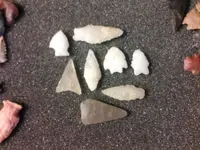
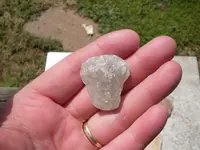
Twitch is on target here. Although I'm not absolutely clear what the question is... Use wear is like on a knife- where one side is worn down more than the other- with re-sharpening marks too, perhaps. Sometimes both edges show signs of wear- as a modern knife would after repeated sharpenings (especially if the one sharpening the knife doesn't have good technique!) Creek-tumbled, or surf-tumbled is a different thing. that's all-over- like sea glass. And the degree of tumbling depends on time in rough environment- think of a rock tumbler. I think too, one of the reasons I find colorful pieces w/o the typical age 'crust' where the surface is oxidizing- is because it's constantly being tumbled off (at least that's my guess). Nevertheless, a piece that's environmentally worn will show that wear all-around. Like sea glass. Wear use will be only on the working surfaces. (laughing quietly to myself, remembering someone once- on this forum stating that a rock was hand-worn/finger-worn. As if prolonged use, being held in the hand, would actually wear down a chunk of rock...) ;) ANYway... My best examples I just gave away. I'll post pics if I can find anything that better clarifies my thoughts here. The examples above are very good (thanks ROCKateer) though it would be good to see down the edge, and not just face-on. Yak the pic below- the bottom piece, a knife, both use-worn and surf-worn.
 

Attachments

  • 0426141124.webp
    0426141124.webp
    236.2 KB · Views: 109
I have an example of a creek worn hafted end scraper. I found it in the creek the other day. Its made from sugar quartz or some might call it quartzite. It has tumbled for so long most of the edge wear is gone but I still kept it.
 

Attachments

  • SDC10834.webp
    SDC10834.webp
    395.7 KB · Views: 102
Not worked

ForumRunner_20140426_221311.webp

Worked

IMG_20130417_164001-1-1.webp
 
One thing I see some do is mistake ripples on a flake edge as being worked. A lot of flakes will have these type ripples caused by the shock wave of it being struck. Some can be more deceiving then the one pictured with the ripples showing up just along the very edge and closely resembling fine flaking.
011 (640x480).webp
 
Thank you to an for the replies, I haven't had a chance to dig out and photograph the pieces that made me ask about the wearing of an edge. It's just the sharp edges in question (for me) on flakes. Some have such razor sharp edges they would have been utilized even though not worked. at least I've read that. would repeated use dull that
edge, kinda rub sharp off of it. Would any kind of action in the water smooth an edge?
 
Of course ... Water will wear alot.. Some of these are thousands of years old. Your never going to be able to see whether or not a flake was used to cut something once or twice.
The pieces you may still see wear on were made to keep for extended periods of time which means the entire item will have work that would be visible.
Here's an example of wear from water.. The edges of this point are completely smooth. Its a middle archaic point

ForumRunner_20140427_074420.webp


739483d1356824934t-big-points-forumrunner_20130211_095250.webp
 
That's a great example gatorboy .There is some water wear.I have a piece that was flaked then ground.The only one I have like it
 
Now that edge is similar to what I'm talking about, what I've seen on flakes, Gator boy. and Yes, I guess that's what I was wondering, could a flake have been used so much, it would smooth the edge, and I'm talking about flint, I'm not familiar with other materials at all. But it also doesn't seem like the overall flake was that worn, just the edge....I know, PICTURES! ;)
 

Users who are viewing this thread

Back
Top Bottom